About a year ago, I nearly walked into the path of a car that was entering traffic from a parking lot. The driver was edging into the road and had carefully scoped out his exit. I am certain that he had looked up the street and down. I was the surprise—a blind spot—in his field of vision. He was moving south; I was headed east. One half-second earlier and I would have gone sailing into his car and over the hood. I am a small woman, somewhat fit and maybe athletic. I saw myself arcing in a gymnastic tumble. Except, unlike those tiny bouncy teenagers who land on their tiptoes, I imagine that my head would have hit the pavement first, a non-sanctioned Olympic move called The Double Concussion Flip and Fall. Maybe, I was too distracted with my earbuds playing Moby’s Wait for Me; it is a mesmerizing tune. I was over-dressed on this seventy-degree autumn day.
I stretched out my hands to cushion the crash. When this failed, my chest hit the hood of the car. I bounced back up and tried to resettle myself. What was I doing before I marched onto the hood of this car, I wondered? The driver waved his hands in apology; I waved back. It was like a silent movie. All gestures, no talk. I wanted to dance a bit, maybe skip in front of the car as I left the scene, just like Charlie Champlin might. It was a magic moment. A minute before we had been invisible to each other; now we separated each with a little memory, a shared story to tell our spouses, and maybe a wee lesson, depending on our temperaments.
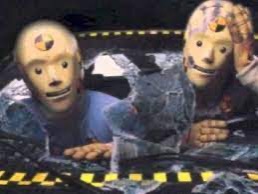
As we live our lives, we collect stories like this all the time. The older you are, the more you have of these. There are accidents, near-misses, losses and what-could-have-beens. Some we bounce back from, others less so. For me, all these brushes with illness and death bring to mind me those public service announcements from the ‘80s with those crash test dummies, Vince and Larry.
I see much of my life a series of crash test dummy trials. This encounter with the car put my mind on the path of other near misses—a series of events that could have led to some serious trouble. I have sped through a stop sign late at night, distracted and tired. I have twice driven the wrong way down a busy street at twilight. If it had been earlier in that day when I walked into the car, I would have without doubt faced a lot more traffic and a much greater probability of getting hurt. I would have been like a little cat facing the running of the bulls. We could all have been seriously hurt. Well, not all of us equally.
I have been in cars that have spun out, flipping on their heads in slick Alabama clay. I have been held up at gunpoint in Texas on a little walk in the good part of town. The man who did this looked upset enough to hurt me. I have dodged so many medical scares, that I am pretty certain that my health insurance company thinks that I am messing with their premium calculation algorithm. I have had so many tests and been diagnosed with so many wrongly accused major illnesses, there must be an office pool somewhere betting on my demise. This includes brain aneurysms, stomach cancer, pancreatitis, and more. I could go on and on here, but it seems with every incident I recount here, I am feeling both dizzier and bolder. To me, each of these is a like a crash test. With so much good fortune, a karmic calculation would have me dead pretty soon. As they say, I may be running out of good luck. Or maybe in that cosmic computation, or my good fortune comes at the costs of another’s unearned bad turn of chance.
Which gets me into the meat of what is really on my mind. Earned and unearned good fortune. the movie Funny Girlwhen Fanny Brice finds early renown, she says to her lover, the fabulously dreamy Nicky Ornstein, and supporter that she can’t be famous yet because she hasn’t suffered enough. I understand this feeling. It is that sentiment that much of what we have is unearned. We moan, “Why me?” when bad luck strikes but when good fortune strikes, we smile, “I so deserve this.” Personally, I have unearned good health, undeserved energy, unnatural optimism. I don’t know if others feel this way about the gifts they have. I think we mainly focus on what’s missing.
It seems to me that most of us have experienced good fortune we have neither earned nor merited and of course, the reverse is true. I used to joke with a friend that I had the Luck of the Portuguese. When that friend remarked that he never heard of the Luck of the Portuguese, I would simply reply, “Exactly.” John Rawls suggests that in considering systems of justice, we imagine that we don’t know where in a social system we may stand. He calls this a veil of ignorance. How would we want the world to distribute its bounty if we didn’t know whether we were rich or poor or white or Black or male or female or a U.S. citizen or a citizen of another county or abled or disabled? If a thought experiment like this were possible and if it could influence social policy, we would have to be convinced that we actually could stand in someone else’s shoes. Hale doubts this can be done because of what he calls the veil of opulence—the blindness that we all have to the privileges of birth and position. We fall victim to the comfort of believing that if we fell on hard times, we would work our way out of it. The veil of opulence works like the Just World Hypothesis. It creates that delusional narrative that we are self-made, deserving human beings whose unearned good fortune insulates from caring more deeply from others who we see as not as worthy or deserving of what we have. Lots of us dodge bullets thinking we are lucky and blessed; not imaging that the cards are stacked in our favor. Like all those crash tests that I have survived, many have to do with an advantage of class or nationality or gender. Others have to do with random events completely out of our control. And like the crash test dummies, we often do not take good advice or live in a manner that reduces the risk we visit upon ourselves or others. But, as humans endowed with some degree of reasoning, we can do more than our best sometimes to avoid doing the worst.
 Delight/ Awe and other things