In my mid-forties, I had a career crisis. I was bored to death at my state job reviewing applications for asbestos abatement assistance. The paperwork to get a grant for abatement was so onerous that we disbursed much more aggravation than we did money. I am not proud of that fact, but I could do could little about it. My supervisor was the sort of man who divided the world into two groups — the criminal and the pre-criminal. No one was above suspicion. He put rules and procedures in place to assure that no sneaky citizen would ever ever pull off a scam under his watch. I was his unwilling lieutenant repeating to applicants stupidly bureaucratic excuses for why their applications were turned down. I took a lot of appropriate abuse from perfectly eligible grantees. It was soul- and mind-deadening. I imagined myself, retiring at 90 or so, never having approved a single grant, and receiving an outstanding public service award from him for The Exercise of Frugal Excellence. He would be 110, still railing against incompetence and corruption, everywhere, everyplace, all the time.
I was located in a brand-new state of the art building laid out in a chessboard of cubicles. Our manager was very excited about this new office design, promising us that we would be more creative, and team-like. In truth, we felt like rats in a maze. With so little privacy and so much overcrowding, our union steward warned our overlords that we would most likely get aggressive and first turn on our supervisors, and then on each other. The workers wouldn’t be responsible. Instead, our bosses would have blood on their hands and it could be theirs, literally.
My little four cubicle pod penned up me and three other low-level bureaucrats. On one side was a young man divorcing from his wife and spending much of the day heaping abuse on her on the phone. On another, a woman constantly snapped gum and by the smell of nail polish and the sound of fingernails being filed, she was clearly running a manicure salon while pretending to meet with other employees. She was the busiest of us. In cubicle #3 was another man who played talk radio all day, muttered all day to himself and was full of bad ideas and half-baked theories. I saw myself as an abandoned soul in the land of troubled and troubling souls.
This new office landscape did not lead to our being more innovative and community spirited at work. It did the opposite. I hadn’t realized until I was trapped with them, how much I disliked each of them. I would sit at my desk with earphones, a face mask, and sunglasses, hoping not to be recognized. It was a perfect place to be a member of a witness protection program. Not one person ever came to look for me. It felt like Kafka may have been the genius behind all of this, like a revenge architect.
I came home each night wondering how much longer I could last. The good news was that this mind-numbing job gave me plenty of energy to dream about other possibilities. I settled on two. The first was to pursue a doctorate in Sociology so I could teach at the college level. I had been doing this for nearly a decade as an adjunct professor. Students liked the way I taught, and I loved the excitement of teaching challenging material in creative ways. This part-time job was like a lifeline to more engaging and stimulating world.
My second option was to become a standup comic. A friend and I ran “How to Be Funny” workshops at women’s conferences and those were really well received. I got several humorous pieces published in magazines. People thought I was funny; I could tell a good story. However, I was nearly fifty years old. Comedy hadn’t really hit the big time in the early 90s and there were few women comics that I really liked and admired. But undeterred by any facts at hand, I decided to explore being a stand-up comic. I connected with a middle-aged man who was a social worker during the day and an aspiring standup comic at night. I went with him to some of his shows. These were located in dismal, smoky bars, late at night, perilous to any woman in these places without a male attached to her arm. I got plenty of offers but none that would advance my career in comedy, except maybe to share truly clumsy pickup lines.
After visits to the clubs watching this guy suffer, I opted to pursue the more conventional route – pursing a PhD in sociology in my late forties, hoping to graduate when I was fifty. A colleague cautioned me that there were already 10,000 unemployed PhDs in sociology and that dreaming that I would land a teaching job was a fool’s errand. Having been on many fool’s errands and enjoyed them, I hopped on board and went to graduate school. I earned a PhD at fifty – the best learning experience of my life – and enjoyed teaching for a few decades before I retired. I was never properly a sociology professor, not a great fit for an academic role, but I did my best to carve out my own special practice as a uniquely weird professor.
Fast forward, twenty-five years after that PhD. and I was a retired sociology professor, ready to explore some new interests and revive others that I had ignored for way too long. During the second year of the pandemic, I decided to try out some new activities — to engage in some classes or activities I had sworn off, telling myself that I didn’t do these sorts of things. I wanted to step out of my comfort and competence zone. I was provoked by Emerson’s quote, “The mind, once stretched by a new idea, never returns to its original dimensions.” I loved that idea because I was sorely feeling that I needed new dimensions. I wanted my older years to be about expanding, not narrowing, my interests, activities, and friendships. I wanted to move down some new avenues while my health was still good and my energy abundant. I was looking forward to changing some things, to exploring what could happen.
Dan Gilbert, the Harvard psychologist, has done research about the end of history illusion. It refers to the ways in which we discount how much we will change in the future. We imagine that we have changed a great deal over the past ten years, let’s say, but assume that we will not change much in the future. What is even more interesting is that this illusion happens in the same way for people from all age groups. Neither the young nor the old nor the middle-age are any better at understanding how much change is ahead of us.
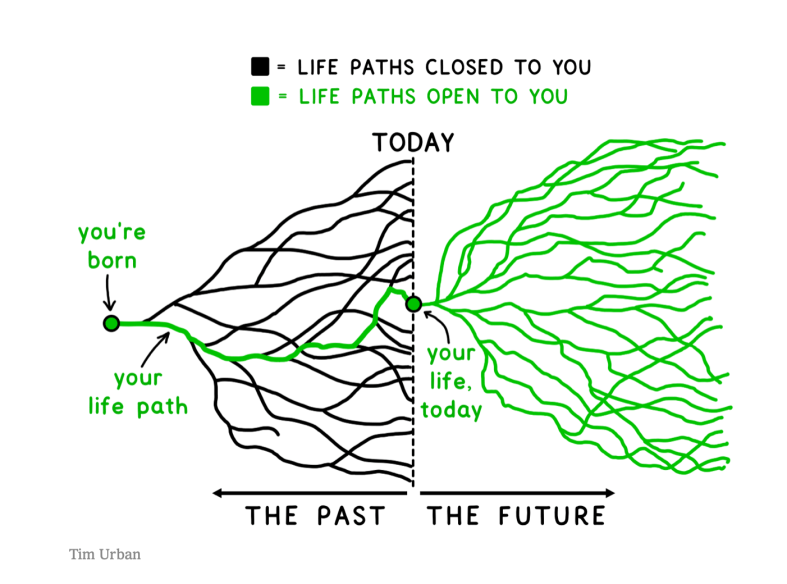
I was intrigued by this image is from a 2022 article in the New York Times [1]where author Tim Urban discusses how we use time and how we might consider our futures. At any point in our lives, we have arrived a place which is the result of multiple narrowing paths. We went to art school, instead of medical school. Or we didn’t apply for that promotion and instead changed jobs. Or we chose one partner over the other. On and on it goes. Each of these decisions leads to other opportunities; you foreclose on some possible opportunities at every turn. We can’t all the lives we might have lived. The only paths closed to us are the ones in the past.
However, ahead of us are many possibilities. We can be easily overwhelmed if we really take this to heart but if we really consider the many paths ahead, it is life-affirming, even in our later life. This is not to say that all of us are blessed with resources, time, and talent to move ahead and follow any dream that we can conjure. That is certainly not the case, especially in mid-life and later years when caretaking our elders, our partners, our grandchildren, and ourselves makes many demands on us. But there was enough truth here to make an impression on me. No matter what the constraints are, there are still plenty of possibilities and choices.
Over the course of my lifetime, I have put many obstacles in the path of exploring possibilities. Before I start anything new, I had to plow through a heavy thicket of objections. Why do this? Why now? What would I learn? Why didn’t I pursue music or language lessons when I was young? Am I too old? Can I really do it? Suppose I fail. Who would I meet? Would I like them? Suppose they don’t like me? What makes me think this is interesting? Am I having a late-life crisis? Is there such a thing? I would entertain doubts for so long that they got comfortable.
These were exhausting enough but not completely discouraging. So, gathering up my courage, I signed up for my very first 5K run. The race was a 5K over the Pell Bridge which spans Narragansett Bay in Rhode Island. The race started just before sunrise with three thousand participants on a beautiful October day At the peak of span, you can see Newport to the east, with a magnificent view of teh East and West Bays. I did very well in that race, finishing in the top quarter of my age class. I felt completely alive, like I did before the pandemic, with the world full of possibilities. And full of people enjoying their lives with each other, embracing the gifts we bring each other. A man proposed to his fiancé at the top of the bridge. Love (of life) was in the air.

That summer, I also signed up for an Improv course, at OLLI,[2] hosted at the local university. The Improv class was a wonderful entry into the world of improvisational theatre. It re-awakened my interest in comedy. The students were at least 65 years old, drawn by an interest in Improv but with no big dreams or pretenses of appearing someday on the Comedy Channel. We were all simply curious and willing to be silly in the company of complete strangers. After years of pandemic isolation, we met in person in class, and it was delightful to be in the company of people I’d never met before; that felt like a completely new experience. I made two wonderful friends in that class. That course led me to another one at our local community theatre where the students were much younger, faster, and sharper[3]. That eight-week course was an engaging and challenging experience. I would leave these classes completely spent and energized. Soon I took another course in Musical Improv which tapped into another of my lifelong interests, singing and dancing and harmonizing—all of these re-ignited my sense of joy in playing with others. This led me to join the chorus catchers at my local theatre, where I am still learning the magic and structure of improv.
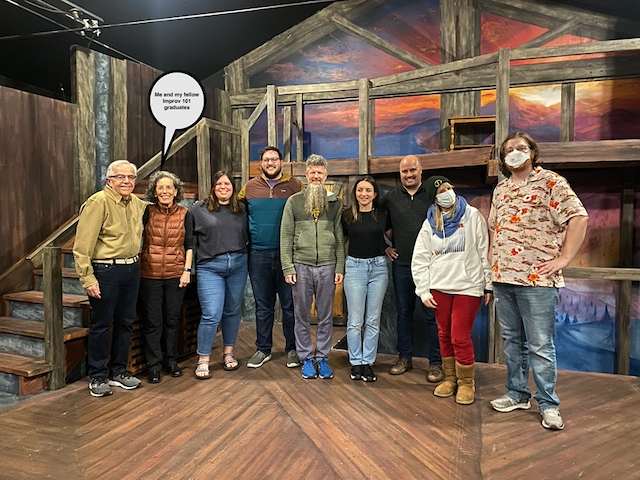
The Improv courses have been among the best learning experiences of my life. I say that in light of the fact that I was a very good student and a pretty good professor. I can perform pretty well in the structure, hierarchy, and predictability of traditional education but I really came alive as a learner in the improv environment and believe that almost anyone would benefit from a similar experience. What follows are my observations from improv classes. So, with less than one year of improv under my belt, I am ready to offer some summary observations and reflections. I call this Life Lessons from Improv or Everything I Learned for Real I Learned in Improv.
What happens in improv doesn’t stay in improv.
In improv, there are no set scripts. Improv classes are a series of games and exercises that teach some of the skills and orientations you would need in improv theatre. These exercises are fast. You are obliged to think on your feet. Not to overthink. Not to try to be funny or clever. To tell a story in improv, you rely on the other actors to create that story together. No one is really in charge. You are simply connected to each other in a contrived space and social situation. No experience is necessary. No basis of knowledge will help you more than another. In fact, it seems to me that the great variety of stories we all carry is the great fuel for improv. These serve as a great reserve for plots and characters and the flow of the stories told.
The key to improv is being in tune with your fellow actors and learning how to be in tune with a great variety of people and personalities in a short time. In music improv, you are not only telling a story, but you are also creating songs and choruses and dances sometimes. It calls on different skills, but you are still co-creating a story right on the spot.
For example, a typical improv musical runs in two acts about ninety minutes long. There may be four or five actors in the cast. The host of the show will ask the audience for the name of a musical that has never been done before. The audience may suggest, such as, Floating Down the River, A Town Called Fortune, or Dancing with the Cows. The actors choose one of these and then are challenged to pitch their idea of what the story will be. The audience claps to indicate their favorite among the options and the show begins. The actors will take their places on stage and the director sets the scene with a time and place. A conversation will ensue among the actors who begin to introduce their characters. Soon, someone says something, like “the trees look so big in this forest” or “I just had a crazy dream” and motion to the pianist that this phrase will form the first song. Music begins to play, and the actor begins to sing the words to the chorus. This is repeated until it seems set. The rest of the actors join and add verses that begin to develop a plot, the characters, the scene, and some interesting possible developments. The director may add challenges (“Ask her to marry you, Gary.”) or ask an actor to change her mood (“You are really really angry about this, Alice.”). The story line and characters develop, and chaos ensues. The magic of all this is how each show unfolds. It is very often a complete surprise to everyone who is on stage. The skills to do this work (or play) depending on your perspective are considerable. I will argue below that these are not just critical for improv, but that they instead broad lessons that could benefit all of us.
Since I have been taking improv classes, my friends have been asking me, if it is improv, why do you need to take a class? Or why does the cast need to go to a rehearsal for an improv show? Very simply, there is lots of learn. Acting is one thing. Bringing life to the written word, putting your voice to words a character may say is hard enough. That takes years of training. However, telling a compelling, maybe hilarious, maybe poignant story from scratch, a story that has never existed and will never exist again is another thing entirely. There has to be some sort of structure or protocols or rules of the stage in place for anything of value to happen.
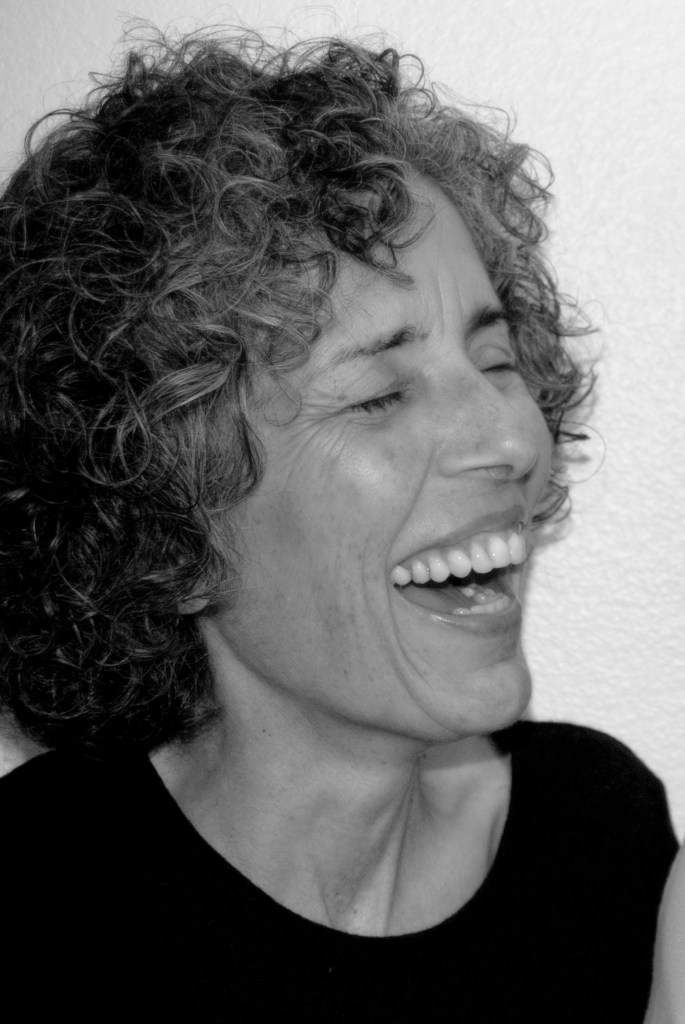
Your fellow actors are at least as interesting, amazing, curious, and complicated as you.
Because you are a member of a troupe, there is great relief to know the success of the enterprise doesn’t rely completely on you. The success of the performance depends on everyone. You bring what you have and what you are to the stage, as do the other actors, and some magic may happen. Just the discovery of what may be cooked up is interesting in and of itself. Things happen. Personalities are revealed. Stories are shared. Connections are made. You can rely on each other’s passion, curiosity, sense of humor and connection to create the story and move it ahead. No matter how old or young we are and independent of what we do for work or play, we have plenty of share. Recognizing that depth and breadth in others is a real blessing in improv.
All of us has a superpower weirdness.
I have taken improv classes in two settings, at a university and at the local theater. All those classes brought together people who were strangers to me. With COVID, retirement and a busy professional life before retirement, I hardly ever found myself in a room full of strangers who were so diverse in terms of age, occupations, race and ethnicity and experience in the theater. Yet, after just a few exercises, people’s personalities would begin to surface. They would say something that was completely off the wall, surprising themselves and all of us. We would regularly crack each other up, based not on our native wit, but instead on the structure of the exercises, which pushed us to free association and creative expression. That occasion for weirdness opens an opportunity to pull something from your mind quickly and in some instances, crazily. That superpower can lie dormant your whole life. We actively suppress it in most settings, unless we have a reputation as a good storyteller among our friends. But that superpower is our very good friend in improv because it presents premises and oddball ideas and characters to work with and around.
Anything can happen.
Improv creates and rests on the premise that anything can happen. This hearkens back to chart we looked at above, where the paths ahead are multiple and unknown. An improv performance takes one of those paths and plays with it, exercising imagination and flexibility as the scenes develop, step by step. In an improv scene, you may be a Scottish farmer, a collector of goldfish, a mad pharmacist, or a grower of artisanal marijuana. You can sing a soulful ballad or belt out the blues. Anything can happen. You simply need to commit to it, to understand the context, and to incorporate both the development of the story and your relationship with the other actors on stage.
All the world’s a stage: All the stages are little worlds.
Improv is great stage for understanding human behavior, misunderstandings, status, culture and more. Real life provides the fodder for improv. In an improv performance what shines through is the character of human beings in social situations as they try to figure out what is going in the world. We can watch as individuals learn about each other, violate social norms, try to vanquish an opponent, fall in and out of love and much more. As much as we may feel on occasions that we are just cogs in some big wheel, we see the actors on an improv stage, learning from each other, as vulnerable, powerful, and very human beings.
The best plans are made by other people.
Improv pushes you to show up, to be fully present, but not to be in charge. As the story evolves, the actors are giving each other room and openings to develop ideas together. Possibilities surface in what are called, offers. An actor suggests an idea, “Hey, Bob. I know your wife has just left you. Why don’t go down to our favorite soak our sorrows in some gin. Who knows maybe you’ll meet a new girl?” Bob has some choices here. He can say, “Hell, no. What are you thinking?” or he can agree, “Hell, yes! And maybe, we will finally find a girl too after all these years?” or go a completely other way. These offers can pivot a story, adding complications, and filling in the characters.
You can stretch a lot and not break.
As I wrote earlier, I am new to improv, less than one year into the practice. I like to study things I get involved with and like to jump in with both feet. Every improv class I have taken has challenged me in some way to move out of my comfort zone.
You realize talents that you have kept under wraps, undeveloped and untested. I can now sing loud enough to offer my sense of harmony and timing. I can initiate a dance line. I can offer plot lines. I can move ahead with ideas. There have been several instances where I thought of opting out of performances until I was legitimately ready and prepared. I held some unproductive rule about readiness in my mind which held me back more than my lack of ability. Because I learned, you can’t feel the talent until you try to employ it and then it may appear or not. The truth of this is that no matter what we do, we are never fully prepared for what happens. We just need to trust ourselves a bit more but that takes practice and self-compassion. We need to defeat self-defeating ideas.
This story will never happen again.
Some periods of your life are packed with stuff; so much happens. In one month on the improv stage, I was a fortune teller in a wild west town in cowboy times, and was a little kid caught adrift on a pirate ship in an awful storm. Later in the month, as an inebriated sheriff, I welcomed two sisters who were prospecting for gold to California in the 1840’s. As a hungry wolf, I terrorized two little girls lost in a forest at night. The girls put a magic leash on me, turning me into Steve the Dog, their friend and protector. Most recently, I joined a chorus line of cows and a crew of French mice and their sexy tormenting cats. All of this happened while our cast was singing and dancing and acting out our destinies which we had just made up. These adventures prime you for more because they engage the best and brightest parts of you, selves you may never be in context but in spirit and emotion, this is you. Not only do you walk in someone else’s shoes, you walk into someone else’s world. And like so many of our encounters in real life, we are not just playing a role, we are creating the story of our lives.
And wonderfully, what happens on stage, whatever song you create on the spot, however brilliant the dialogue, will never happen again. Improv is like a Tibetan sand painting, beautiful and ephemeral. The doing is the essence. And, once again, it is like life. We have one pass through it; today can be practice for the future, we are wiser, less judgmental, more fun to be with, a better listener, someone who is completely present, especially for the people who depend upon us and for the ones that don’t as well.

What skills are needed to succeed in life (and improv)
You can study improv for many years and take lots of improv courses before you will really get it, I believe. Well-done, improv classes are a wonderful way to learn about communication. So much is about connecting with the other actors in the exercise, maintaining eye contact, fully listening to what they are saying, appreciating the emotional feeling of scenes, bringing yourself there, and both being present and in the moment. It is wonderful to see improv shows as they are put together, to fully appreciate how much is left to the actors. Based on my one year of experience, I believe that among the skills you need to succeed at improv is confidence, believing in your bones that you can be on stage as a problem solver. You have something to offer that is creative or possible, something that will either develop the story or fill out a character. To me to be good at improv means that the other actors can rely on you to stand up and stand down, to be there for them, just like being a good member of any community. To this well in improv, you need practice that develops your improv muscle memory.
Important in Improv is the understanding that not every moment will be a brilliant one. You are never always at your best. Your attempts at humor or pathos may fail. You can die on stage, but others will have your back. They have energy at the moment when yours fail. Your obligation here is to be aware and open and ready and prepared to help others when they are lost for a moment.
We are always both living and creating our life stories
There are plenty of challenges to capturing the essence of improv. I think of it as “brain to fable.” In some ways, it is like writing a novel or play, laying out the plot, developing the characters, creating and resolving tension, and making it worth the reader’s time to turn the next page or stay in their seat. That takes lots of drafts and reworking. Many authors can write a novel in about a year but there’s lot of variation here. William Faulkner wrote As I Lay Dying in six months, but it took Tolkien sixteen years to write The Lord of Rings. At one end of the writing process continuum, Mary Shelley wrote Frankenstein in about a year, JK Rowling spent six years writing Harry Potters and the Sorcerer’s Stone. In improv all of this happens in a very compressed time period. It happens almost at once. On stage, the actors are deeply present, aware of the recent past, and looking forward to the future, but not too much because that future is so tied up with the future of other actors.
There is also the great blessing of having a brain and heart full of stories, yours, and others, that can be called upon as goofy, exquisite, and captivating slices and tidbits of live to offer to the actors and audience.
Balancing comfort and commitment
As my friend, Elisabetta says, we all need to be comfortable with being uncomfortable. Improv certainly affords that opportunity. The more improv I do, the more I discover the talent, skills, awareness, and emotional openness on the parts of the actors that makes a performance great for the audience. There is a palpable discomfort to making up an entire story on the spot but like life itself, it evolves in every sentence said, every gesture expressed, every choice made, and every breath taken. There is a sweet spot between that discomfort and being completely in the experience. Giving it all you’ve got. Showing up. Raising your voice and pushing to be heard.
In improv, there is a practice that pushes you to be committed – to your character, to the story, to the other actors, to the belief in the magic of pretending – in the moment and comfortable with the unknown and along for the adventure of whatever comes next.
Summary
Running a road race and being so engaged with improv were never on my bucket list; neither were they on my F(explitive)-it list. They were simply off my radar, out of my orbit. It wasn’t until I was searching for something new that I discover what have been some of the most enjoyable experiences of my life. Is this some late-in-life epiphany of what could-have-been? Career paths untaken? I don’t think so. What I am convinced of is that we all need to do things we’d never imagine ourselves doing, things that our of character. Who knows? We may find that we are many more characters that we would have imagined in our small worlds (like Parisian mice, and wolves, and sheriffs).
[1] Here’s a link to the article How Covid Stole Our Time and How We Can Get it Back by Tim Urban. He is the author and illustrator of the Wait but Why blog (@waitbutwhy) where he explores topics ranging from aliens to marriage to A.I., and its accompanying newsletter.
[2] OLLI stands for OSHER Lifelong Learning Institute. This is a network of over 120 programs located at colleges and universities in the U.S. that offer courses for older adults, taught by community members.
[3] The Contemporary Theatre Company (CTC) in located in Wakefield RI, the downtown area of the small town of South Kingstown, RI with a population of 30,000. The CTC offers scripted shows as well as improv theatre, live music, classes, campus for children. It has been located in a newly renovated space for about 10 years. It is a wonderful and welcoming community organization, vital to our lively downtown.
 Delight/ Awe and other things