This blog includes essays about life, aging, humor, inspiration and creativity. These things capture my attention and I hope are worthy of yours. Sandra Enos.
Growing up in the fifties, I am given more freedom than I deserve. My distracted mother, a recent widow with three young children to raise, ignores my adolescence. I explore far and wide. I pal around with boys and the girls. I am athletic years before Title IX. I am crazy about music. I teach myself guitar. We write plays and perform musicals at my little high school. We sing and play music on our bus rides home, me playing bongos on my math and English textbooks. We know all the moves of those girl groups and can mimic and even embellish their dances. I can harmonize. It is magic for me.
I don’t give this up at eighteen. In my twenties and thirties, I find another group of women friends who also love to do this. It was a heady time for the women’s movement. We want to be in and celebrate each other’s company. We sing and dance for our friends and perform at women’s conferences. We perform Aretha, the Shirelles, the Supremes, the Dixie Cups, Gladys Knight and the Pips. We never tried to do a Tina Turner song She was too far a reach for us. Which of us white working-class girls imagined dancing like Tina did? None of us. I had seen her on TV with Ike and the Ikettes. She was too sexy. Too crazy. Too beautiful. Unreachable as an icon with those long legs and warrior woman body. She was just too hot.
That all changed. She survives her abusive relationship with Ike Turner and returns to the music scene with ground-breaking album Private Dancer, with the hit What’s Love Got to do with it? She rises strong, confident, strutting. A music critic writes that this album “reeks of attitude.” I can’t read that as adoration. George Bush awards her the Kennedy Center Honors and notes that she has the “most famous legs in show business”. They still don’t understand what Tina is all about. At 44, she becomes the oldest woman to receive a Grammy for Best Solo performer. That doesn’t sound that old to me.
I see her anew. She is just ten years older than me. In my youthful eyes, I saw her a giant. I learn that she is a tiny 5’ 4” tall and weighs 120 pounds. That is exactly me. In her emergence, Tina gives me strength. I am finally ready to bust out of my good girl, Catholic obedient, uniform wearing, background singing self. Tina creates the space for me to come out to my friends. To feel flirtation for the first time in my bones. I let myself be attracted and attractive. And maybe for the first time, I think, “That can’t be love. What’s going on? We just met!” But there is something powerful and worth paying attention.
And not just me. Liberation is recognizing that is always time for re-birth and reinvention. My troupe is done with happy songs about “Going to the Chapel” and waiting for that boy to call. We’ve been burned and are ready to claim power and respect. Turner steps out and we follow. We sing Tina Turner in our comfortable shoes, with our short legs and choreographed moves until my group falls apart, with heart aches, broken marriages, wayward children, cracking voices, slower paces. One of us has cancer. Another, a husband certain to die with a brain tumor. We are well prepared for the next transition.
I spent my childhood in the fifties, living a standard working class childhood. Besides all the other tasks associated with socializing children, the adults in my life were focused on exposing us to wholesomeentertainment. I remember Sundays at Mass where we would as a community take the Legion of Decency pledge, foreswearing temptation, and the work of the Devil. One version of the pledge read as follows:
I condemn all indecent and immoral motion pictures, and those which glorify crime or criminals. I promise to do all that I can to strengthen public opinion against the production of indecent and immoral films, and to unite with all who protest against them. I acknowledge my obligation to form a right conscience about pictures that are dangerous to my moral life. I pledge myself to remain away from them. I promise, further, to stay away altogether from places of amusement which show them as a matter of policy.
I remember all sorts of films received C (condemned) ratings including the Rosemary’s Baby, Clockwork Orange, The Producers, The Rocky Horror Picture Show, and Saturday Night Fever. The Legion of Decency was run by a loose affiliation of local civic leaders, not really a body of the Church. Pope Pius XII wrote that instead of condemning morally dangerous movies, Catholic organizations should be promoting good ones which is something my mother and my grammar school did all the time. I am not certain why the adults were so obsessed with movies. Perhaps, they had seen the ravages of unwholesome entertainment on the brains, souls, and character on the population. Maybe these effects were especially powerful on innocent children and callow youth. They wanted to mount a defense. My Catholic elementary school was especially vigilant about protecting “purity”. In my reading of the Lives of the Saints, a very high percentage of girls who became saints did so by protecting their purity. As a small child, I had no idea what any of this meant. I imagined it might have to do with the cleanliness of my soul, making sure nothing nasty entered. The ritual of confession offered a nice regular scrub down. You would share your sins with the priest. He would pass along some penance prayers, and within no time, you could be back to making mischief again.
I had loads of questions about penance. I knew that basically my sins were small potatoes. But suppose, someone confessed that they murdered someone or denied their faith or stole candy from their brother, could the priest make them go to jail or whip them or send them to their room without dessert? Certainly, it couldn’t be that everyone should just get to say a few prayers and go about their evil business. Who even remembered those prayers and who checked up to see if they were really recited with a pure heart?
A prime rule of child rearing in mid-century families was that It is important to offer children good things to do and consider, otherwise evil forces will capture them and never let go. They had to cut off bad influences at the start. A child will not want to see a a bad movie, “bad” in the sense of corrupting, when they can see a “good” movie, one that would lift them up morally, like the Song of Bernadette or even better, Rebecca of Sunnybrook Farm? The former was nominated and won several Academy Awards. The film tells the story of the apparition of the Blessed Virgin Mary to a poor girl named Bernadette. Miracles ensue, the sick are cured, and she is eventually canonized. Her faith triumphs over lots of disbelief and naysaying. As a Catholic child, I saw that movie lots of times, fully expecting my own apparition, if I could remember to pray and be good and simple hearted, full of faith and obedience and not much else. I was not visited but neither were my more obedient and devout classmates.
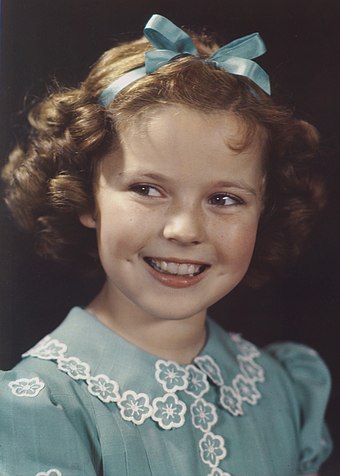
Despite the fact that I saw plenty of religious movies, the central figure of my wholesome childhood viewing was Shirley Temple. She loomed large at home and at school. We saw her movies at school at our first Friday film afternoons where the entire student body from first through ninth grade would gather. These were also shown on television on Saturday afternoons and my mother, a real devotee of Shirley’s, would watch those movies with us. We laughed and cried and “Awwwed” together. My mother could recite lines from these films that she remembered from seeing them in the movie theaters as a child and as a young adult. She loved Shirley Temple; I could see the adoration in her eyes, and I think I wanted some of that unqualified enchantment.
Shirely Temple
She had everything on her side. She was undeniably and overwhelmingly cute. She danced and sang in an adorable little girl way. She pouted endearingly. She had a strong moral compass and consistently directed adults to do the good and better thing. She showed the path to joy through good wholesome living. Even if you were a misanthrope, you had to like this kid. I remember feeling badly for boys because their role models seemed to be troublemakers from the Little Rascals, like Spanky, Alfalfa, and Buckwheat.
I don’t ever remember thinking that Shirley and I could be friends. I don’t remember thinking that she’d be a nice sister to have. I liked all of my friends well enough and really loved my sister. But I watched her in overalls in Rebecca of Sunnybrook Farm and made a note that I had overalls, but I didn’t quite look as cute. What was it about this kid? I saw her in so many movies with those killer banana curls. I had thick, black, nearly uncombable hair but earlier in my life, I had workable hair. Somehow that changed. Maybe, we lose our lovely baby hair like we do our baby teeth. My mother’s only attempt at hair styling was to cut my bangs short and let things fly. To address my hair issue, my favorite aunt took me to the hairdressers in the first grade where Leona gave me a makeover in the form of a pixie cut. With a gap in my front teeth and a very short haircut, I was quickly running away from any chance of looking like Shirley Temple. I needed another strategy.
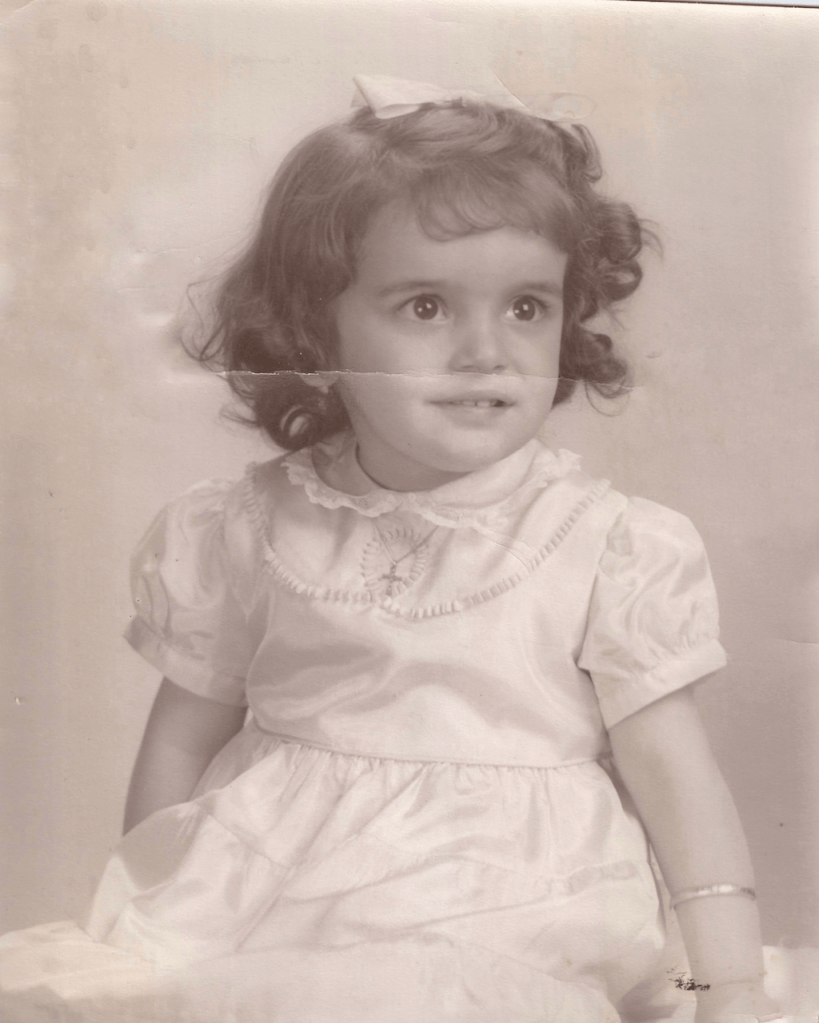
Me at three years old. The Shirley Temple influence is obvious.
I tried to sing like Shirley Temple and followed her steps closely when she tap-danced up and down a staircase. I tried to pout, swing my arm into a let’s-go-get-‘em pose, and say cute things like, “I’m very self-reliant”, which Shirley pronounced to the great delight of her elders in Rebecca of Sunnybrook Farm. My obsession with Shirley reflected my mother’s. She clearly adored this little girl. I compared her object of adoration and her own regard of me, which was so full of ambiguity and restraint. I recently learned that films like The Little Colonel, The Littlest Rebel, Captain January, Bright Eyes, Curly Top, Poor Little Rich Girl, andSusannah of the Mounties were made between 1935 and 1938. They were full of messages about optimism, grit, resilience, and spunkiness. Adults in Shirley’s orbit are charmed by her to do the right thing, to change their lives toward the better, to raise money for good causes, and golly, to do whatever it took to keep this child happy.
She is often without a family of her own. She is orphaned more frequently than any kid should be, but this gives her lots of chances to wheedle her way into the hearts of rich and poor, young and old, white, Black and Native American, the kindly and the grouchy. It is truly amazing. My Mom grew up during this time – in those years between the Depression and the Second World War. She may have embraced Shirley as a role model of sorts. She had six brothers and sister in an alcoholic home and was placed in an orphanage during the Depression at two or three years old when her parents couldn’t afford to keep her at home. Shirley Temple offered a glittering example of a charmed life. If the Gods could grant it, I would have loved to have been that child for my mother, but she very effectively resisted my charms for good reason.
But to live in the shadow of this lovely golden child – to see her weekly on TV and often at school, gave me a model of what a child I could be. What about this little girl could I emulate? Or maybe that was a losing battle. Maybe, I could simply understand that Shirley Temple was my mother’s fairy tale, and I was too busy with my own stories to be diverted by this one for too many years. I grew out of love with Shirley Temple and set my sights on Annie Oakley, another hero of fifties television.
I was at a perfect age when I wrote my first eulogy, just a few months after I officiated at my first wedding. I was just sixty years old, the oldest in my family of three children, just old enough to understand my mother as a mature adult, beginning my own aging journey. For the first time in our shared history, I could see her life from a larger more generous perspective. If you are blessed with some wisdom, you understand that understanding your mother is not all about you. She has her own history, of which you are only a tiny part, perhaps. If I had been younger, I would have missed much of this and written a good enough eulogy, but not one so deeply felt. If she had lived longer, I might have done better.
I wrote that eulogy for my mother and conducted that marriage ceremony for two former students. For a brief period, it felt like I was doing so much officiating that I should look into becoming a minister. I had developed a nice demeanor and a warm appropriate manner, according to those attending these ceremonies. It is a lovely feeling to be of comfort or to be a handmaiden of joy and commitment.
My mother died soon after falling in her apartment: she never recovered. In a short two weeks, she was hospitalized and went to a nursing home where she picked up an aggressive infection. We were planning for her return to independent living, but things took a different turn. She failed fast, not eating, or communicating. I think she died of exhaustion, loneliness, loss, and fatigue. The moments in her life that felt full to her were dwindling, like they do for so many older people. She was tired of living. At my age now, mid-seventies, I completely understand that. I am losing my life-long friends, not because of betrayal or disinterest, but because their lives have ended. Somehow, I never expected that one of us would die before the other. And if I had imagined it all, I would have me dead first. That appealed to me as tragically just right.
I took on the assignment to write and deliver my mother’s eulogy by default and by design. I had grown to be the closest to my mother, seeing her every week, sometimes twice. My brother was busy with his family; my sister lived a thousand miles away. I was the writer in my family, although any of us could have done the deed, each in our own way. In fact, I believe that I could have written versions of what I would have imagined by brother and sister would have said about our mother. Siblings experience their parents quite differently and I presented my eulogy as my own, not speaking on behalf of the family, except to express our thanks to everyone in attendance who cared for her, as a friend, and a relative.
Her Mass was at the church near where she lived in an elderly high-rise. I accompanied her to Mass on holidays and special occasions so knew the pastor there. When we were arranging her funeral, I asked if I could share some remarks. He said that I could, after the end of Mass. I had three minutes no longer.
I loved doing that eulogy. It gave me an opportunity to set the record straight, to tell those gathered that snowy morning, how funny, how smart, how underestimated she’d always been. I got to claim some territory for her that she had ceded to us children. I don’t think I have ever met anyone who was as humble. Even after she raised three children on her own after my father died at fourteen, she was convinced that we raised ourselves. There is something about wanting to be nearly invisible because of anxiety that puts that person into a place where they can’t feel their impact on others. That was my Mom; it took me way too long to understand her. I sometimes think if she had been born a generation or two later, that she would have found some refuge and respite in therapy or maybe some better friends or a more accepting community.
Eleven years later, I delivered my second eulogy for a very close friend, Marion. She was dying of a terminal pulmonary disease, and I was visiting weekly. I asked if there was anything on her mind that I could attend to on her behalf.
“Well, I have to write my eulogy. Could you do that for me?”
I was stunned. She handed me this assignment which I said I’d be honored to do. I wasn’t really thinking that she was near death. We never talked about it again. But, it was the most that any friend had ever asked of me – the most important mission of my life as a friend. However, because of the error every living person makes – thinking we had more time together — I never asked the questions that I should have.
“Marion, my dear friend, how do you wish to be remembered? What would you like me to say? What quotations should I recite? What message would you like to pass along? Do you need to set the record straight? Is there a secret you’d like to reveal now? What would you like people to know about you that you haven’t quite gotten around to telling us yet?”
So, none of that got asked or answered. I didn’t even properly tell her how much I loved her. Over the course of our fifty-year friendship, we pledged our fidelity to our truth- and beauty-seeking over and over again. That intense interest in each other’s mind was our deep love. She was such a treasure in my life. I am always reading something or writing that I want to show her. I want to know what she’s reading and thinking. I want to be filled with all the love and attention she poured into me. If you know and love someone deeply enough, they simply can’t be replaced; there is no one else. We often forget that is true about our closest friends and family members is also true for us, as well. We will be missed when we pass on.
Of course, my heart was broken when she died so quickly but one’s pain in the loss doesn’t make for a real eulogy. The standard ritual of a funeral may serve as the perfect balm for some. The familiar cadence of the Mass. The prescribed readings from the Psalms and the Gospel. The final anointing and blessing of the soul to be reunited with God as he welcomes her in the everlasting glory of the chosen with Him. But that doesn’t serve all of us well. A eulogy begs for something different.
A eulogy is a tribute. My friend was a published writer and an English teacher at an all-girls high school. She was brilliant and beloved. The tributes that were posted about her were glorious.
She changed my life.
She opened me to literature.
I became a teacher because of her.
She really saw me., like no one else.
She helped me see the beauty of stories.
I so wanted to be just like her – smart and funny and kind.
My friend was a brilliant conversationalist. She found almost everything interesting, except small talk and narrow people. She wanted your mind to fly like hers did, so you could explore together and wonder and then wonder some more.
She had a hard childhood but she never wore that damage. It simply made her curious about families and love and attachment. Later in her life, she explored her roots and her father, especially in his service in the Canadian army.
When you spend all of your adult years with a friend, you watch them grow and change. If you are lucky, the qualities you loved about them are there for the duration. They don’t grow bitter or self-pitying. They allow you to grow with them. You see all the passions and interests that once absorbed you both float along like that Buddhist cloud that contains fleeting thoughts and feelings. You grew together step by step along a journey that you don’t realize until later in life is one we all take. I see this more and more clearly as I watch my elders and juniors all with their generationally-specific concerns and anxieties and challenges. We change so much over a lifetime that we are barely recognizable to ourselves when we look back and wonder how we raised three kids under the age of six or got our Ph.D. part-time over ten years or hitchhiked across the country or drove too fast one night and nearly killed our little brother. It is all in the memory; it is just hard to see that it is us sometimes.
So when you are writing a eulogy, you are also writing your own history, as you consider what your life would have been like without this friend. And often that is unimaginable, not because the imagined emptiness is so sad but instead because your mind has been so shaped by this individual, your ideas so intertwined with hers, that you really can’t separate them. It would be like observing just the water in the brook, trying to block out the rocks, the movement of the water, the sand at the bottom, the banks at the side. It is just impossible; it is all of one piece.
I think this is what makes writing a eulogy so challenging. I consulted with Marion’s friends about what made her so special to them. These were a handful of people who visited with her during her last months of life. Long-term friends. Work colleagues. Former students. Several themes surfaced but it was clear that Marion was not just a treasure to me. She was a treasure to many people. We were caught up in a circle of her love but didn’t know each other, like planets governed by gravitational pull and not aware of that force. I wanted to write a eulogy that would be unmistakably hers. No one in the audience could say, “Oh yes! That sounds just like my friend, Margaret” if I did my job correctly. I wanted to plot out exactly the size, dimension, character, and nature of my loss. Something impossible to fill; someone impossible to replace.
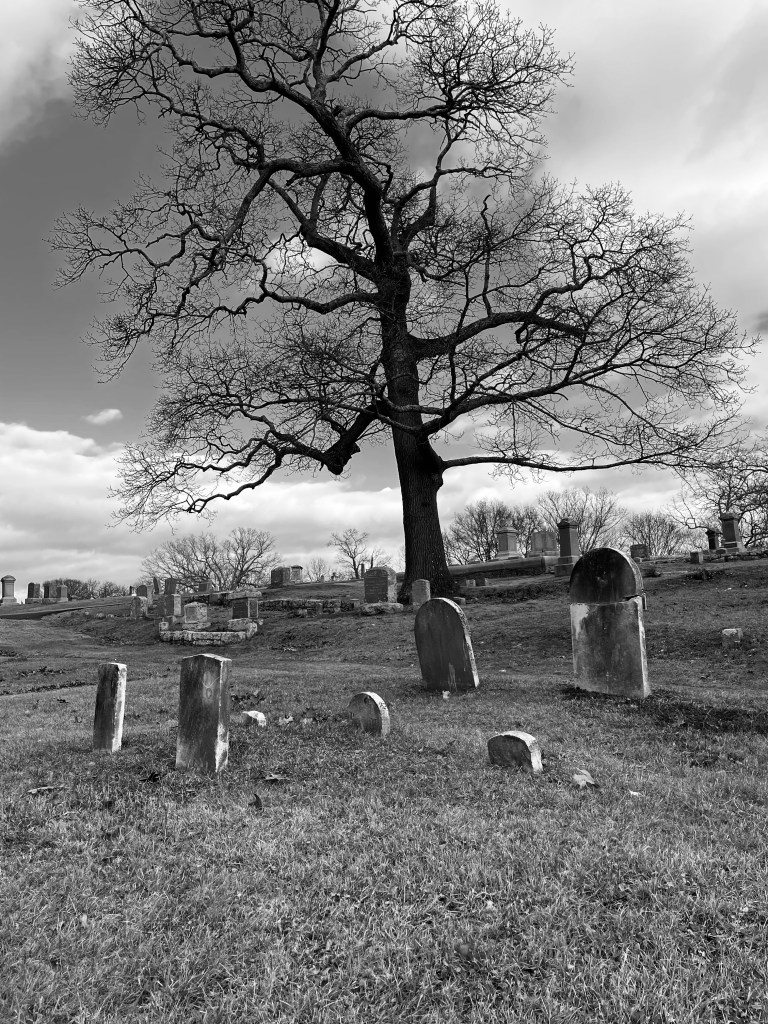
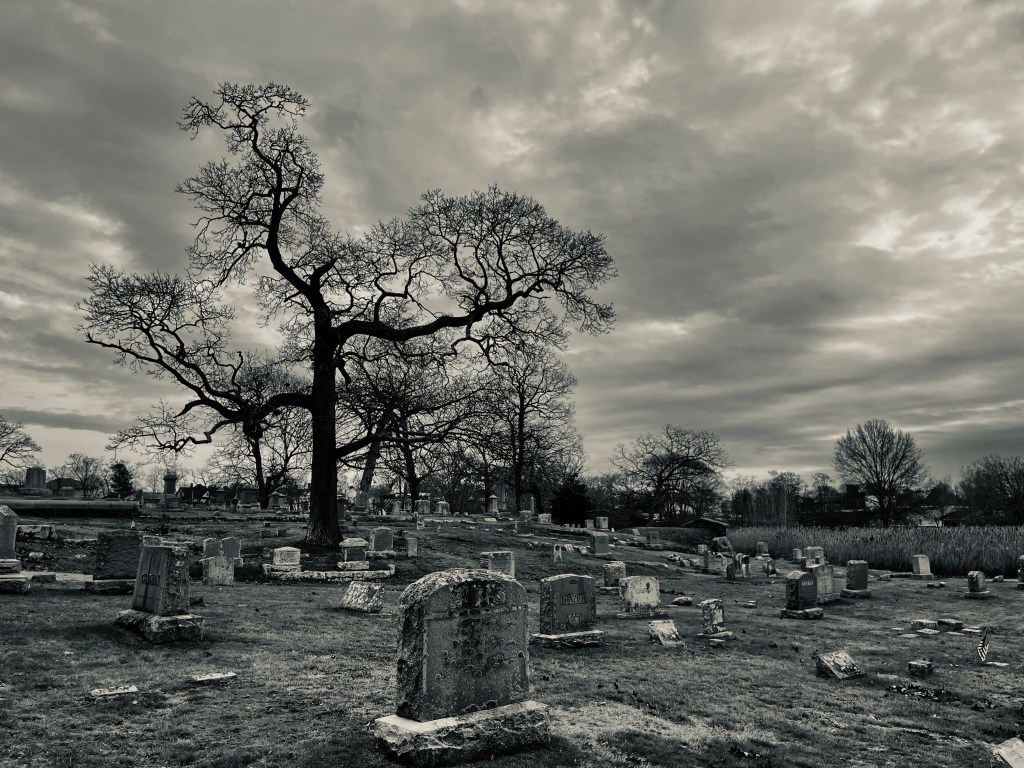
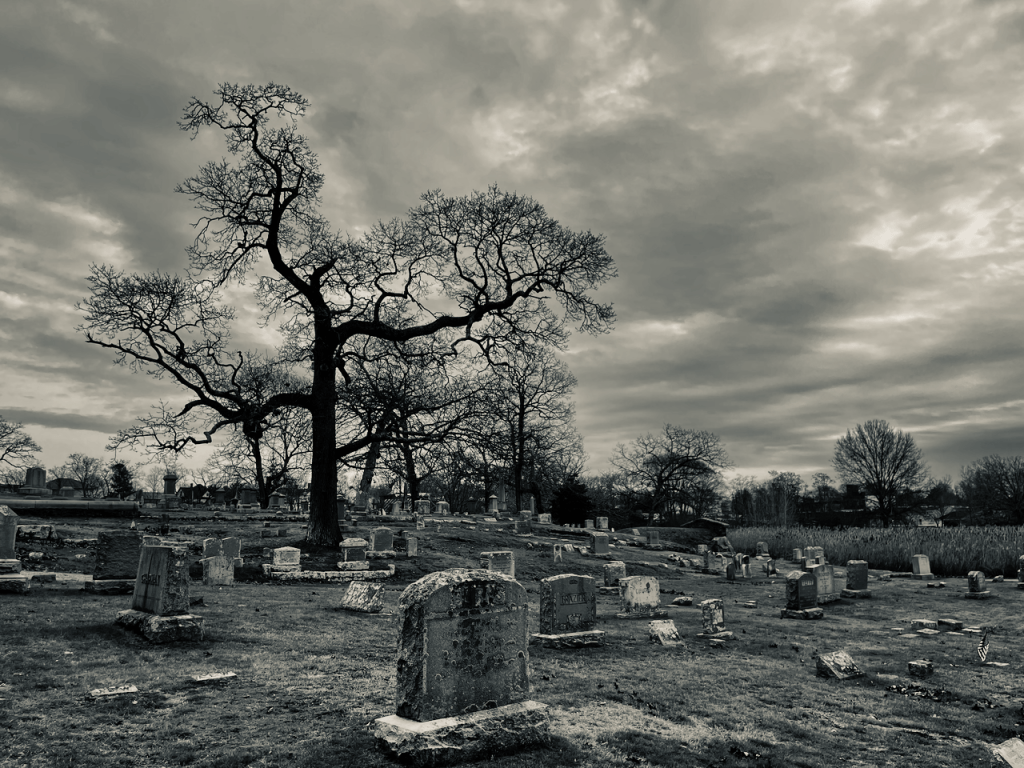
Writing a eulogy is the very start of facing your undeniable loss. Your entry into a lifelong process of missing your friend, remembering at so many turns of their absence. Sitting down to write them a letter and aching for the notes they used to send along. Because their place in your world was so unique, there is no filling that void. It remains a hole in your heart. And the eulogy delivered with tears and grace reminds you as well that others are feeling the same or even greater loss than yours. And that you are connected with all of those who have suffered similar losses. I walk once a week through the cemetery just off the bike path and I pay more attention to the names and dates on the graves, marking all those lives that have come before, loved and buried, with some memories still echoing. Each tombstone its own sliver of a eulogy.
Every day, we face opportunities to bloom and grow, as well as lots of ways to stagnate and get stuck. It takes some work on our part to recognize how many choices we make every day — deliberate and unconscious — that really steer our lives along one path or the other. I have been thinking a lot about this since I retired a few years ago.
When you are pursuing a career, the last thing you want to do is to undermine your pose as a serious competent person, someone who knows the rules and follows them. But since leaving that position as a sociology professor, I’ve embraced new adventures that take me way away from my comfort zones. I have embraced the blessing of the being the dumbest person in the room. We all have a long list of reasons why we don’t take up new adventures and opportunities. “ I will stink at this. What if I embarrass myself?Everyone will be better than me. I should have started in my teens. And on and on. I have countered those arguments with my own list of counterarguments. Imagine learning how to read music! Wouldn’t it be fun to put your wicked sense of humor to good use? This opens up new worlds to you.
If we want to grow, we may need to change our self-definition from a person who can’t to one who can and will.
Following these bold declarations, have taken up a series of projects that I really had no business doing, according to those self-defeating criteria of being too busy, too old, too shy, too me. In fact, a key here is to define yourself as a new kind of person, a person who tap dances, or sings in a choir, or plays drums or leads walks, or teaches yoga and whatever that may be.
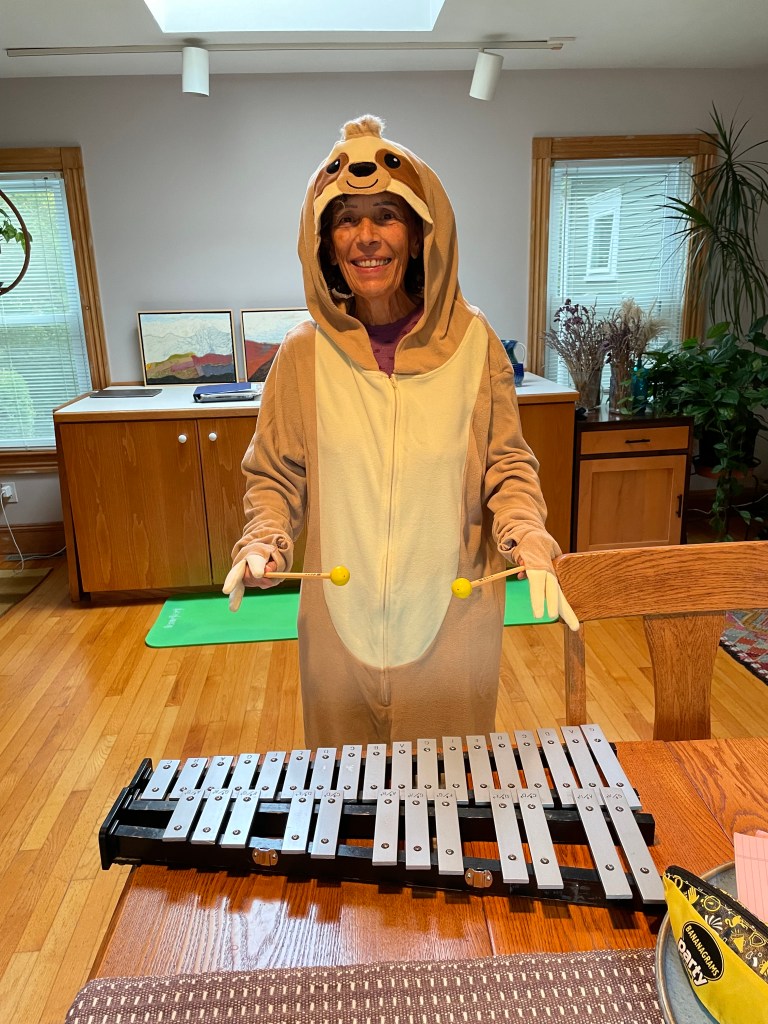
So, I started a new business that’s been a wonderful gift with some big fails. I took improv classes and been on the stage with a talented group of actors. I enrolled in a poetry class, my very first foray into writing poetry and sharing it with others. I joined a community band where I was not only assigned instruments, I’d never played but just had my debut as a mallet percussionist (Glockenspiel and timpani) in costume. In the photo, I am dressed like a sloth because I really am not only the slowest person in the orchestra but also the least experienced, having never in a band before and very new to reading music. In every one of instances, people have been kind and welcoming; I have made new friends; I have learned new skills that I thought were out of reach and have a new sense of possibility and joy. This all in the context of a challenging personal year with the deaths of several people I was close to.
Combined with the hard-won wisdom of being an older person, embracing being the dumbest person in the room has left me with more room for learning, growing and fun and less space for self-criticism, embarrassment, and regret for not doing things I have dreamt of doing.
A friend of nearly fifty years died earlier this month after a long struggle with a difficult illness.
Last summer, on a visit with Marion, I asked if there was anything on her mind. She remarked that she had to write her eulogy. I offered to help, and she proposed that I wrote that eulogy, which is a great honor. But imagine the challenge of writing a tribute for someone so wonderful and so special, so dear to our hearts. I had planned on writing this sometime in the far-off future. But Marion’s death came too early. Anytime would have been too early. I do know, like so many of you, that this eulogy would have been much better if Marion had written or edited it. It would have been stronger, and clearer, maybe even poetic. She was, after all, a genius at making us all better in her kind and gentle way.
I met Marion in the fall of 1973 — almost 50 years ago. Right away, I recognized that she was brilliant — like no one else I’d ever met. She was also beautiful and stylish. The consummate conversationalist. You were never bored in her company. Unmatched intellectual curiosity. A beautiful writer. Interested in all of us and everything. In fact, you became more interesting in her company. At home with big ideas about the universe and meaning and purpose and completely delighted with the silly and inane. I used to love that raised eyebrow and the tilt of her head when something delighted her.
Since that first meeting and in all the years that have followed, I recognized the treasure that Marion was in my life. Recently, as I have met the friends and former students that I have heard so much and read the beautiful comments from her Bayview community, I realized that she was treasure to all of us — not just my dear and special friend. The lovely community she has gathered around her is testament of how much she mattered and how much she matters still. Her close friends have remarked on her ability to listen carefully with support, to always be there in difficult times, to see us as the vulnerable and irreplaceable people we were to her. We felt cherished. She was a symbol of light and love.
A great teacher will inspire you to fly and give you the tools to do just that. You can’t be a beloved teacher with just a command of content and a mastery of material. You need to be deeply present in the classroom aligned with the students teaching them about something you love. You need to be your authentic beautiful self. Parker Palmer, the educational philosopher, wrote, “Whoever our students may be, whatever the subjects we teach, ultimately we teach who we are.” And that indeed was true about Ms. Wrye. She was deeply and profoundly in love with her subject, enchanted by her students and alive with the challenge of creating a beloved community in her classroom. Her unique and lovely spirt and soul were completely revealed in her friendships, in her writing and in her teaching.
What and how she taught in reflected in the tributes that former students and fellow teachers have left on the Bayview Academy’s Facebook pages.
Miss Wrye gave me a voice
Inspired me and my career
My favorite teacher ever
No one ever taught me so much
Her lessons remain with me today.
She created a safe space for us.
Miss Wrye changed the way I thought.
A student wrote that she incorporated Marion’s kindness in feedback into her own teaching.
Another wrote, she believed me to be better than I was or am and I will always want to live up to her opinion. I wanted to more like her.
And directed to Ms. Wrye,
I am so grateful to you for the gift of yourself.
You opened my eyes to great storytelling and literature.
And there so many comments about how kind and loving she was after the death of a parent, or a classmate or a during serious illness or a family difficulty. One student remembers Ms. Wrye reaching out to the Alumni Association to raise money when own family couldn’t pay tuition in her senior year. Thanks to Marion, the student walked with her graduating class.
Miss Wrye also had her wonderful quirky style. A former student recollects one Christmas celebration where the school sponsored a classroom decorating contest. The students dressed up Barbie dolls as angels and hung them from the ceiling fan. When Marion turned on the fan, the angels spun around at breakneck speed. The fact that the students felt that this creative act would delight Miss. Wrye says a lot about the wonderful connection she had with her students.
Marion was an inspired path-breaking educator, as passionate and as thoughtful about teaching as anyone I have ever met. As an educator myself, I was constantly impressed by the thought, the love, the fun she brought to the classroom. How I would have loved to have been a student of hers. She published several important essays about teaching in prestigious journals. Within the past year, she wrote a well-received article about teaching the essay form. She received a national award for her inspired teaching. Many of her students received prizes for their writing. Unfortunately, she did not finish her own story, a memoir she had been working on which would have given us all another glimpse of this amazing woman.
All of us visiting Marion these past years acknowledge the beautiful caretaking of her by Jayne Martin and her close friends. To take on the responsibility of caring for someone you know will pass away in your care is the truest act of love. Because you know on some level, this story will not and cannot have a happy ending. But the kindness, patience, the daily drone of chores, the hard work of caretaking, the demands on your energy and time, the challenge of taking care of someone who is suffering, watching a loved one fail – takes immense sacrifice and generosity. Sometimes, it takes more than we have to give but we do it anyway. So, on behalf of all of us, Jayne, thank you so much for taking care of our beloved friend with all her quirks and foibles. And thanks as well to Marion’s visitors who delighted her with their company and conversation and comforted her in so many ways.
Marion was extraordinary, wasn’t she?
Of course, it is one thing to write a eulogy for Marion and to actually deliver it, to acknowledge her death means facing a bitter and unreal truth, that our friend and teacher has passed away. It is hard to reconcile any loss that is as painful as this one. Some of us have the comfort of a belief in the afterlife. If so, Marion is in heaven, starting great conversations with her favorite poets and philosophers. Maybe she is making some wonderful new friends, like us. I can picture her there in a small carefully organized room with a beautiful window view with her books, a journal and a favorite pen, some Barbie Dolls, a cup of coffee, and maybe the Bee Gees, playing in the background. A chair pulled up close for a friend’s visit. I am certain that everyone in heaven agrees that it is much more interesting place now that Marion is there. Also, I am so certain she misses us. How could she not? She loved us so much.
But even if there is no afterlife, she is always with us. I believe that we pass along some of ourselves to people we have loved and cherished. It is not genetic DNA but something as precious and as powerful – we pass on our unique way of being in the world. I also believe that we have all been written into her spiritual will. We are her legacy. It doesn’t take a lot of effort to find the strands and traces of Marion in our hearts and souls and minds – that thrill at being alive, a loving awe and curiosity about the world, the beauty of a poetic soul, an orientation toward the good and the generous, a love of our friends and family. I know that I am a much kinder, more reflective, a more full-of-life person because of her. I think you are, too.
Of course, you cannot make such an impression on people without leaving an immense gaping hole for us all to fill with love and kindness and a love of life, celebrating our great good fortune of knowing Marion and being embraced by her. How lucky we were!
Marion’s friends are working on developing a scholarship or writing prize at Bay View to recognize her immense contributions to the Bay View community. We want to develop a tribute that really reflects her legacy of exceptional teaching. More about that later.
Over these nearly fifty years, Marion and I exchanged a lot of our writing. I have folders full of her essays, reflections, and poetry. A few years ago, I wrote a poem about her and sent it along for her review. She read it carefully and kindly made it better. She urged me to publish it right away. Instead I let it sit and mature and ripen with time. I am hoping she would have approved of this new version. It is called At the beach, without my poet
At the beach, without my poet
This precious morning beach walk
You were on my mind.
If you were here, my poet, we would toss out lovely names
Of what we see
And hear
And feel.
Like scattering bread for the birds
Our words taking aim at the truth in this very moment.
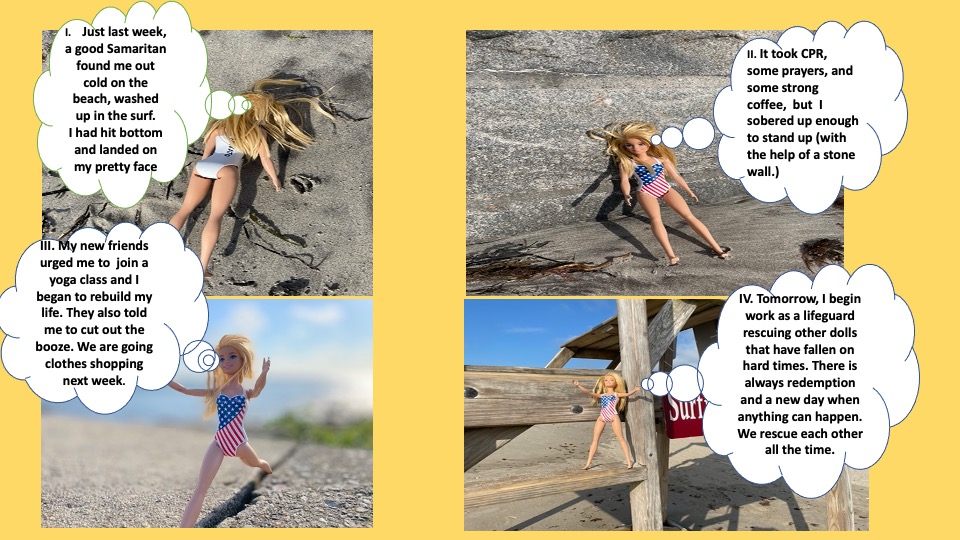
I took this series of photographs after finding this Barbie-like doll washed up in the surf at high tide. She was lying face down in the sand. I picked up and looked about for a little girl who made have left her but the beach was abandoned by then. I took her home, washed her up and put her to bed. I took her back to the beach the next day to take some more photographs, trying to tell a story of this girl who fell on hard times and was saved by some friends. I posed her on the lifeguard chair just after sunrise. This chair is usually populated by two young female lifeguards and thinking they could use some company, I left her with them.
2021, the second summer of COVID. I was hungry for human contact that steeped beyond my tiny world. I must have been radiating that vibe because my early morning beach walks were filled with surprise encounters. The humans I met regularly during these walks seemed completely free and eager to share with me their grand claims about the universe and their profound theories about the ways of the world. They were all sharing a bit of themselves, revealed to a total stranger. There must have been something in me that drew them out without fear of contradiction or challenge. Some people I saw every day, others for one moment, not longer than that.
To be fair, in this second summer, I emerged shell shocked from confinement. Certainly, I connected with people on Zoom calls, but those meetings like I was watching a movie with some friends cast in unfamiliar roles. I was distracted watching myself watching everyone else. None of it felt real. As the months wore on, my colleagues turned off their screens. It was too much exposure and not enough real exchange. We all dove into a huddle with ourselves, it seemed.
Exchanges with strangers on the beach felt like the only true contact I had, and I relished these. I was open and eager for spontaneous conversation to lighten my day. Until that point, I was never that person to begin a conversation with a stranger. I would smile and nod but no more than that. However, based on the conversations I was having, I seemed to present myself as a 72-year-old naïf, like someone brand new to the world. People told me stories and I was enchanted.
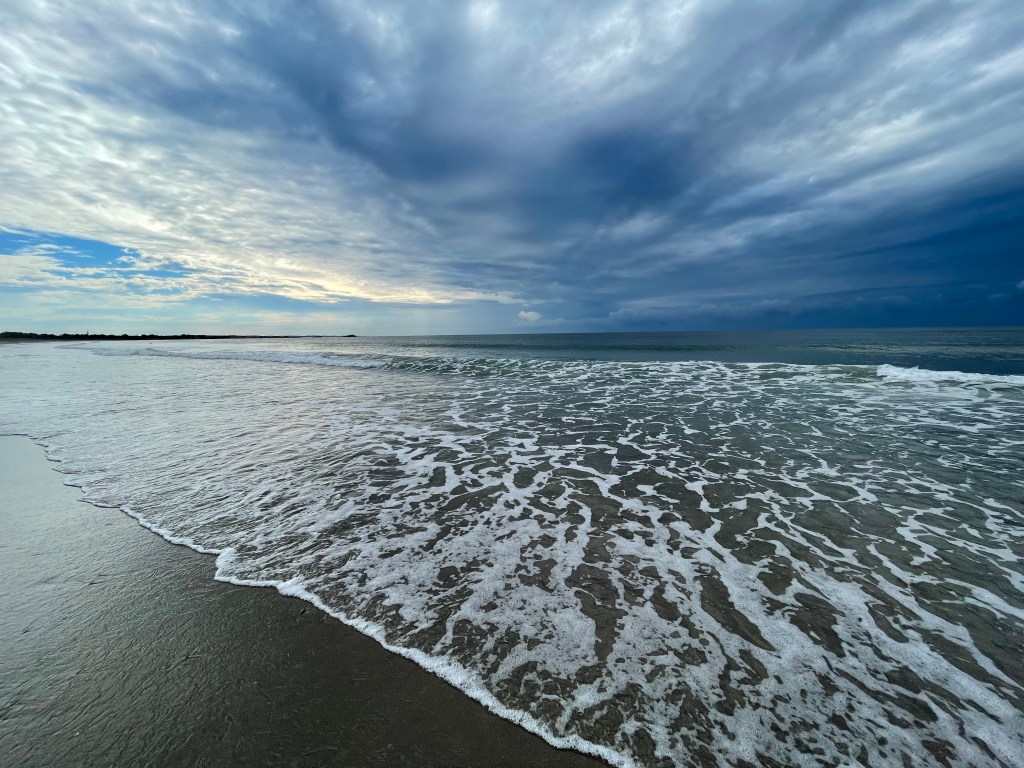
Narragansett beach between weather patterns
One woman, I will call her Hailey, was always splendidly adorned, as if she were attending a party with others similarly dressed. Her disappointment with dress code of the rest of us beach bums was obvious. She sported a giant gold necklace, evocative of a Roman gladiator, and wore well-fitting matching tops and tights. She had the excellent bearing of someone who was not only born into money but also married into it and likely earned some her own. She spoke of afternoons at the Club. She told me about her friend, Billie, her dyspeptic dog, and her former husband who met a fitting end at a hospital in the Philippines. Maybe, this was interesting to me because my father had served there in World War II, although she didn’t know that. Hailey kept asking me if I knew people from the Club, “Do you know Marsha Dawson?” “Have you seen the Clements since they came back from Florida?” Nope. Never. I didn’t even know there was a Club. She shared a story about an albino deer who was especially fond of her. Maybe, albinos are just that way, like some dogs are people dogs and some deer are people deer. This deer had so much regard for her that he never ate her hydrangeas. He also hid from the guests when she was entertaining, keeping him exclusively hers. He sounded like an ideal combination of a gardener and a younger boyfriend.
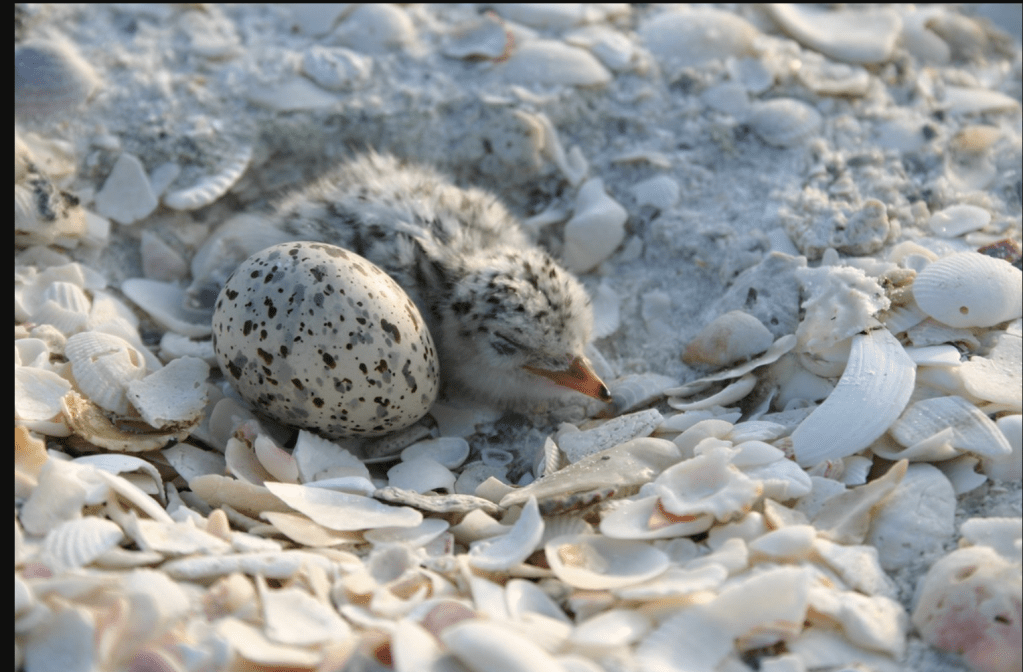
Tern egg with hatchling
As the summer wore on, we stopped on the beach to chat every day. No matter how early I arrived, she boasted that she was there well before sunrise. (At the of beginning of summer, that would be about 4:30 in the morning). No matter how far I had walked, she had walked farther and faster. No matter what I had discovered on the beach—sea glass, an egg from a lesser tern nest abandoned on the beach, fishing lures caught up in seaweed – she had discovered other better things just the day before. How did a beach walk get so competitive? I was tempted to wear a necklace myself made of shark teeth and shrunken heads, just to show her that I was interesting, as well.
Another morning a woman paced one stretch of the beach over and over again, head down and picking at the sand, like an egret looking for food. I learned that she collected sea glass. These people are easy to spot once you know what they are looking at and looking for. I do a lot of beach exploring on my own and will pick up anything of interest. We chatted about sea glass and the perfection of those mornings. I remarked to her about a lovely violet piece of sea glass I had just found, and she replied, “Well, of course, you did. The universe offers these pieces to you, and only you, when the glass is ready to be found, not a minute sooner.” I could have countered with my own analysis, but some minutes in our lives are best spent letting go and listening to how others see the world. She then passed on a chant to me (and only me) and told me how much her dog loved my vibe. I liked his vibe, as well, I suppose. I think he really appreciated that I knew how to scratch his ears but that is part of our vibe together, I suppose, for some of God’s creatures, anyway.
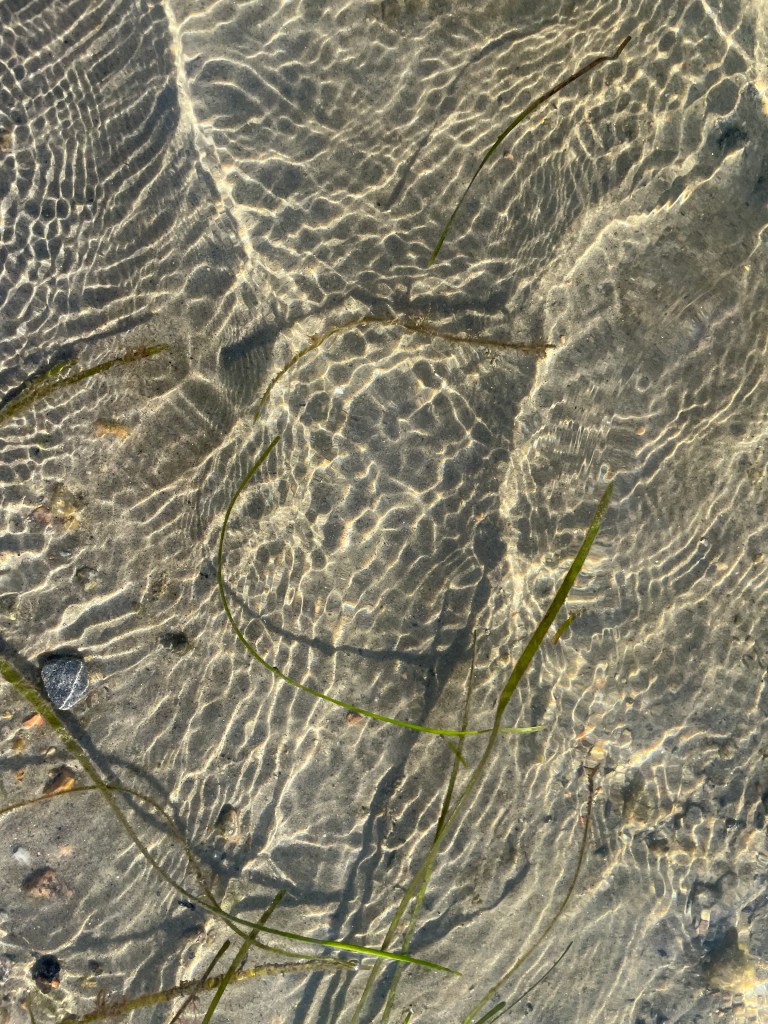
Another woman with a scarf wrapped around her neck and I smiled at each other. We were down at the far end of the beach, dazzled by the light on the water, where the river empties into the bay. The currents and the tides flowing in the opposite direction make for exquisite patterns with light and water and sand. After a few minutes of shared bliss, we acknowledged that we were sharing a beautiful moment. I broke the silence. I said I had seen her yesterday for the first time and she told me in a low voice that she was living out of a van, just like the movie, Nomadland.[1] She was just recovering from melanoma surgery on her neck and chest, aiming to enjoy the day’s light without further damaging her skin. She lived in New Mexico and was visiting her sister who was dying of cancer. This woman was convinced that the cancer was self-inflicted, the result of unresolved childhood trauma. She observed that we can be both victims of trauma and perpetrators, as well. She couldn’t bring herself to care for her sister like she wanted to. Leslie felt she was battling for her own life in the company of her sister. She was bristly about human company although she commented on my gentleness and openness. She also liked my energy.
On the same day, I ran into Tim who practices meditation on the beach. He has a lovely beard and a kind smile. He invites me to join him. I pass and claim that I do a walking meditation. He salutes that intention with a small bow of his head. My next encounter was with an older couple I had been seeing for a few years now. They have a European accent which despite lots of conversations, I have yet to identify. She is wearing a pair of short orange overalls which I recommended to her last year after she complemented me on mine. She said just a few years ago she would have never worn something so comfortable and utilitarian. I congratulated her, nearly hugged her actually. We are always growing together as humans; there is no other way.
For two years now, I’ve seen a lovely couple who are here on summer weekends. They swim at the end of Narrow River floating with the current, into the ocean where the waves guide them to safety. We comment on the wonder of this perfect day, just as beautiful as the day before and the day to come. “How can this be?” I ask. “How can things be so good?” Greg answers, “Gosh, I am so good, there should be two of me.” Exactly. Me, too.
My daily rounds were topped off by speaking with David, a patent attorney whose wife has multiple sclerosis. He so wishes she could join him on his walks. When she does, she is completely exhausted, but maybe in a good way, he thinks. We talk about sea glass which he also collects. “How do you know when you have collected enough?” I ask. “Do you have a plan for it when you die”? He has asked his children to mix the glass with his ashes and to dump both in the bay. That idea really appealed to me. This may be illegal, he fears, not the glass, but certainly the ashes. Legal training sometimes makes you too aware, I think. That sort of thinking can stifle your dreams.[2]
I can say that this daily practice of encountering strangers has added immeasurably to my life in surprising ways. We encounter so many people in so many ways that they can blend into an undistinguished crowd of “people I don’t know.” But each of them has a story and a perspective. Those minutes together are improvised stories, an exchange that brings us both to the present and keeps us here long enough for a true encounter. These are blessings in each morning.
And, of course, there is the simple beauty of the beach, where a careful eye and ear and an open heart with reveal something new every walk, like shimmering light on the water.
Sandra Enos
[1] Nomadland is a wonderful film with a perfectly scored soundtrack.
[2] The EPA has a policy about burial at sea. Cremated remains must be disposed three miles off the coast and reported to the EPA. You cannot simply toss remains off the side of a fishing pier or take them along with your lunch on a nice kayak paddle. I think the Mafia must have scared the EPA into regulating these burials at sea, even cremated remains. They are silent on sea glass.