This blog includes essays about life, aging, humor, inspiration and creativity. These things capture my attention and I hope are worthy of yours. Sandra Enos.
Even though I keep a daily journal, my notes on the pandemic are sparse. I recall best those very early days when neither science nor faith could stem the tide and terror, fear, and dread of the virus. As an older person, I felt my age for the first time, as both a high-risk target for the disease and as a vulnerable elder requiring careful watch and extra protection. I’ve learned that children can be just as paternalistic as their parents in that caring but condescending way.
I do have an entry in my daily notes for Sunday April 5th, a few weeks after the federal government declared a national emergency, just a week after the U.S. had more COVID cases than anywhere else in the world. We were in the early days of lockdowns, travel bans, shortages. Fear of the disease and of each other. Daily briefings. Panic. On that day, I spoke with my sister in Florida. A few weeks prior, we had set up bi-weekly check ins. That Sunday, we talked about how these could be our final days. That sentence sounds melodramatic when I write it, but it rings true to my experience. On that day, we broached the subject of final plans. She had organized a box full of important documents with my name on it on the second shelf of her guest room closet. All her contacts– professional ones and personal ones – to be notified when she passed away. Emails, phone numbers, passwords, online accounts. She had thought of everything – so kind. I committed to doing the same thing as soon as possible, yet still to this day, four years later, I have left most of this undone.
She considered almost everything. I asked her about her eulogy. Had she thought about who would say those final words? As soon as the question left my lips, I knew what I wanted to hear. As her older sister, I prayer it would me. She confirmed that hope. I would deliver her eulogy and she mine. We wondered together whether we knew everything we should know about each other. I made these notes in my journal. Committed to writing Marcia’s eulogy. That sent me down a rabbit hole of wondering. Was I really the best person to write this? Did I really remember the important points in her life? Did I underestimate how painful those early illnesses were for her? Did I comprehend how deeply she at age twelve felt my father’s early death? Did I know the whole story about her marriage? Did I appreciate how deeply others loved her? Did I know only my special sister-side of her? Did she know I’d nearly been hospitalized for depression? That I came close to suicide more than once? Those eulogies may reveal more than we have told each other so far. These can be reckonings.
I delivered my first eulogy for my mother. I asked her parish priest if I could say a few words after Mass. He told me that this wasn’t the custom in his parish but since my mother was a parishioner, he’d allow it. I could have three minutes. Three minutes? For my mother? And then I thought of her, so hating attention in any of its forms. She would tell me to take no more than two minutes, more than enough to say what needed to be said. So, I delivered that eulogy from my heart as I knew my Mom to be, underestimated, full of broken strength. I learned during the reception in the church basement how much I didn’t know about her. How kind she was to a neighbor. How much attention she paid to a lonely resident in assisted living. How crazy funny she was. That she was a wonderful dancer in her twenties. How she was a complete person separate from me—a richer, deeper, more complex story than I knew. I wished I had done better for her. Reaching beyond what I know or think I know; I will do better for my sister.
I came from a family where wearing makeup and caring much about one’s appearance was frowned upon and considered vain. I knew that I was not a great beauty. I was one of those “she has such a nice personality” girls, encouraged by my mother to develop my brain and housekeeping skills because youthful good looks wouldn’t last forever. She failed to tell me that my brain and housekeeping skills would also fade with time. (Thank goodness for the latter.)
I successfully resisted makeup and even paying much attention to my appearance until much later in life. Then I relented in my early seventies. Maybe it was my very pretty dermatologist. We had tried lotions and cremes for aging spots, and nothing worked. One day, she suggested a chemical peel. The results sounded promising. Clear skin! My heart swelled with expectation. I remembered what Charles Revson, the founder of Revlon, said about the cosmetic industry. “We don’t sell lipsticks. We sell dreams.” Or “Perfume is made in the factory, ‘hope’ is sold in the store.” So, I bit the bullet, believing in magic. The promise, dream, and hope of a better me.
Even after bottle after bottle and tube after tube fails to make us beautiful, we again and again put our faith in the magic of potions and creams and procedures, resting on a shaky foundation of that improbable fix.
I signed for theleast intrusive chemical peel, as I called it, the baby peel. My lovely dermatologist and her aide prepped me with alcohol and brushed the peeling agent over my face, paying special attention to the darkest areas. The whole thing took less than thirty minutes. I went home with discharge instructions and suggestions to stay out of the sun and take it easy. I should be back to normal with some redness in just a few days. Imagine that!
The discharge instructions and the calm counsel from my dermatologist were completely inadequate for what followed, like the instructions that Marie Antoinette might have gotten before her beheading, “You feel a sharp pinch in your neck that will end quickly, and you will fall into a deep state of rest and relaxation.” Follow-up instructions generally fail to describe what really happens in post-surgical recovery. Doctors are woefully inadequate in describing pain. Maybe, they figure no one would sign up for any surgery if they told the truth or maybe they resolve to leave the theatrics to the fiction writers of the world. If I wanted to really know the truth about a chemical peel, I could watch a Lifetime movie.
I resolved to catalog my agony and suffering. I took photographs and maintained a log. I have had several surgeries, some quite serious and nothing was as painful as this. I was actually crying in the anguish that I had gone through this suffering for vanity and nothing else – my punishment for believing in magic.
In the follow up visit to the pretty dermatologist, I am eager to share my misery. I have photographic evidence on my phone and paper documentation. However, before I can answer her question, “So, how was the recovery?”, she interrupts, looks kindly at me, and says “Horrible, right?” I nod in disbelief. All that was normal? I suggest to her that she needs to rewrite the discharge materials to more accurately describe the burning, the tightness in face, the frightening peeling of the skin.
Before she can disagree, I begin, “Here’s my version, Doctor.”
First, they pour acid on your face.
Then your skin lifts off your face and dies right in your hands.
Then your face burns no matter what you do.
It will seem that the procedure has gone completely wrong but that is entirely normal.
And please don’t sneeze because we have no idea what will happen.
Clinical results will vary.
We suggest that your loved ones take a short trip while you are recovering because some partners may suffer from nightmares from seeing the patient on days three and four.
Results will vary and are unrelated to your suffering.
The procedure may be repeated in six months because the spots are likely to reoccur.
Her days were undistinguished except for the afternoon sun. As the seasons passed, she watched the shadows shorten and lengthen gliding across the floor in her tiny sitting room. At her side, a basket of knitting sat untouched. The last time she picked it up, she had no memory in her fingers of how she once made blankets and hats for every member of her family and many of the babies at the church.
She felt the warm June sun and looked out to the garden. She struggled to recall the year when she. was strong enough to dig a two-foot trench for the asparagus bed. It thrived for years when the children were small and began to fail when she could no longer tend it lovingly. Where did that lovely asparagus go, she wondered.
She surveyed the yard, once resplendent at this time of year — every bed a surprise of color and form, her peonies with the grace of ballerinas, those dahlias uncompromising in their bold colors and shapes. Where had all those flowers gone? Or maybe, she didn’t recall this so clearly. A fleeting thought poked into her mind, perhaps this beautiful garden in her memory was actually someone else’s garden. Not hers at all, perhaps.
The neighbor’s children, the age of her great grandkids, were screaming with delight, splashing into their backyard pool, celebrating the birthday of the youngest, Liam. She recalled such parties when she was young but not much about them. She couldn’t recall the name of her favorite cousin or remember when she had last seen him. Had he died? Maybe so. Could that be that I wouldn’t remember? She knew she had a happy childhood but the details, of it like so much else these days, escaped her.
So much had passed by in her long life. Friends. Wars. Struggles. Great joy. Great books. Love. Being a mother. A productive career. Losing a husband. Losing all but one of her siblings. She tried not to dwell on the past, but her future seemed short to her. She did remember her high school friends. “We were such a gang of girls, full of energy and delight and not a little sassiness” she thought. “We were so lovely although we didn’t know it at the time. Where did those girls go?” When she saw the few friends that remained, she saw old women, with their youth like phantoms beside them.
She was willing to accept that life was full of loss; that fact she could accept with equanimity. More than anything, she missed her words, her clever mind, her intellectual power. Once, she could summon a rich vocabulary and choose words that delighted her, like a captain commanding his troops to attention, those words bold and perfectly fitted to her ideas. Now, those words were fewer, wandering, and remote and painfully slow to appear. That loss she felt deeply.
But even as others saw her depleted and elderly, she felt something else. A favorite author of hers wrote at the end of her life, that she was herself, as never before, with fierce energy and intense feelings. Everything was profoundly beautiful to her. Even her own children weren’t as captivating as the children she saw these days. Last year’s Mother’s Day flowers drew her attention like never before. Music brought her to tears. She wanted to draw the world close, to live each minute with all the passion and light that was remained.
I spent my childhood in the fifties, living a standard working class childhood. Besides all the other tasks associated with socializing children, the adults in my life were focused on exposing us to wholesomeentertainment. I remember Sundays at Mass where we would as a community take the Legion of Decency pledge, foreswearing temptation, and the work of the Devil. One version of the pledge read as follows:
I condemn all indecent and immoral motion pictures, and those which glorify crime or criminals. I promise to do all that I can to strengthen public opinion against the production of indecent and immoral films, and to unite with all who protest against them. I acknowledge my obligation to form a right conscience about pictures that are dangerous to my moral life. I pledge myself to remain away from them. I promise, further, to stay away altogether from places of amusement which show them as a matter of policy.
I remember all sorts of films received C (condemned) ratings including the Rosemary’s Baby, Clockwork Orange, The Producers, The Rocky Horror Picture Show, and Saturday Night Fever. The Legion of Decency was run by a loose affiliation of local civic leaders, not really a body of the Church. Pope Pius XII wrote that instead of condemning morally dangerous movies, Catholic organizations should be promoting good ones which is something my mother and my grammar school did all the time. I am not certain why the adults were so obsessed with movies. Perhaps, they had seen the ravages of unwholesome entertainment on the brains, souls, and character on the population. Maybe these effects were especially powerful on innocent children and callow youth. They wanted to mount a defense. My Catholic elementary school was especially vigilant about protecting “purity”. In my reading of the Lives of the Saints, a very high percentage of girls who became saints did so by protecting their purity. As a small child, I had no idea what any of this meant. I imagined it might have to do with the cleanliness of my soul, making sure nothing nasty entered. The ritual of confession offered a nice regular scrub down. You would share your sins with the priest. He would pass along some penance prayers, and within no time, you could be back to making mischief again.
I had loads of questions about penance. I knew that basically my sins were small potatoes. But suppose, someone confessed that they murdered someone or denied their faith or stole candy from their brother, could the priest make them go to jail or whip them or send them to their room without dessert? Certainly, it couldn’t be that everyone should just get to say a few prayers and go about their evil business. Who even remembered those prayers and who checked up to see if they were really recited with a pure heart?
A prime rule of child rearing in mid-century families was that It is important to offer children good things to do and consider, otherwise evil forces will capture them and never let go. They had to cut off bad influences at the start. A child will not want to see a a bad movie, “bad” in the sense of corrupting, when they can see a “good” movie, one that would lift them up morally, like the Song of Bernadette or even better, Rebecca of Sunnybrook Farm? The former was nominated and won several Academy Awards. The film tells the story of the apparition of the Blessed Virgin Mary to a poor girl named Bernadette. Miracles ensue, the sick are cured, and she is eventually canonized. Her faith triumphs over lots of disbelief and naysaying. As a Catholic child, I saw that movie lots of times, fully expecting my own apparition, if I could remember to pray and be good and simple hearted, full of faith and obedience and not much else. I was not visited but neither were my more obedient and devout classmates.
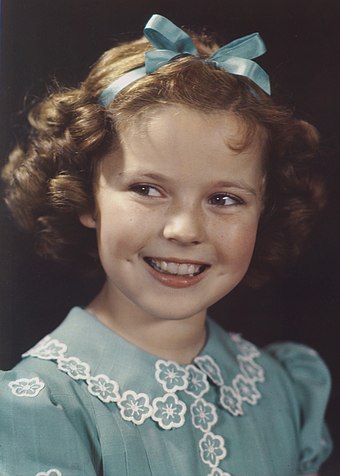
Despite the fact that I saw plenty of religious movies, the central figure of my wholesome childhood viewing was Shirley Temple. She loomed large at home and at school. We saw her movies at school at our first Friday film afternoons where the entire student body from first through ninth grade would gather. These were also shown on television on Saturday afternoons and my mother, a real devotee of Shirley’s, would watch those movies with us. We laughed and cried and “Awwwed” together. My mother could recite lines from these films that she remembered from seeing them in the movie theaters as a child and as a young adult. She loved Shirley Temple; I could see the adoration in her eyes, and I think I wanted some of that unqualified enchantment.
Shirely Temple
She had everything on her side. She was undeniably and overwhelmingly cute. She danced and sang in an adorable little girl way. She pouted endearingly. She had a strong moral compass and consistently directed adults to do the good and better thing. She showed the path to joy through good wholesome living. Even if you were a misanthrope, you had to like this kid. I remember feeling badly for boys because their role models seemed to be troublemakers from the Little Rascals, like Spanky, Alfalfa, and Buckwheat.
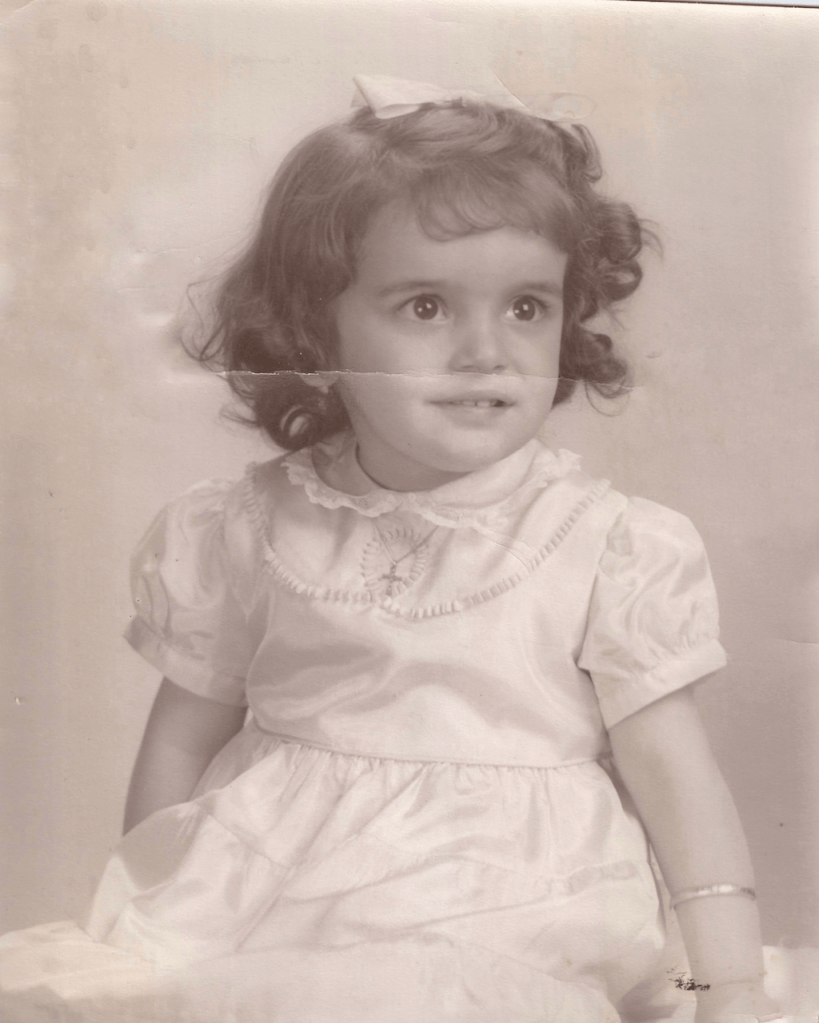
I don’t ever remember thinking that Shirley and I could be friends. I don’t remember thinking that she’d be a nice sister to have. I liked all of my friends well enough and really loved my sister. But I watched her in overalls in Rebecca of Sunnybrook Farm and made a note that I had overalls, but I didn’t quite look as cute. What was it about this kid? I saw her in so many movies with those killer banana curls. I had thick, black, nearly uncombable hair but earlier in my life, I had workable hair. Somehow that changed. Maybe, we lose our lovely baby hair like we do our baby teeth. My mother’s only attempt at hair styling was to cut my bangs short and let things fly. To address my hair issue, my favorite aunt took me to the hairdressers in the first grade where Leona gave me a makeover in the form of a pixie cut. With a gap in my front teeth and a very short haircut, I was quickly running away from any chance of looking like Shirley Temple. I needed another strategy.
Me at three years old. The Shirley Temple influence is obvious.
I tried to sing like Shirley Temple and followed her steps closely when she tap-danced up and down a staircase. I tried to pout, swing my arm into a let’s-go-get-‘em pose, and say cute things like, “I’m very self-reliant”, which Shirley pronounced to the great delight of her elders in Rebecca of Sunnybrook Farm. My obsession with Shirley reflected my mother’s. She clearly adored this little girl. I compared her object of adoration and her own regard of me, which was so full of ambiguity and restraint. I recently learned that films like The Little Colonel, The Littlest Rebel, Captain January, Bright Eyes, Curly Top, Poor Little Rich Girl, andSusannah of the Mounties were made between 1935 and 1938. They were full of messages about optimism, grit, resilience, and spunkiness. Adults in Shirley’s orbit are charmed by her to do the right thing, to change their lives toward the better, to raise money for good causes, and golly, to do whatever it took to keep this child happy.
She is often without a family of her own. She is orphaned more frequently than any kid should be, but this gives her lots of chances to wheedle her way into the hearts of rich and poor, young and old, white, Black and Native American, the kindly and the grouchy. It is truly amazing. My Mom grew up during this time – in those years between the Depression and the Second World War. She may have embraced Shirley as a role model of sorts. She had six brothers and sister in an alcoholic home and was placed in an orphanage during the Depression at two or three years old when her parents couldn’t afford to keep her at home. Shirley Temple offered a glittering example of a charmed life. If the Gods could grant it, I would have loved to have been that child for my mother, but she very effectively resisted my charms for good reason.
But to live in the shadow of this lovely golden child – to see her weekly on TV and often at school, gave me a model of what a child I could be. What about this little girl could I emulate? Or maybe that was a losing battle. Maybe, I could simply understand that Shirley Temple was my mother’s fairy tale, and I was too busy with my own stories to be diverted by this one for too many years. I grew out of love with Shirley Temple and set my sights on Annie Oakley, another hero of fifties television.
I was at a perfect age when I wrote my first eulogy, just a few months after I officiated at my first wedding. I was just sixty years old, the oldest in my family of three children, just old enough to understand my mother as a mature adult, beginning my own aging journey. For the first time in our shared history, I could see her life from a larger more generous perspective. If you are blessed with some wisdom, you understand that understanding your mother is not all about you. She has her own history, of which you are only a tiny part, perhaps. If I had been younger, I would have missed much of this and written a good enough eulogy, but not one so deeply felt. If she had lived longer, I might have done better.
I wrote that eulogy for my mother and conducted that marriage ceremony for two former students. For a brief period, it felt like I was doing so much officiating that I should look into becoming a minister. I had developed a nice demeanor and a warm appropriate manner, according to those attending these ceremonies. It is a lovely feeling to be of comfort or to be a handmaiden of joy and commitment.
My mother died soon after falling in her apartment: she never recovered. In a short two weeks, she was hospitalized and went to a nursing home where she picked up an aggressive infection. We were planning for her return to independent living, but things took a different turn. She failed fast, not eating, or communicating. I think she died of exhaustion, loneliness, loss, and fatigue. The moments in her life that felt full to her were dwindling, like they do for so many older people. She was tired of living. At my age now, mid-seventies, I completely understand that. I am losing my life-long friends, not because of betrayal or disinterest, but because their lives have ended. Somehow, I never expected that one of us would die before the other. And if I had imagined it all, I would have me dead first. That appealed to me as tragically just right.
I took on the assignment to write and deliver my mother’s eulogy by default and by design. I had grown to be the closest to my mother, seeing her every week, sometimes twice. My brother was busy with his family; my sister lived a thousand miles away. I was the writer in my family, although any of us could have done the deed, each in our own way. In fact, I believe that I could have written versions of what I would have imagined by brother and sister would have said about our mother. Siblings experience their parents quite differently and I presented my eulogy as my own, not speaking on behalf of the family, except to express our thanks to everyone in attendance who cared for her, as a friend, and a relative.
Her Mass was at the church near where she lived in an elderly high-rise. I accompanied her to Mass on holidays and special occasions so knew the pastor there. When we were arranging her funeral, I asked if I could share some remarks. He said that I could, after the end of Mass. I had three minutes no longer.
I loved doing that eulogy. It gave me an opportunity to set the record straight, to tell those gathered that snowy morning, how funny, how smart, how underestimated she’d always been. I got to claim some territory for her that she had ceded to us children. I don’t think I have ever met anyone who was as humble. Even after she raised three children on her own after my father died at fourteen, she was convinced that we raised ourselves. There is something about wanting to be nearly invisible because of anxiety that puts that person into a place where they can’t feel their impact on others. That was my Mom; it took me way too long to understand her. I sometimes think if she had been born a generation or two later, that she would have found some refuge and respite in therapy or maybe some better friends or a more accepting community.
Eleven years later, I delivered my second eulogy for a very close friend, Marion. She was dying of a terminal pulmonary disease, and I was visiting weekly. I asked if there was anything on her mind that I could attend to on her behalf.
“Well, I have to write my eulogy. Could you do that for me?”
I was stunned. She handed me this assignment which I said I’d be honored to do. I wasn’t really thinking that she was near death. We never talked about it again. But, it was the most that any friend had ever asked of me – the most important mission of my life as a friend. However, because of the error every living person makes – thinking we had more time together — I never asked the questions that I should have.
“Marion, my dear friend, how do you wish to be remembered? What would you like me to say? What quotations should I recite? What message would you like to pass along? Do you need to set the record straight? Is there a secret you’d like to reveal now? What would you like people to know about you that you haven’t quite gotten around to telling us yet?”
So, none of that got asked or answered. I didn’t even properly tell her how much I loved her. Over the course of our fifty-year friendship, we pledged our fidelity to our truth- and beauty-seeking over and over again. That intense interest in each other’s mind was our deep love. She was such a treasure in my life. I am always reading something or writing that I want to show her. I want to know what she’s reading and thinking. I want to be filled with all the love and attention she poured into me. If you know and love someone deeply enough, they simply can’t be replaced; there is no one else. We often forget that is true about our closest friends and family members is also true for us, as well. We will be missed when we pass on.
Of course, my heart was broken when she died so quickly but one’s pain in the loss doesn’t make for a real eulogy. The standard ritual of a funeral may serve as the perfect balm for some. The familiar cadence of the Mass. The prescribed readings from the Psalms and the Gospel. The final anointing and blessing of the soul to be reunited with God as he welcomes her in the everlasting glory of the chosen with Him. But that doesn’t serve all of us well. A eulogy begs for something different.
A eulogy is a tribute. My friend was a published writer and an English teacher at an all-girls high school. She was brilliant and beloved. The tributes that were posted about her were glorious.
She changed my life.
She opened me to literature.
I became a teacher because of her.
She really saw me., like no one else.
She helped me see the beauty of stories.
I so wanted to be just like her – smart and funny and kind.
My friend was a brilliant conversationalist. She found almost everything interesting, except small talk and narrow people. She wanted your mind to fly like hers did, so you could explore together and wonder and then wonder some more.
She had a hard childhood but she never wore that damage. It simply made her curious about families and love and attachment. Later in her life, she explored her roots and her father, especially in his service in the Canadian army.
When you spend all of your adult years with a friend, you watch them grow and change. If you are lucky, the qualities you loved about them are there for the duration. They don’t grow bitter or self-pitying. They allow you to grow with them. You see all the passions and interests that once absorbed you both float along like that Buddhist cloud that contains fleeting thoughts and feelings. You grew together step by step along a journey that you don’t realize until later in life is one we all take. I see this more and more clearly as I watch my elders and juniors all with their generationally-specific concerns and anxieties and challenges. We change so much over a lifetime that we are barely recognizable to ourselves when we look back and wonder how we raised three kids under the age of six or got our Ph.D. part-time over ten years or hitchhiked across the country or drove too fast one night and nearly killed our little brother. It is all in the memory; it is just hard to see that it is us sometimes.
So when you are writing a eulogy, you are also writing your own history, as you consider what your life would have been like without this friend. And often that is unimaginable, not because the imagined emptiness is so sad but instead because your mind has been so shaped by this individual, your ideas so intertwined with hers, that you really can’t separate them. It would be like observing just the water in the brook, trying to block out the rocks, the movement of the water, the sand at the bottom, the banks at the side. It is just impossible; it is all of one piece.
I think this is what makes writing a eulogy so challenging. I consulted with Marion’s friends about what made her so special to them. These were a handful of people who visited with her during her last months of life. Long-term friends. Work colleagues. Former students. Several themes surfaced but it was clear that Marion was not just a treasure to me. She was a treasure to many people. We were caught up in a circle of her love but didn’t know each other, like planets governed by gravitational pull and not aware of that force. I wanted to write a eulogy that would be unmistakably hers. No one in the audience could say, “Oh yes! That sounds just like my friend, Margaret” if I did my job correctly. I wanted to plot out exactly the size, dimension, character, and nature of my loss. Something impossible to fill; someone impossible to replace.
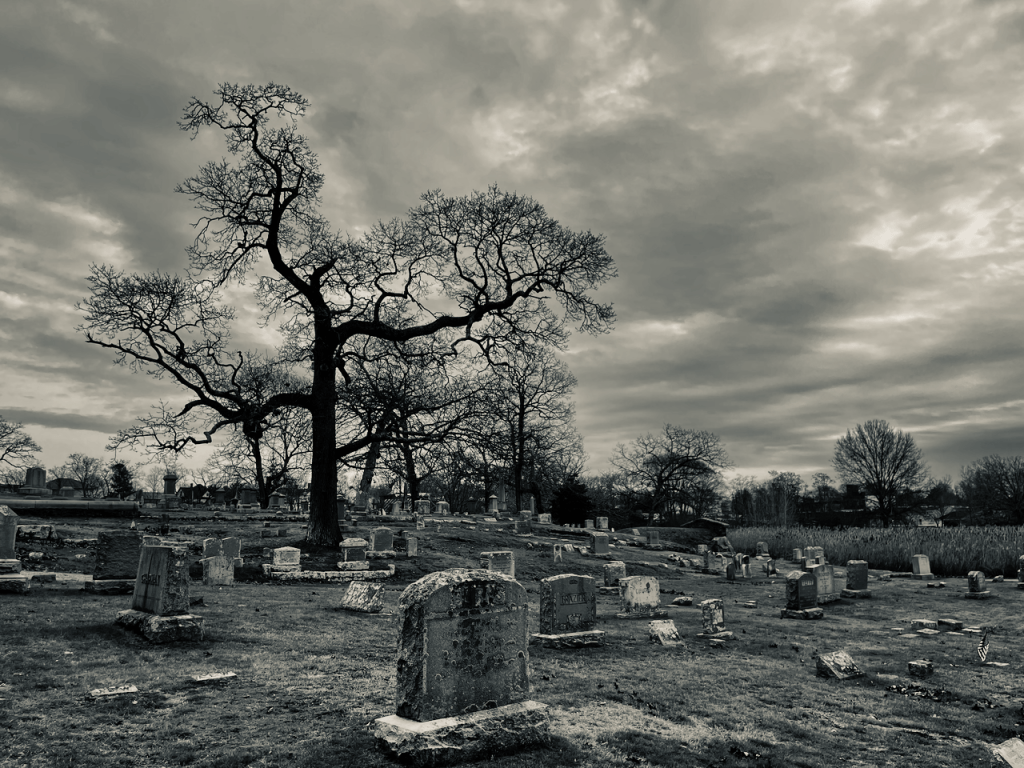
Writing a eulogy is the very start of facing your undeniable loss. Your entry into a lifelong process of missing your friend, remembering at so many turns of their absence. Sitting down to write them a letter and aching for the notes they used to send along. Because their place in your world was so unique, there is no filling that void. It remains a hole in your heart. And the eulogy delivered with tears and grace reminds you as well that others are feeling the same or even greater loss than yours. And that you are connected with all of those who have suffered similar losses. I walk once a week through the cemetery just off the bike path and I pay more attention to the names and dates on the graves, marking all those lives that have come before, loved and buried, with some memories still echoing. Each tombstone its own sliver of a eulogy.
Every day, we face opportunities to bloom and grow, as well as lots of ways to stagnate and get stuck. It takes some work on our part to recognize how many choices we make every day — deliberate and unconscious — that really steer our lives along one path or the other. I have been thinking a lot about this since I retired a few years ago.
When you are pursuing a career, the last thing you want to do is to undermine your pose as a serious competent person, someone who knows the rules and follows them. But since leaving that position as a sociology professor, I’ve embraced new adventures that take me way away from my comfort zones. I have embraced the blessing of the being the dumbest person in the room. We all have a long list of reasons why we don’t take up new adventures and opportunities. “ I will stink at this. What if I embarrass myself?Everyone will be better than me. I should have started in my teens. And on and on. I have countered those arguments with my own list of counterarguments. Imagine learning how to read music! Wouldn’t it be fun to put your wicked sense of humor to good use? This opens up new worlds to you.
If we want to grow, we may need to change our self-definition from a person who can’t to one who can and will.
Following these bold declarations, have taken up a series of projects that I really had no business doing, according to those self-defeating criteria of being too busy, too old, too shy, too me. In fact, a key here is to define yourself as a new kind of person, a person who tap dances, or sings in a choir, or plays drums or leads walks, or teaches yoga and whatever that may be.
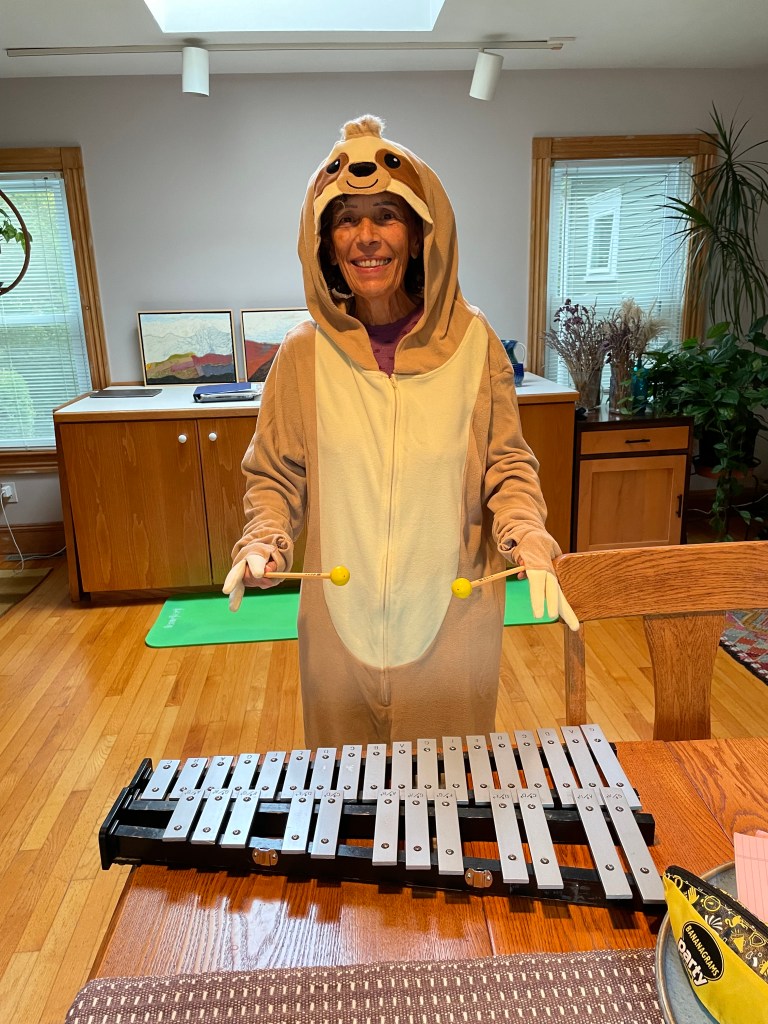
So, I started a new business that’s been a wonderful gift with some big fails. I took improv classes and been on the stage with a talented group of actors. I enrolled in a poetry class, my very first foray into writing poetry and sharing it with others. I joined a community band where I was not only assigned instruments, I’d never played but just had my debut as a mallet percussionist (Glockenspiel and timpani) in costume. In the photo, I am dressed like a sloth because I really am not only the slowest person in the orchestra but also the least experienced, having never in a band before and very new to reading music. In every one of instances, people have been kind and welcoming; I have made new friends; I have learned new skills that I thought were out of reach and have a new sense of possibility and joy. This all in the context of a challenging personal year with the deaths of several people I was close to.
Combined with the hard-won wisdom of being an older person, embracing being the dumbest person in the room has left me with more room for learning, growing and fun and less space for self-criticism, embarrassment, and regret for not doing things I have dreamt of doing.
A friend of nearly fifty years died earlier this month after a long struggle with a difficult illness.
Last summer, on a visit with Marion, I asked if there was anything on her mind. She remarked that she had to write her eulogy. I offered to help, and she proposed that I wrote that eulogy, which is a great honor. But imagine the challenge of writing a tribute for someone so wonderful and so special, so dear to our hearts. I had planned on writing this sometime in the far-off future. But Marion’s death came too early. Anytime would have been too early. I do know, like so many of you, that this eulogy would have been much better if Marion had written or edited it. It would have been stronger, and clearer, maybe even poetic. She was, after all, a genius at making us all better in her kind and gentle way.
I met Marion in the fall of 1973 — almost 50 years ago. Right away, I recognized that she was brilliant — like no one else I’d ever met. She was also beautiful and stylish. The consummate conversationalist. You were never bored in her company. Unmatched intellectual curiosity. A beautiful writer. Interested in all of us and everything. In fact, you became more interesting in her company. At home with big ideas about the universe and meaning and purpose and completely delighted with the silly and inane. I used to love that raised eyebrow and the tilt of her head when something delighted her.
Since that first meeting and in all the years that have followed, I recognized the treasure that Marion was in my life. Recently, as I have met the friends and former students that I have heard so much and read the beautiful comments from her Bayview community, I realized that she was treasure to all of us — not just my dear and special friend. The lovely community she has gathered around her is testament of how much she mattered and how much she matters still. Her close friends have remarked on her ability to listen carefully with support, to always be there in difficult times, to see us as the vulnerable and irreplaceable people we were to her. We felt cherished. She was a symbol of light and love.
A great teacher will inspire you to fly and give you the tools to do just that. You can’t be a beloved teacher with just a command of content and a mastery of material. You need to be deeply present in the classroom aligned with the students teaching them about something you love. You need to be your authentic beautiful self. Parker Palmer, the educational philosopher, wrote, “Whoever our students may be, whatever the subjects we teach, ultimately we teach who we are.” And that indeed was true about Ms. Wrye. She was deeply and profoundly in love with her subject, enchanted by her students and alive with the challenge of creating a beloved community in her classroom. Her unique and lovely spirt and soul were completely revealed in her friendships, in her writing and in her teaching.
What and how she taught in reflected in the tributes that former students and fellow teachers have left on the Bayview Academy’s Facebook pages.
Miss Wrye gave me a voice
Inspired me and my career
My favorite teacher ever
No one ever taught me so much
Her lessons remain with me today.
She created a safe space for us.
Miss Wrye changed the way I thought.
A student wrote that she incorporated Marion’s kindness in feedback into her own teaching.
Another wrote, she believed me to be better than I was or am and I will always want to live up to her opinion. I wanted to more like her.
And directed to Ms. Wrye,
I am so grateful to you for the gift of yourself.
You opened my eyes to great storytelling and literature.
And there so many comments about how kind and loving she was after the death of a parent, or a classmate or a during serious illness or a family difficulty. One student remembers Ms. Wrye reaching out to the Alumni Association to raise money when own family couldn’t pay tuition in her senior year. Thanks to Marion, the student walked with her graduating class.
Miss Wrye also had her wonderful quirky style. A former student recollects one Christmas celebration where the school sponsored a classroom decorating contest. The students dressed up Barbie dolls as angels and hung them from the ceiling fan. When Marion turned on the fan, the angels spun around at breakneck speed. The fact that the students felt that this creative act would delight Miss. Wrye says a lot about the wonderful connection she had with her students.
Marion was an inspired path-breaking educator, as passionate and as thoughtful about teaching as anyone I have ever met. As an educator myself, I was constantly impressed by the thought, the love, the fun she brought to the classroom. How I would have loved to have been a student of hers. She published several important essays about teaching in prestigious journals. Within the past year, she wrote a well-received article about teaching the essay form. She received a national award for her inspired teaching. Many of her students received prizes for their writing. Unfortunately, she did not finish her own story, a memoir she had been working on which would have given us all another glimpse of this amazing woman.
All of us visiting Marion these past years acknowledge the beautiful caretaking of her by Jayne Martin and her close friends. To take on the responsibility of caring for someone you know will pass away in your care is the truest act of love. Because you know on some level, this story will not and cannot have a happy ending. But the kindness, patience, the daily drone of chores, the hard work of caretaking, the demands on your energy and time, the challenge of taking care of someone who is suffering, watching a loved one fail – takes immense sacrifice and generosity. Sometimes, it takes more than we have to give but we do it anyway. So, on behalf of all of us, Jayne, thank you so much for taking care of our beloved friend with all her quirks and foibles. And thanks as well to Marion’s visitors who delighted her with their company and conversation and comforted her in so many ways.
Marion was extraordinary, wasn’t she?
Of course, it is one thing to write a eulogy for Marion and to actually deliver it, to acknowledge her death means facing a bitter and unreal truth, that our friend and teacher has passed away. It is hard to reconcile any loss that is as painful as this one. Some of us have the comfort of a belief in the afterlife. If so, Marion is in heaven, starting great conversations with her favorite poets and philosophers. Maybe she is making some wonderful new friends, like us. I can picture her there in a small carefully organized room with a beautiful window view with her books, a journal and a favorite pen, some Barbie Dolls, a cup of coffee, and maybe the Bee Gees, playing in the background. A chair pulled up close for a friend’s visit. I am certain that everyone in heaven agrees that it is much more interesting place now that Marion is there. Also, I am so certain she misses us. How could she not? She loved us so much.
But even if there is no afterlife, she is always with us. I believe that we pass along some of ourselves to people we have loved and cherished. It is not genetic DNA but something as precious and as powerful – we pass on our unique way of being in the world. I also believe that we have all been written into her spiritual will. We are her legacy. It doesn’t take a lot of effort to find the strands and traces of Marion in our hearts and souls and minds – that thrill at being alive, a loving awe and curiosity about the world, the beauty of a poetic soul, an orientation toward the good and the generous, a love of our friends and family. I know that I am a much kinder, more reflective, a more full-of-life person because of her. I think you are, too.
Of course, you cannot make such an impression on people without leaving an immense gaping hole for us all to fill with love and kindness and a love of life, celebrating our great good fortune of knowing Marion and being embraced by her. How lucky we were!
Marion’s friends are working on developing a scholarship or writing prize at Bay View to recognize her immense contributions to the Bay View community. We want to develop a tribute that really reflects her legacy of exceptional teaching. More about that later.
Over these nearly fifty years, Marion and I exchanged a lot of our writing. I have folders full of her essays, reflections, and poetry. A few years ago, I wrote a poem about her and sent it along for her review. She read it carefully and kindly made it better. She urged me to publish it right away. Instead I let it sit and mature and ripen with time. I am hoping she would have approved of this new version. It is called At the beach, without my poet
At the beach, without my poet
This precious morning beach walk
You were on my mind.
If you were here, my poet, we would toss out lovely names
Of what we see
And hear
And feel.
Like scattering bread for the birds
Our words taking aim at the truth in this very moment.
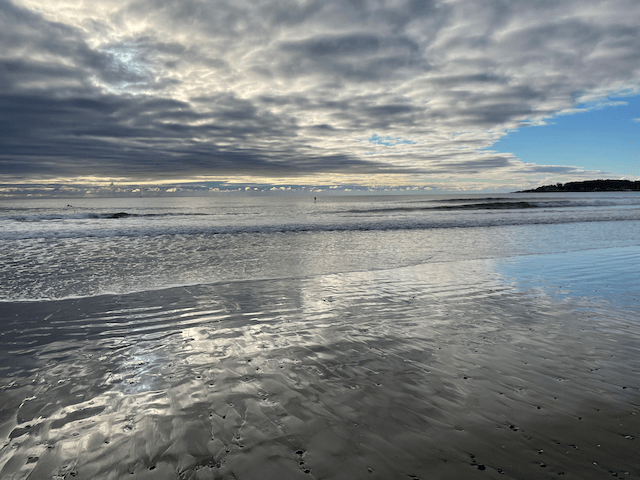
I have hit that time in my life when I less production-focused and more aligned with delivering the summary report. I have fewer things to do that are connected to larger purpose and complex organizations more to do with observing that the spit at the beach extends a little farther to the north today because of yesterday’s storm and rip currents. I do the later as part of my daily walk at the edge of the Atlantic Ocean on Narragansett Bay, which reminds me of a story. That is another artifact of this life as an elder. Much of what happens reminds you of another thing that happened a while ago. I don’t think I have ever heard a twelve-year old say, “Oh, yes. That reminds me of a story? Have I told you about walking home from school in a blizzard and nearly dying of frostbite?”
Back to that story. A few ago, I served on the board of an organization whose mission was to provide job training and employment for refugees. I was speaking to a middle-aged woman called Maria whose husband was killed in during the Iraqi war. She was left to care for her four children and because of her dead husband’s work, she needed to leave Iraq as soon as possible. She spent years in a refugee camp in Jordan with her extended family. Many of them were eventually sent to Germany but for some unknowable reason, she and her children were to be sent to Rhode Island. She asked a fellow passenger on the flight to New York City about this place called Rhode Island. He asked her if she ever saw the movie Titanic. She replied that she had. He then said, “Well, if you remember, the Titanic sank when an iceberg hit it. That was the Atlantic Ocean. Rhode Island is at the edge of the Atlantic Ocean where the Titanic sank. Right at the edge.” Marie would refer to that orientation point for years when as she told people of the Iraqi diaspora where she lived – here on the edge of the Atlantic Ocean where the Titanic sank. As I look out from the water, I imagine the Titanic and Marie and much more. I can hardly see the horizon without a memory, allusion or poem flooding to the surface. That amazing neural networked, hyperlinked three-pound brain, sitting at the top of seventy-two years of lived experience.
On a recent holiday, I brought my iPad along so that I could do some writing. I have been writing all my life without much synthesis. It is a good thing there is no editor in our Word programs that would remark in a little bubble “You are repeating yourself. Please don’t write this again!” And then it would refer you to a document or many documents from decades ago where you surfaced the same complaint or delivered the same brilliant insight. I suppose we cannot help but echo the same themes that pass through our lives; they are defining. Mary Catherine Bateson writes that our lives are not so much linear progressions as the re-circling and development of themes we live out and through. However, in this encounter with my iPad, I decided to do some digging and exploring. Instead of writing something new (Ha!), I thought to explore files I hadn’t looked at in a while — essays, poetry, observations, drawings from years ago. I found ideas I had abandoned, essays I really loved to read, stories I swear I have no recollection of and more. It was better writing than I remembered creating. I found a beautiful memoir from a painful time in Chicago. I found humorous essays that made me laugh out loud. I was gathering bits and pieces of who I was decades ago and what remained just now. I was trying to reassemble myself the way an archeologist might put together artifacts of a vanished species. I wanted to get a clearer view of who I was with less of a reconstructed pre-formed narrative story. As researchers have established, none of our memories are pure. All are constructed in the way we would write a movie script. We edit out the parts that don’t fit the story we wish to tell. I wanted to confront these former lives in another way.
And there is so much of this writing. Some are like the ones I find on my computer files. Others rest in repose in my large rattan chest of journals. Others in scraps of paper here and there. I have to remind myself that is somewhat unusual. I don’t know anyone else except maybe a friend who was a high school English teacher who has kept a journal for so long. And what would one do with all of this, this enormous collection of a lifetime? It is an amazing record, I imagine of something, of a single surprising and completely average life. If I were a researcher writing my biography, (let’s put aside the question of why anyone would), what would I find? Would my writings be an accurate and telling account of what was on my mind? Would I be disturbed by this telling by another’s hand? Just writing that sentence taps into my defensive nature. I am already primed to argue. Or maybe, that blessed biographer would be gentle and put things in warm perspective.
At the same time that I am collecting these writings wherever they lay and hide, I am reading The Practice by Seth Godin about sharing your work with an audience that will or may care, comforting myself in the knowledge that my writing is not for everyone but that doesn’t matter much. I just need to find a following that is large enough to feel worthwhile for me and them. So, reacquainting myself with all of this work has put some wind under my sails. I just need to get into a completion habit. I can’t really just put things in a TO DO file and imagine they will get done by themselves. That is probably my first and deepest resolution, the result of a life-long bad habit. I see it all over my office and in cabinets. And it weighs on me more than I think.
So returning to the archeology idea, one finds at the end stage of a life, having evolved good and bad habits. If we had archeologists of our personalities, they could assay your long life and conclude, “Well, that lifelong optimism worked for the first five decades but after that, this was a failure.” Or “On balance, the making of new friends all your life made sense, but you lost more than you made. You were careless there.” And then maybe a medical archeologist as well, to say, “Well your chronological age is 72 but you have a 62-year-old heart, 86-year-old hair, 90-year-old hearing and a liver that is over 100. This will all get complicated very soon.”
About a year ago, I nearly walked into the path of a car that was entering traffic from a parking lot. The driver was edging into the road and had carefully scoped out his exit. I am certain that he had looked up the street and down. I was the surprise—a blind spot—in his field of vision. He was moving south; I was headed east. One half-second earlier and I would have gone sailing into his car and over the hood. I am a small woman, somewhat fit and maybe athletic. I saw myself arcing in a gymnastic tumble. Except, unlike those tiny bouncy teenagers who land on their tiptoes, I imagine that my head would have hit the pavement first, a non-sanctioned Olympic move called The Double Concussion Flip and Fall. Maybe, I was too distracted with my earbuds playing Moby’s Wait for Me; it is a mesmerizing tune. I was over-dressed on this seventy-degree autumn day.
I stretched out my hands to cushion the crash. When this failed, my chest hit the hood of the car. I bounced back up and tried to resettle myself. What was I doing before I marched onto the hood of this car, I wondered? The driver waved his hands in apology; I waved back. It was like a silent movie. All gestures, no talk. I wanted to dance a bit, maybe skip in front of the car as I left the scene, just like Charlie Champlin might. It was a magic moment. A minute before we had been invisible to each other; now we separated each with a little memory, a shared story to tell our spouses, and maybe a wee lesson, depending on our temperaments.
As we live our lives, we collect stories like this all the time. The older you are, the more you have of these. There are accidents, near-misses, losses and what-could-have-beens. Some we bounce back from, others less so. For me, all these brushes with illness and death bring to mind me those public service announcements from the ‘80s with those crash test dummies, Vince and Larry.
I see much of my life a series of crash test dummy trials. This encounter with the car put my mind on the path of other near misses—a series of events that could have led to some serious trouble. I have sped through a stop sign late at night, distracted and tired. I have twice driven the wrong way down a busy street at twilight. If it had been earlier in that day when I walked into the car, I would have without doubt faced a lot more traffic and a much greater probability of getting hurt. I would have been like a little cat facing the running of the bulls. We could all have been seriously hurt. Well, not all of us equally.
I have been in cars that have spun out, flipping on their heads in slick Alabama clay. I have been held up at gunpoint in Texas on a little walk in the good part of town. The man who did this looked upset enough to hurt me. I have dodged so many medical scares, that I am pretty certain that my health insurance company thinks that I am messing with their premium calculation algorithm. I have had so many tests and been diagnosed with so many wrongly accused major illnesses, there must be an office pool somewhere betting on my demise. This includes brain aneurysms, stomach cancer, pancreatitis, and more. I could go on and on here, but it seems with every incident I recount here, I am feeling both dizzier and bolder. To me, each of these is a like a crash test. With so much good fortune, a karmic calculation would have me dead pretty soon. As they say, I may be running out of good luck. Or maybe in that cosmic computation, or my good fortune comes at the costs of another’s unearned bad turn of chance.
Which gets me into the meat of what is really on my mind. Earned and unearned good fortune. the movie Funny Girlwhen Fanny Brice finds early renown, she says to her lover, the fabulously dreamy Nicky Ornstein, and supporter that she can’t be famous yet because she hasn’t suffered enough. I understand this feeling. It is that sentiment that much of what we have is unearned. We moan, “Why me?” when bad luck strikes but when good fortune strikes, we smile, “I so deserve this.” Personally, I have unearned good health, undeserved energy, unnatural optimism. I don’t know if others feel this way about the gifts they have. I think we mainly focus on what’s missing.
It seems to me that most of us have experienced good fortune we have neither earned nor merited and of course, the reverse is true. I used to joke with a friend that I had the Luck of the Portuguese. When that friend remarked that he never heard of the Luck of the Portuguese, I would simply reply, “Exactly.” John Rawls suggests that in considering systems of justice, we imagine that we don’t know where in a social system we may stand. He calls this a veil of ignorance. How would we want the world to distribute its bounty if we didn’t know whether we were rich or poor or white or Black or male or female or a U.S. citizen or a citizen of another county or abled or disabled? If a thought experiment like this were possible and if it could influence social policy, we would have to be convinced that we actually could stand in someone else’s shoes. Hale doubts this can be done because of what he calls the veil of opulence—the blindness that we all have to the privileges of birth and position. We fall victim to the comfort of believing that if we fell on hard times, we would work our way out of it. The veil of opulence works like the Just World Hypothesis. It creates that delusional narrative that we are self-made, deserving human beings whose unearned good fortune insulates from caring more deeply from others who we see as not as worthy or deserving of what we have. Lots of us dodge bullets thinking we are lucky and blessed; not imaging that the cards are stacked in our favor. Like all those crash tests that I have survived, many have to do with an advantage of class or nationality or gender. Others have to do with random events completely out of our control. And like the crash test dummies, we often do not take good advice or live in a manner that reduces the risk we visit upon ourselves or others. But, as humans endowed with some degree of reasoning, we can do more than our best sometimes to avoid doing the worst.
I started my life as a Baby Boomer member of a working-class family in a mixed class neighborhood in a factory town in New England. Through fortuitous circumstances, few of my own doing, I entered the white-collar class soon after graduating from college. I was the first in my family to graduate from high school and college. With that degree, I no longer worked factory and waitressing jobs that I held in high school and during college summers. I moved into low-level jobs in organizations where my brain was occasionally put to use. Through a series of positions in nonprofits, public service and the tech world, I was able to buy a house, a car and save for retirement. A late in life PhD. allowed me to earn a better salary as I neared retirement.
Somewhere along the way, I had accumulated stocks and bonds into a portfolio, where my savings were invested by my financial advisor. I am putting these words in italics because they still seem so foreign to me. When I was in the seventh grade, my father advised me to start saving for a house as soon as I could and to never ever put any money into the stock market. “The stock market is a rich man’s game”, he argued. “It is no place for people like us.” He also warned me against getting rich or wanting to. “Nothing good can come from that,” he cautioned. I still think my father was right about the stock market and the desire for wealth but with an economic system that simply doesn’t reward savings in a bank account any longer, I opted for the tools available to me. Thankfully, every job I had that came with a retirement plan; there was no way to escape investing in the markets.
So now, over seventy years old, I am faced with figuring out what happens to my portfolio should I die before my modest fortune disappears. I have the chance to bequeath money to my heirs (I don’t have children of my own, but I do have relatives and beloved friends that could benefit from these funds, I am sure). If I pass along wealth to my family, those assets join whatever wealth they already have. Although neither of my siblings is wealthy, we are all comfortable. So maybe some of my fortune could go to nieces and nephews who in their thirties and forties could use an infusion of cash for a house or a car or their own retirement and college planning.
Alternatively, I could donate money to worthwhile charities or create some fund to distribute those dollars after I pass away. If I donate them carefully, maybe I could share the wealth with others who didn’t have the advantages I and my family enjoyed during our careers. As I have been thinking about all of this, I recognize that I am not the only one with this challenge. To understand just how important these decisions are we can look at some larger trends.
Research shows that the passing of the Baby Boomers will lead to the greatest intergenerational transfer of wealth we have ever seen. No generation has been wealthier than the Boomers. Between 2018 and 2042, members of this generation will transfer $70 trillion dollars of their wealth, approximately $61 trillion to their children and grandchildren and the rest to charity. That passing on this great wealth can’t help but contribute to growing inequality. We have never before seen more wealth concentration in this country than the present moment. Estate taxes are virtually zero for most Americans and those with sizable assets are usually armed with accountants and financial planners that work to preserve assets. Perhaps, this transfer of wealth will generate great innovation and entrepreneurship. However, we do have some data that shows that giving wealthy folks more money, like we do with tax cuts, doesn’t necessarily lead to creation of new jobs or social betterment. In fact, it may encourage more second homes, exclusive educations, cooler cars, expensive hobbies, moon shots, along with increased concentration of political and economic power, and other mischief.
As I consider this intergenerational passing on of wealth to our children, I am also thinking about the impact all of this wealth creation has had on the planet. I believe the term externality as used by economists can be helpful here. Externalities are impacts created by producing energy, for example, that is not reflected in price charged for that good. Externalities are also borne by third parties. In this case, it could be environmental degradation. Neither the producer nor the consumer pays the price of this instead it is passed along to the local community, or maybe to the larger society in terms of unhealthy air and water. What externalities have been created by virtue of our accumulating wealth?
If accumulated wealth is what we have earned while on the planet, what unpaid debts can we incurred? What sorts of impact have we had living on the earth, making our living, enjoying ourselves, and raising our children? We can assume that this impact is great if we live in an advanced economy. Research shows the big economies, like the U.S, Europe, and Japan have contributed by far the greatest amount of greenhouses gases to degrading the environment, but those other economies, like India, China and Brazil are catching up. And while these nations are the chief contributors to climate change, it is highly likely that the poorest nations will bear the great burden from these changes. On a more personal level, we can also assume that if we are middle- to upper-income that our impact on the planet is greater than if we were lower income, because we are able to travel more, consume more, have larger houses, demand more products and services, and more.
Oxfam estimates that the world’s richest 10 percent of people have carbon footprints that are 60 times higher as the poorest 10 percent. Any estimation that generalizes large populations is difficult to make, but researchers at Oxfam also estimate that the emissions of the world’s richest 1 percent create an even larger emissions gap: the 1 percent could emit 30 times more than the poorest 50 percent and 175 times more than the poorest 10 percent.
So, imagine as we near the end of our lives, we could calculate the debt we owe to the planet. Suppose when we died, a report issued that measured our environmental impact over the course of our lives. That would include our lives as individuals on the planet, in our households, at our jobs, as we traveled and consumed. It would also take account of the waste we have generated and left behind in landfills, as well as the impact of our investments, and more. Imagine if we can all the water, gasoline, plastic, minerals, food, and other resources that we have consumed or that have been consumed on our behalf.
What if there was a reckoning at the end of our lives based on a valid and reliable calculation of our environmental footprint? Smart economists could determine a monetary value for this. This could be presented at the reading of your will by your executor. First, there would be a statement of your wealth at your death, a total count of your assets and obligations, all set forth and ready for distribution to your lucky heirs and a few selected charities. Second, there will be a fair accounting of your environmental footprint which your children will be obligated to pay off in terms of taxes and other assessments. If they don’t pay it off, it gets passed down to the next generation, just like accumulated wealth. Perhaps knowing that own descendants will be responsible for own environmental impact would lead some of us to care more about the environment than we do now. We would be incentivized to avoid passing down what would be onerous burdens to our children. Those families with parents who had the greatest impact on the environment would pass on their children the greatest burden of accounting for their parents’ impact. It would be likely that those with the largest inheritances would also be those with the largest environmental burdens.
On the other hand, those who trod softly on the earth, who used less than their share, who lived in less resource-intensive economies would pass on credits to their children. Similarly, those who were the victims of environmental harms caused by others, would also receive credits. Those with debits and credits could settle up in some marketplace yet to be devised.
This proposal is way too radical to work, I imagine, but it is a good exercise to begin to take account of the fact that those of us with “portfolios” haven’t earned them out of thin air. We do have an obligation to leave the world a better place than we found it. For the Baby Boomers, I think our time is running out.

 What if there was a reckoning at the end of our lives based on a valid and reliable calculation of our environmental footprint? Smart economists could determine a monetary value for this. This could be presented at the reading of your will by your executor. First, there would be a statement of your wealth at your death, a total count of your assets and obligations, all set forth and ready for distribution to your lucky heirs and a few selected charities. Second, there will be a fair accounting of your environmental footprint which your children will be obligated to pay off in terms of taxes and other assessments. If they don’t pay it off, it gets passed down to the next generation, just like accumulated wealth. Perhaps knowing that own descendants will be responsible for own environmental impact would lead some of us to care more about the environment than we do now. We would be incentivized to avoid passing down what would be onerous burdens to our children. Those families with parents who had the greatest impact on the environment would pass on their children the greatest burden of accounting for their parents’ impact. It would be likely that those with the largest inheritances would also be those with the largest environmental burdens.
  Delight/ Awe and other things