Not my kind of Saint

When I was a child growing up in the fifties, it seemed that everyone in my life – my parents, my teachers, my aunts and uncles, and grandparents – and everything in my life – from the movies I watched to the books I read to the things I dreamed about – were all aligned in a project to make me a very good person. I resisted these influences in my childish ways but overall, I bought in. I embraced their hopes and dreams for goodness for me, but that wasn’t enough; I wanted to be a Saint.

My little sister and I shared a tiny bedroom and, on those nights, when my mother had a late shift at work, I would read to her at bedtime. I had the upper bunk and with the streetlight falling brightly onto my pillow, I could read as late in the evening as I wanted without detection. Our favorite book was given to me by my aunt Gaby. Without her own children, she had plenty of time and energy to devote to my development and guidance. She gifted me The Children’s Book of the Saints for my First Communion.  Every day of the year, there was another story of a Catholic saint, a simple guide for us to inspire goodness and courage. It was perfect for my dreams of sainthood. We loved best the stories of the saints who were martyrs. Stories of Saint Ignatius who was a rich boy and a soldier who then repented and found the Society of Jesuits did nothing to excite us. Saints like him seemed to us good enough but not bold or inspiring. We need saints who had visions and who suffered. We loved stories of saints like St. Bartholomew who was skinned alive, St. Ignatius of Antioch who was fed to the lions, or St. Lawrence who was burned at the stake. Never denying their faith. We relished stories of saints, like St. Juthwara who’d been beheaded and walked away with her head in her arms, on her way to church to pray. Our favorite was St. Thecia. When they tried to burn her at the stake, it rained. When they fed her to the lions, they laid down and licked her toes. She kept trying to kill her with snakes and swords but protected by her faith, not torture not the work of man could kill her. She lived to her eighties. As a child, I hadn’t yet worked out just how I would get myself into situations where I be given a chance at martyrdom but my mind was firmly made up to do whatever I needed to do to become St. Sandra of Rhode Island. 


Recognizing the power of movies over our generation, the nuns gathered us together in the cafeteria every month to watch an inspirational film like Boy’s Town, Captain January, or The Miracle of Fatima. When I was in the second grade, we watched a film about the Maryknoll Brothers doing missionary work among the pagans in China. At the end of the movie, the Chinese marched a Maryknoll Brother up a hill and crucified him – “He refused to deny his faith”, the narrator intoned.  We were stunned; I was inspired. Our nun talked with us about the movie and about our faith and passed around the little metal box where we were supposed to drop our change to support the missions. Some of the kids had spent theirs on candy; not me. Then, she asked, “Children, how many of you are willing to die for your faith?” Almost all our hands went up. “Me, sister! Me, sister!” I was so proud of myself for offering my life for Jesus Christ.  I never told my Mom, although maybe she would have been proud of me, as well. She knew about my sainthood thing.

From that moment on, I have never doubted for a minute that children could be recruited into Brown Shirts or an army of child soldiers or into the Children’s Crusade. Children may be innocent but they are engineered to be socialized into groups well-intended or evil seeking. I gave up on sainthood when it seemed the pagans were disappearing from the planet and emerging as Buddhists, Muslims, Hindis, and people of other faiths. There were other diversions from sainthood, as well, but that is a much more common story.

Living in the shadow of Shirley Temple

I spent my childhood in the fifties, living a standard working class childhood. Besides all the other tasks associated with socializing children, the adults in my life were focused on exposing us to wholesomeentertainment. I remember Sundays at Mass where we would as a community take the Legion of Decency pledge, foreswearing temptation, and the work of the Devil. One version of the pledge read as follows:

I condemn all indecent and immoral motion pictures, and those which glorify crime or criminals. I promise to do all that I can to strengthen public opinion against the production of indecent and immoral films, and to unite with all who protest against them. I acknowledge my obligation to form a right conscience about pictures that are dangerous to my moral life. I pledge myself to remain away from them. I promise, further, to stay away altogether from places of amusement which show them as a matter of policy.

I remember all sorts of films received C (condemned) ratings including the Rosemary’s Baby, Clockwork Orange, The Producers, The Rocky Horror Picture Show, and Saturday Night Fever.  The Legion of Decency was run by a loose affiliation of local civic leaders, not really a body of the Church. Pope Pius XII wrote that instead of condemning morally dangerous movies, Catholic organizations should be promoting good ones which is something my mother and my grammar school did all the time. I am not certain why the adults were so obsessed with movies. Perhaps, they had seen the ravages of unwholesome entertainment on the brains, souls, and character on the population. Maybe these effects were especially powerful on innocent children and callow youth. They wanted to mount a defense. My Catholic elementary school was especially vigilant about protecting “purity”. In my reading of the Lives of the Saints, a very high percentage of girls who became saints did so by protecting their purity. As a small child, I had no idea what any of this meant.  I imagined it might have to do with the cleanliness of my soul, making sure nothing nasty entered.  The ritual of confession offered a nice regular scrub down. You would share your sins with the priest. He would pass along some penance prayers, and within no time, you could be back to making mischief again.

I had loads of questions about penance. I knew that basically my sins were small potatoes. But suppose, someone confessed that they murdered someone or denied their faith or stole candy from their brother, could the priest make them go to jail or whip them or send them to their room without dessert? Certainly, it couldn’t be that everyone should just get to say a few prayers and go about their evil business. Who even remembered those prayers and who checked up to see if they were really recited with a pure heart? 

A prime rule of child rearing in mid-century families was that It is important to offer children good things to do and consider, otherwise evil forces will capture them and never let go. They had to cut off bad influences at the start. A child will not want to see a a bad movie, “bad” in the sense of corrupting, when they can see a “good” movie, one that would lift them up morally, like the Song of Bernadette or even better, Rebecca of Sunnybrook Farm? The former was nominated and won several Academy Awards. The film tells the story of the apparition of the Blessed Virgin Mary to a poor girl named Bernadette.  Miracles ensue, the sick are cured, and she is eventually canonized. Her faith triumphs over lots of disbelief and naysaying. As a Catholic child, I saw that movie lots of times, fully expecting my own apparition, if I could remember to pray and be good and simple hearted, full of faith and obedience and not much else.  I was not visited but neither were my more obedient and devout classmates. 

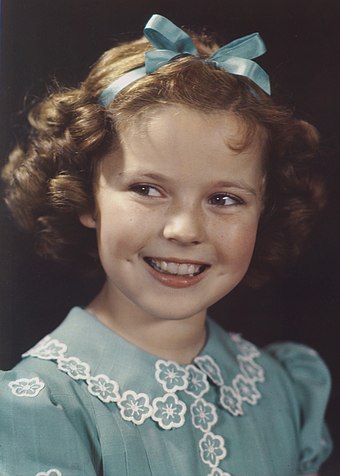
Despite the fact that I saw plenty of religious movies, the central figure of my wholesome childhood viewing was Shirley Temple. She loomed large at home and at school. We saw her movies at school at our first Friday film afternoons where the entire student body from first through ninth grade would gather. These were also shown on television on Saturday afternoons and my mother, a real devotee of Shirley’s, would watch those movies with us. We laughed and cried and “Awwwed” together. My mother could recite lines from these films that she remembered from seeing them in the movie theaters as a child and as a young adult.  She loved Shirley Temple; I could see the adoration in her eyes, and I think I wanted some of that unqualified enchantment.

Shirely Temple

She had everything on her side. She was undeniably and overwhelmingly cute. She danced and sang in an adorable little girl way. She pouted endearingly. She had a strong moral compass and consistently directed adults to do the good and better thing. She showed the path to joy through good wholesome living. Even if you were a misanthrope, you had to like this kid.  I remember feeling badly for boys because their role models seemed to be troublemakers from the Little Rascals, like Spanky, Alfalfa, and Buckwheat. 

I don’t ever remember thinking that Shirley and I could be friends. I don’t remember thinking that she’d be a nice sister to have. I liked all of my friends well enough and really loved my sister. But I watched her in overalls in Rebecca of Sunnybrook Farm and made a note that I had overalls, but I didn’t quite look as cute. What was it about this kid?  I saw her in so many movies with those killer banana curls. I had thick, black, nearly uncombable hair but earlier in my life, I had workable hair. Somehow that changed. Maybe, we lose our lovely baby hair like we do our baby teeth. My mother’s only attempt at hair styling was to cut my bangs short and let things fly.  To address my hair issue, my favorite aunt took me to the hairdressers in the first grade where Leona gave me a makeover in the form of a pixie cut. With a gap in my front teeth and a very short haircut, I was quickly running away from any chance of looking like Shirley Temple. I needed another strategy.

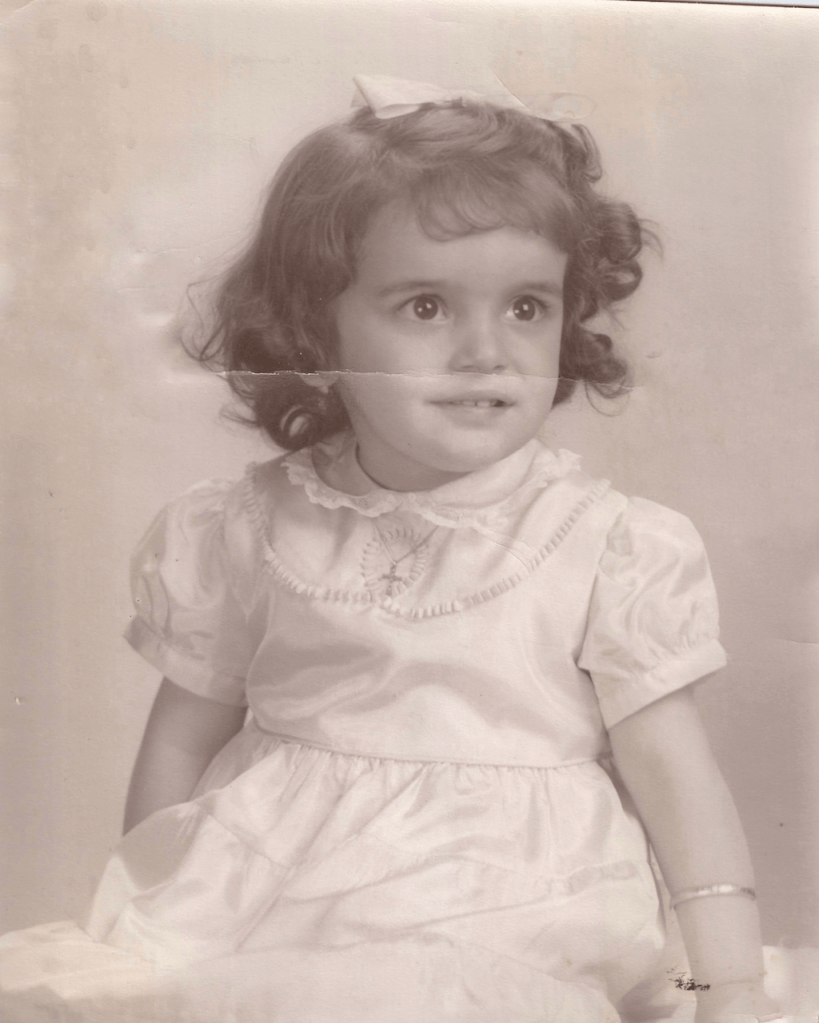
Me at three years old. The Shirley Temple influence is obvious.

I tried to sing like Shirley Temple and followed her steps closely when she tap-danced up and down a staircase. I tried to pout, swing my arm into a let’s-go-get-‘em pose, and say cute things like, “I’m very self-reliant”, which Shirley pronounced to the great delight of her elders in Rebecca of Sunnybrook Farm.  My obsession with Shirley reflected my mother’s. She clearly adored this little girl. I compared her object of adoration and her own regard of me, which was so full of ambiguity and restraint. I recently learned that films like The Little Colonel, The Littlest Rebel, Captain January, Bright Eyes, Curly Top, Poor Little Rich Girl, andSusannah of the Mounties were made between 1935 and 1938. They were full of messages about optimism, grit, resilience, and spunkiness. Adults in Shirley’s orbit are charmed by her to do the right thing, to change their lives toward the better, to raise money for good causes, and golly, to do whatever it took to keep this child happy.  

She is often without a family of her own. She is orphaned more frequently than any kid should be, but this gives her lots of chances to wheedle her way into the hearts of rich and poor, young and old, white, Black and Native American, the kindly and the grouchy. It is truly amazing. My Mom grew up during this time – in those years between the Depression and the Second World War. She may have embraced Shirley as a role model of sorts. She had six brothers and sister in an alcoholic home and was placed in an orphanage during the Depression at two or three years old when her parents couldn’t afford to keep her at home. Shirley Temple offered a glittering example of a charmed life. If the Gods could grant it, I would have loved to have been that child for my mother, but she very effectively resisted my charms for good reason. 

But to live in the shadow of this lovely golden child – to see her weekly on TV and often at school, gave me a model of what a child I could be. What about this little girl could I emulate? Or maybe that was a losing battle. Maybe, I could simply understand that Shirley Temple was my mother’s fairy tale, and I was too busy with my own stories to be diverted by this one for too many years. I grew out of love with Shirley Temple and set my sights on Annie Oakley, another hero of fifties television. 

My mother gave me the precious gift of not being so special

In our present culture, we seem oriented to believe that our children are special. Maybe that is a biological imperative. We want them to feel special all the time for everything they do. But I think children see through that pretense. They feel the deep fake in it. They are embarrassed when their parents present them as gifted and talented and better than their peers. On some level, children know differently.  They know the difference between careless praise and really accomplishing something for themselves. 

Although I think a brief study of the history of parenting would lead us to the discovery that our ideas about what children need from us are very much the product of this cultural moment. The history of childhood is a fascinating tale of the history of ourselves as a species. Even a generational change can make an enormous difference in the expectations for parents and children. This may be my nostalgia for my rosy-colored baby boomer childhood, but I am feeling very grateful for my mother’s parenting of us. She did a lot of this as a widow when my father died in an auto accident leaving her with three children – me, the oldest, at fourteen, my younger sister at twelve and my little brother at eight. My mother had no suspicion that any of her children were special in any way. It caused her not one sleepless night that we were perfectly average. And, she might argue that since no one is perfect, we were all actually averagely average. She would have found the idea that you are special just because you are you to be completely insane and especially wrongheaded when it came to raising children. I am inclined to be completely in her corner here. 

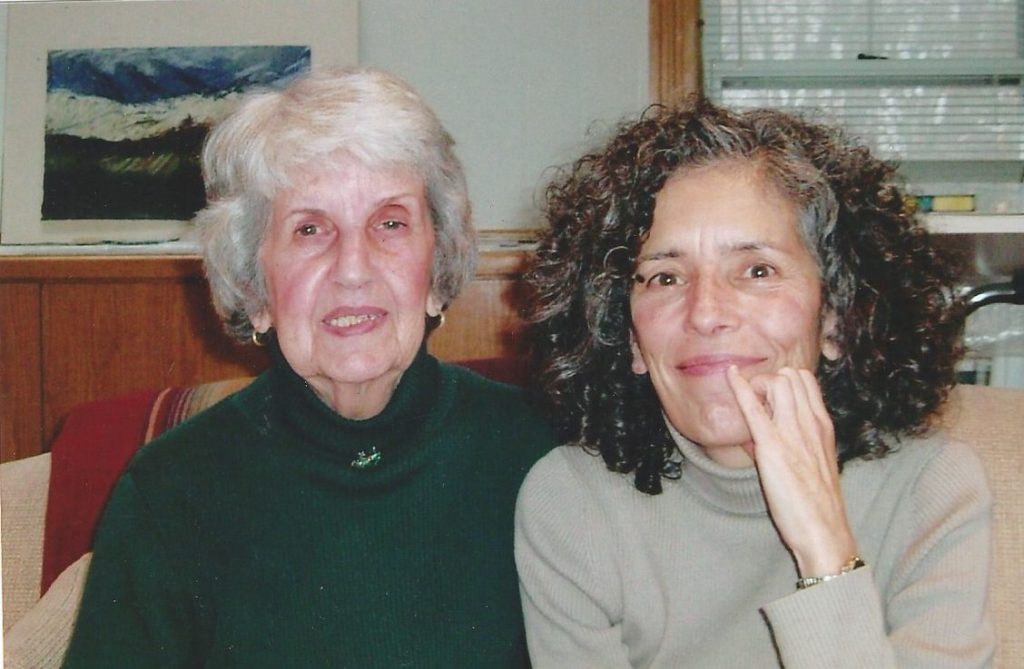
My mother and me

If no one tells you that you are special, that you are musical or artistic or beautiful or funny or smart or just really talented in any way, you are left to discover those things through your own exploration. Without those early and (perhaps) misleading observations about you from your parents and relatives and whomever wants to make such a comment, you are on your own to discover your people, your interests, and talents. You play guitar or basketball and go on long bikes, and you discover things about yourself without much parental support. My mother never attended one of my basketball games. I never sought her advice about pursuing a degree in college because she never had any sense that I would be particularly good at anything. When I did go to college, my mother bet the lady next door ten dollars that I wouldn’t last a semester. I never resented that wager when I learned about at the end of my freshmen year. Given her experience of not knowing anyone personally who had gone to college, she was imagining that college students were very smart, and that I certainly wasn’t. 

I worked in a series of factory jobs during the summers, many of which she was familiar with. She had worked in rubber and jewelry factories and knew very well the tedium of those jobs. She had friends who worked in these places, sometimes they were my bosses. I am pretty certain they told her I wasn’t showing much promise cutting huge pieces in rubber into rectangles to be glued onto to the bottoms of welcome mats; I might as well go to college. They may have also shared that the thing I was best at was reading a book. During coffee breaks and lunch, I found some refuge alone outdoors on a picnic bench to escape harassment and bullying as “college girl.” I didn’t feel so special there, either.  

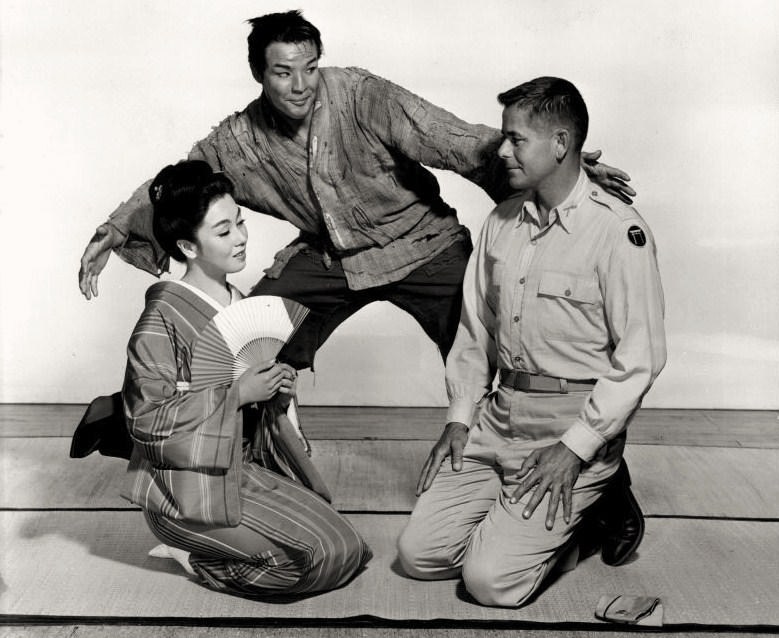
When I was elected class president in the ninth grade and rushed home to tell my mother, she responded. “Well, that’s nice. I am sure everyone in class will get their turn.” When I brought home good grades, she would nod and say, “That is good. You are doing your job studying. I think you could be studying more.”  Or when I was the star of the senior play, she was proud enough but wondered why it was I had to play the role of a man. (In my defense, I would have to say here that I attended an all-girls school and not just anyone in class could have made a convincing man by simply painting on a mustache.)  In fact, to toot my own horn here, I played the role of Sakini, the Okinawan interpreter, in Teahouse of the August Moon. The great Marlon Brando played that role in the movie of the same name to his great embarrassment I would imagine. Here he is.  I am very glad I didn’t see the movie before I played that role.

Marlon Brando as Sakini in Teahouse of the August Moon

When I was in the 10th grade, I saw an advertisement in thelocal newspaper for the Famous Writers School and sent away for the aptitude test. The premise here was that America needed a lot of writers and that by working with distinguished writers like Rod Serling, Faith Baldwin, Bennett Cerf and Phyllis McGinley, you could learn to write and make a big success of yourself. There is an interesting video on You Tube featuring Serling in a promotional piece.  I figured if I get into that correspondence school, maybe I could be a famous writer. But more importantly, maybe I could see if I had any talent. I did very well on the test which I recall asked the applicant to describe a scene prompted by a photo, write some complete some items that tested grammar and vocabulary. I don’t know how it happened, maybe it was because of my excellent test results, but a man came to our house and told my mother and me that I was indeed a very talented young person and could be a famous writer. I was so excited.  My mother not only doubted the test’s validity, she also zeroed in on true scheme behind his discovery of me as a young talent. 

I learned recently The Famous Writers School was actually a cover for a giant fraud. Most students did very well on the test and many signed contracts that they couldn’t escape from. If my Mom had any faith in all in my talent, we would have all been bamboozled. I can imagine many parents falling for such schemes today where their children’s TikTok videos may be used by some random “talent agent” as a key to swindle them out of their savings. Instead, my mother said to me and the salesman that we wouldn’t sign up for Famous Writers School. Rather, I would study harder and learn to learn to write at school where I was studying this every day away. No special talent to coddle here. Soon after he left, she wondered out loud, “what sort of people make a living by writing? What kind of work is that anyway?” 

I would also come home with dreams to be something I had heard about in school. One of my classmate’s fathers was a lawyer and that was her dream, too.  I asked her about that, and it seemed like a very interesting job to my seventh-grade self. When I told my mother, I thought I would like to a lawyer, she suggested I think of something else. “Don’t get your hopes up too high”, she would caution.  I came slowly to understand the source of this dissuasion. With the Great Depression and the Second World War, a difficult childhood and maybe a challenging marriage, she’d had plenty of dreams that went nowhere. Her possibilities were so constrained. My most successful relative was a foreman in a factory. I don’t think she could imagine the possibilities I might have. I didn’t realize those myself until my third year of college. 

My mother kept my self-image within tiny bounds, safely trimmed from getting in the way of others. And even though I attended Catholic school, her parenting set me for a Buddhist orientation to life.  I have never thought I was exceptional in any way. I think many of us set a goal or attach our hopes to a dream, like writing a book, or earning a PhD. Then, when you do, you learn that lots of average people do these things all the time. That is not to diminish the achievement, it is just to put it all in context.

The gift of those lessons from my mother was that suffered no heartbreak later in life when I recognized that I wasn’t so special after all. I wasn’t as smart as many of my classmates. I was never a great beauty. I was never one to stand out in a photograph or to turn heads when I entered a room. The great gift here is that you have to discover those talents by yourself. You can carve your own path which certainly will be a winding one. You find that in your seventies that great passion is music or theatre and that your long career and several paged resume hardly matters any longer.  It is mental furniture for another time and place. You find your specialness in the network of friends you have built around you, all indicators of who you really are. Maybe more self-aware. Maybe more aware of the natural world and the connections. Maybe appreciating your tiny place in the universe. 

The Lamentations of Santa

As the Gifter-in-Chief at Giving Beyond the Box, LLC, I hear from a lot of people who want our help in giving a gift that really matters to a loved one.  That means it has to matter to the person giving the gift and the one receiving it. And, in our case, it also has to do good in the world. I love these calls and emails because I can tell from how much the person I am communicating with loves and cares about the other person. A gift after all is a vector of love and appreciation. 

You can imagine my surprise when Santa Claus called just the week before Christmas, our busiest time of the year. Santa sounded defeated and overwhelmed. To use a term that is popular right now, Santa sounded like he was languishing. He put aside that jolly “Ho! Ho! Ho!” pretense and spoke frankly. 

As he was speaking, I was remembering how much Santa meant to me as a child and recalling that special magic that Santa made. I was late giving him up and resisting not believing in Santa for as long as I could but, I hadn’t really ever thought about the challenges and pressures that face him every year. What follows is my summary of what I am calling the Lamentations of Santa. This is what is keeping Santa up late at night. I am writing this both to document the situation and to appeal to my readers for help on Santa’s behalf.

Worries about the workforce. According to Santa, it is getting harder and harder to keep a dedicated and talented workforce of elves. Some young elves from families who have been in the elf business for generations are no longer interested in these careers. They want to go out and explore the world. That is understandable, of course. And in a moment of hard self-reflection, Santa has also come to recognize that there really is not much of a career path for elves. No elf has ever in the history of the world ever been a Santa. A critical elf recently told Santa that he ran his operation like a monarchy, not like a well-tuned modern organization where employees are treasured and given the flexibility and support to be, to be anything they wanted. So, like everyone, the North Pole is experiencing the Great Resignation, as well, with lots of elves becoming life coaches and baristas. How to replace that workforce remains a big challenge. 

Concerns about sustainability. There is no place more affected by climate than the polar ice caps where Santa lives. If the ice completely disappears, Santa’s Home is in danger to being wiped out. And, after planning his 2021 Christmas route, Santa calculated his carbon footprint and was horrified to learn what impact his travels all over the planet in one frenzied night had on the climate. He has concluded that this long-term practice of distributing gifts is simply no longer sustainable. Alternatives must be found which get us to our next issue.

The cage-free, free-range reindeer movement. As we all know, reindeer have pulled Santa’s sleigh since Santa first pioneered this whole gift-giving industry. However, with each passing year, Santa becomes more and more aware that his reindeer really belong out in the wild, not confined to his workshop, even though he treats them well and kindly. (He was slammed a few years ago by PITA but it is hard to keep them happy.) So, in the spring of 2022, Santa is releasing his herd of reindeer and replacing them with all-electric sleighs. Better for the reindeer and better for the environment, as well. 

Moving Diversity, Equity and Inclusion into the heart of operations. After attending some sensitivity trainings with other cultural icons, like the Easter Bunny, and Davy Crockett, Santa is having a moment of wokeness. Here is a direct quotation that really expresses his thinking here,

Whatever let me think that I, a white cisgendered man living in the global north, could really imagine what children all over the world really wanted for Christmas. This hegemonic approach truly reflects my unearned privilege in this position. It is way past time for me to share the limelight here and champion a whole new generation of Santas that reflect our diverse community and experiences. 

Santa has established a small advisory group, exploring regional distribution centers with culturally competent Santas. More to come here, for certain. We could be looking forward to Santas that upend our traditional model of what Santa should be. We may in fact see a wholescale revolution! The Lose-the-Lap Campaign popular on some social media sites is an early indication of changes we can anticipate. 

Mission drift and the commercialization of Christmas. While all these issues were important, the one that took up most of our conversation was about the true meaning of the holiday. Here, Santa was nearly in tears, regretting his role in making Christmas a delivery system for late-stage capitalism and the deification of corporate power. He argued that by asking children what they wanted for Christmas, he was simply falling into the hands of marketers, training children to be aggressive consumers from the first moment they sat on Santa’s lap to their dying wishes. The Santa brand was in serious trouble, he worried, in danger of becoming just another Ronald McDonald or Tony the Tiger or Kim Kardashian, a shill for big business and worthless products. So, Santa is working to reclaim the true meaning of the holiday in a campaign next year where he is refusing to deliver Amazon gift cards, overpriced toys, fast fashion, cocaine, and more. (You can read about the Santa’s Naughty List and can suggest other items to exclude on Santa’s webpage.) Santa wants you to shop local small businesses, to make some of your own gifts, and to truly share some of your wealth not with the already wealthy people but with others who could use your help. That would make Santa happy.  

So, in summary, Santa has lots on his plate. If you have ideas for him or would like to help in some way, please be in touch. You know that he reads your letters. Your own childhood proved that to be the case.   Merry Christmas!

The beauty of the beauticians

Let me say right off that I am not what people consider a classic beauty.  I have, despite my best efforts, been appreciated more for my wit and intelligence than loved for my beauty or body.  Not that I’ve resented this.  I remember my mother told me that it was a good idea to develop your mind because even if you were good-looking, it was very likely that your looks would fade with age. She neglected to tell me that even if you developed keen intelligence and a wonderful memory, chances are that these would fade with age as well. If you grew up in the sixties, you can hear your mother saying about your lovely average-looking friend, “Well, she has a lovely personality.” That always meant that the girl in question was a girl like me. I do have to admit that in my family anyway, we weren’t supposed to be beautiful. That was reserved for movie stars. I would hate to be young these days when your image is plastered on Instagram, posing for glamor shots at 10 years old when the pressure is on young women, especially, to be beautiful and desirable.

Those of us not endowed with classic looks spend the first thirty-five years aching to look like someone else and the next fifteen years searching for our own style. This roughly translates into trying make the best of the assets you have.  These are personal characteristics that are not recognized by the rest of the culture but of great comfort to one’s mothers and aunts.  For example, while good looks don’t run in my family, my mother and aunts applauded themselves for having very thick dark hair, none of that stringy blond stuff some women have to deal with.  We are also blessed with strong nails, a characteristic that I’ve used to attract legions of men to myside. And, best of all, we have very wide hips which make it very easy to us to carry children in our wombs.  My Aunt Mabel reminded me all the time that when she’s at the mall and sees

these slim girls with long legs and slender hips having babies, she pities them. Well, lucky me. 

So, in my fifties, I began to investigate my own personal style.  I did this very deliberately.  I stared at every one who might look a little bit like me and determined whether they looked better or worse than I did. My measure was very generous. If they looked worse, I maintained my haircut, style of dress and lack of makeup.  If they looked better, I try to catch them on another occasion and see if they still looked better.  If they did, it planted an idea in my head. Hmm. Maybe I needed a new haircut? A tattoo? Colored hair? 

Or I may have looked at old pictures of myself to see if I’ve ever looked better than I did then. This is an insane thing to in late middle age and can be a depressing experience. In my search, I found a picture of myself with a very short haircut and that idea of cutting my hair really short lingered in my mind. Mind you, this photo was of me when I was six years old with a pixie cut and missing front teeth in a class picture. My aunt had just kidnapped from school and taken me to my first haircut at a salon. She did this because managing my too curly hair was driving my mother insane. She was tearing her hair out because she was tearing out mine, trying to comb through it. So, with no solutions sight, no conditioner, no hair management tonic, the only thing was to chop my hair off. When she saw with this tiny little hairdo, my mother was outraged on the outside and delighted on the inside. It seemed that usually, she was the opposite, pleasant enough on the outside and raging within. 

So, with that image in my mind, I summoned up my courage, found a new stylist and resolved to get a really short do. I had to change stylists because my Beverly, my previous haircutter would never allow to me to do such a crazy thing at my age. Too radical! If it was awful, how would I show up at work? What would this do to my social life, to all of a sudden look like Joan of Arc on her way to the stake? Beverly was a worrier and my haircuts reflected that. Twenty years of the same style was enough. Time to go bold and beautiful! I could always wear a wig. 

So, I submitted myself to the whims and caprices of a 21-year-old beautician named Tami. A recent graduate of beauty school, I figured she would have state-of-the art training and be completely up to date with all the cosmetology literature.  All the women who were working at this new salon were about her age, and all spelled their names ending in ‘i’. That was a nice touch; it felt casual and cute. Tami and her fellow stylists were wonderful because even though I was a college professor from a very good school, had won several awards and published well reviewed books, she clearly held the floor, decidedly more confident and more knowledgeable about life and beauty that I would ever have been.  

I entered the salon Hair Today and checked in the front desk. By the looks of the receptionist, I was clearly underdressed and undergroomed for an appointment. I had the feeling I should have entered through the emergency room or the back door which they reserved for hopeless cases. Nonetheless, we agreed that I was there for a cut and styling; the receptionist was clearly thinking, “Coloring. Highlights. Eyebrows. Make up. Facial mask. Manicure. Surgery is not out of the question.” She waved me into the waiting room.

I sat patiently waiting for Tami. She eventually called me to her chair and clicked the cape around my shoulders. I looked at myself in the mirror, with that big mass of hair, unruly and unkempt, curly and a bit of grey. She asked, “So what are we doing today?” Before I could answer, she pulled my hair back closer my head and then up and asked, “Let’s try this, shall we?” I had no idea. She came around to look at me from the front with a clump of my hair still in her hands and nodded, “This will be wonderful.” I nodded too, putting myself completely into her hands. I was wheeled into the shampoo bay where I got some important information about shampooing just my scalp, not my hair, about harsh detergents in the shampoo I was using at home and how I’d been neglecting my grey hair. How do these young people know so much? Why didn’t I learn any of this in college? 

After my hair was treated with something God made on the first day of Creation so it wouldn’t be contaminated by other things, we returned to the stool where the clipping began.  Well, after thirty minutes of intense clipping, my face began to emerge.  This was frightening enough, but soon after, my neck began to surface, bare to the world.  And, before I knew it, I had a new haircut, a radical pruning down of a concealing canopy of hair. I commented throughout the session while she was trying to concentrate. I tried to ask questions that would help guide her in a Socratic way.  “Do you feel this is a bit much”, I asked? She just smiled. She told me to let her know immediately if I crossed my legs. She would stop cutting right away.  She informed me that this sort of careless action could cut the line right out of the haircut.  She warned me that it would be readily apparent to anybody that saw me that I had a very crooked haircut. She wanted no part of that. Besides, she said, her mother got varicose veins from crossing her legs.  I guess she had me pegged.  I nearly did it a couple of times but was too terrified of the consequences.

So, ninety minutes later, I emerged with a biodegradable bottle of biodegradable gel and a little cap of a haircut.  With a great short haircut, I really saw the shape of was skull. It was very reassuring and comforting to rub my nearly bald head. Many of my friends asked for that opportunity; other people just rubbed my head for luck, I thought.

 Overall, the haircut was a great success.  One man at work came up and said to me that if my boyfriend didn’t take me to a fancy restaurant and dancing and that if he didn’t tell me how gorgeous I was, I should dump him immediately.  Then, he wanted to know if I was married.  Every time, he passed my desk, he whistled but, his whistles sounded like bird calls.  

And, everyone else has been just as complimentary.  One woman told me it was the best thing I could have done. Quite an assessment. So, Tami was right on target. She led me to the promised land of a great haircut entirely out of my own comfort range. Even now at the age of seventy-two, I think, maybe it’s time to go see Tami again. She’d be middle-aged by now, probably still a genius.   

Shop Good for Goodness Sake!


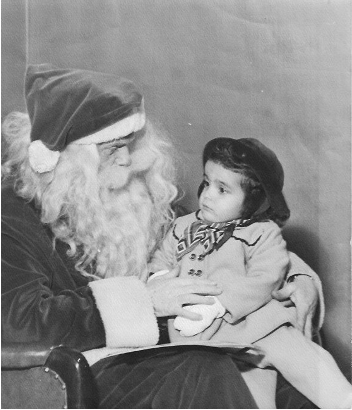
Here is a picture of me at two or three years old. I am sitting on Santa Claus’s lap. I am wearing a lovely little coat with a velveteen collar. This is a hand-me-down from one of my better-dressed cousins. My sister and I wore lots of these clothes and passed them on to other cousins. Like many working-class families of the time, we had an internal barter system that kept us with few pieces of clothing in our individual closets but with access to an ever-changing wardrobe of used clothes. I loved that coat and took care of it while it was in my care.  I am also wearing a little hat and carefully tied scarf.  I was so much better dressed when my mother was in charge than I am now. But my outfit is not what draws my attention, rather, it is the expression on my face. 

Santa has introduced himself. He has been told my name and engages me in a typical holiday conversation. He knows the script and I have been briefed by my parents.

Santa: So, Sandy, Santa wants to know. Have you’ve been good this year?

Little Sandy Lee: Gosh, Santa. “Good” sounds to be me like an end state and how can that happen in human beings who are always changing?  This year, I would call myself “goodish.” 

Santa: Well, sure, that’s a fine point to make but I am sort of busy here. Little girl, what do you want for Christmas?

As I take in that photo, I am wondering how hard Santa and my parents may have worked to make me smile. I appear to be in a meditative mood. How was I to know what I want? Even at the age of 72, I am still pondering that big question. What do I want? I see a child that is perplexed. Why ask me what I want? Aren’t my parents in charge of knowing what I want? Besides, decisiveness has never been my strong suit and as the Buddha teaching, wanting is a sure path to suffering. 

So, I reply,


Little Sandy Lee: Oh, don’t worry about me, Santa. My Mom and Dad have that covered. I’ll get more than I want. They’ll be clothes and candy and toys and if I am lucky, there will be some empty cartons to play with.

Santa: So, if you don’t want anything, why the visit today? You are not just wasting my time, are you? There are millions of children in China who would love to be sitting on this lap.

Little Sandy Lee:  No, Santa. I really need your advice. I know that I am an over-indulged child and I live a life of ease. I don’t even have a job and although I’ve begged to have some chores to do my parents say I am way too young. Next year when I am four, that’s when opportunities will emerge. 

Well, Santa, what I really want is to get some gifts for the people I love who care about the planet, the empowerment of women and social justice.  I want to give some gifts that mean something. Do you know what I mean, oh, wise one? 

Santa: Oh! I get it. Gifts that make social impact? What about Giving Beyond the Box? They have gift boxes full of products with meaning and purpose. 

Little Sandy Lee: Wow! That would be perfect. And isn’t it true that you can’t buy their boxes on Amazon and that tiny little company is run by an overly energetic septuagenarian?

Santa: That is exactly right on both counts! Giving Beyond the Box is a tiny company in a tiny state run by a small woman who is old enough to be your great grandmother. Check them out as soon as the internet is invented.  That will be in about fifty years. Your time is nearly up. Anything else?

Little Sandy Lee. No, thanks, Santa. No wonder we all believe in you. Next time, however, can we talk about your carbon footprint, your treatment of those caged reindeer, whether elves are really contract workers or employees, and whether you are help to create children addicted to hyper-consumerism?  

Merry Christmas, Santa!

Still no smile. 

Lessons my father would have taught me had he lived

I thought about writing this essay as I was trying to figure out some mechanical problem. At home, I happily tackle nearly every problem—plumbing, electrical, digital–despite not ever knowing what I am doing. This attitude distinguishes this part of my life from most of my other experiences where I don’t try my hand unless I am nearly an expert. I think I picked this up from academic training where you learn to deny your interest in anything but your own area. Friends ask my opinion about all sorts of things and I can always defer, “I am sorry to say that is really outside my area.” This doesn’t work when we are trying to figure where to go for dinner but it works in lots of other areas, especially with other academics.


In hacking the repair of a broken ceiling fan, I was thinking about all the wisdom and know-how that my father may have passed on if he lived past the age of 45. When he died, I was 14 years of age and he was right in the middle of teaching me to be a caring respectful and contributing adult. For me, his oldest daughter, he held high expectations for my character. He could have cared less about other things I could have achieved. I wonder if I would have held the same ideals in place for my own children.

Lesson #1 Fix things
So, my willingness to tackle these projects can be traced, I think, to playing around in our cellar where my father’s tools were randomly gathered. He never had any nicely arrayed selection of screwdrivers, saws and hammers. In fact, I don’t think we ever asked permission to use his tools, or take odd pieces of pipe and plywood. We were never asked to put things back where we found them as well and I am imagining that my father must have run over plenty of these tools when he was mowing the lawn. But certainly as I think about it, had he lived and had I asked, I am quite certain he would have taught me how to fix a washing machine agitator. He already taught me how to build a motor and to understand the armature and the magnetism of the electric current through the metal bars.
He has also taught us how to mount an old lawn mower motor on a chassis so we could make a go-cart. I remember playing with the spark plug. This was all great fun. I don’t remember my mother ever warning my father that we could hurt (Our first go-cart didn’t have brakes.) This all makes me think that I would have been miserable under this current regime of parenting.
We also build a miniature golf course, digging up holes in the lawn and adding sand traps and water features. We used saws and hammers and nail and string and whatever we could find. We would regularly send divots sailing through the air, borrowing my father’s clubs and ripping up the lawn, Once again; he seemed not to mind at all—the lawn or the golf clubs. It was as if we could do anything we wanted as long as we were busy and learning things and not just hanging around. He was at the heart of him, a hacker. Someone who would apply a temporary fix and be happy with it. So from him in observation and in instruction, I learned to work with my hands and to fix things that I could. Part of this, I am certain, were the requirements of being working class. Calling in a repairman to fix the toilet is out of the question. It compromises your manhood and working class resilience.

Lesson #2 Being a man

My father was a veteran of World War II. He was a lace weaver early in this working life. I recently learned from the Census data that his birth year was estimated to be 1919. We thought it was 1917 or 1918 and his birthdate the 17th or 18th of August. It seems odd to me that much of this is unconfirmed. As a man who married late (30 years or so) maybe because of the war, maybe because he didn’t want to settle down, he was a father quickly About eleven months after they married I was born, a baby girl, when maybe a boy would have been more welcome, although I never felt like that. I think in his expectations for his children, my father couldn’t tell his sons from his daughters. We could all play baseball and drive the go-cart. He could all be good in school. We could all be crazy and silly.

My father taught me how to be a man. I considered that he was out in the world, doing things and fixing things and helping people and making money and I wanted that. I had no interest in cooking and sewing and being in the house when all the action was outside. He was to me what people in the fifties would call a “stand-up” guy, the sort of man who did the right thing, who honored his obligations and kept his word. I wanted that, too. I didn’t want to be liked in school but I did want to do the right thing. From an immigrant family with a tradition of working the fields, he distrusted money made in other ways. He urged me to save my money to buy a house as quickly as I could and to avoid the rigged rich man’s game—the stock market. He was constantly busy. I never recall him sitting with a book, except when we were on his lap and he was reading a story. As a man, he was different from any of the men on our block. He obviously loved children, loved their play, and admired their imagination. That went for all kids. While it may have been a manly thing to assign all of this to older siblings or to the women, my father dove right it. What kind of man did that? When I think about his tools, his golf clubs, his ceremonial sword from the Philippines, a cellar full of the body of washing machines, tubes of mercury and vials of oils and grease—all were available to us. In retrospect, I think, my gosh what a generous adult. What an embrace of our creativity and curiosity.  What sort of dangers did he leave for us to discover? Did we need more protection?


Lesson #3 Being a stand-up guy

And, he was the rare individual who could find a lonely person in a crowd and seek them out for company. Even though, he could be the life of the party and the center of attention—which he never sought. In this part of this personality, he was everything I wanted to be. A few months before he died, we went to the 9th grade father-daughter dance and he made a point of dancing with all the girls whose fathers were sitting things out. I asked him about this and he told me—in a moment that I still see in my mind’s eye, that like him, I could spot loneliness and sadness and when I did (and because I could) I was obligated to do something to ease that pain. I don’t know how his friends regarded him but I know he was a good man, always willing to lend a hand. I see much of him in my brother and his generosity and in this kindness to his children and to people in general. I remember as well how many times aunts and uncles would tell how much I would miss him and how much he loved us. Maybe, that is what one says to children whose father has passed away suddenly. I read it, however, as a sincere concern because he made it clear how much we loved us.

Lesson #4 The excitement of the tiny

I cannot look back and take an honest look at our income and expenses. I really don’t know how much my parents struggled over money. I know that my mother would have imposed a budget on my father’s spending and drinking if she could have. We lived in a house that they owned but it constantly needed repair. That wore on her; he was more relaxed about that and everything else. I share his tendency to put off addressing issues until I have to and her anxiety about things precipitously falling apart. He dreamed of living on a farm and for a while he had rabbits. I think he had other dreams for us as well. My mother, I think, dreamed of not having so much to attend to and not carrying so much of the burden of feeling not up to any of the tasks that presented themselves. Whenever we asked her what she wanted for Mother’s Day or Christmas, she always said, “Peace and quiet,” which we could never give her.

But the dreams of a farm, the possibility of a great vacation, like trips for ice cream—everything was more fun when my father was around. We would bring us snacks when he came home from the bar he used to frequent. He would be inordinately excited about this. He would buy the latest toy and happily try it out with us. I am doing my best to remember that lesson. With aging and aging friends and anticipating the next few decades, I find my mind more occupied by my mother’s perspectives than my fathers—more about loss and anxiety and less about fun and possibilities and living for today.


Lessons #5 Lessons about lessons

One could note that all of these lessons may be seen through rose-colored glasses. Maybe, I would have fought with him. Maybe, he would have placed obstacles in the path of college or VISTA or graduate school. Maybe, my coming out in my thirties would have been delayed until he passed away. None of this is knowable, of course. So, I do my best to piece this all together with remnants of memories, like any storyteller, fashioning one plot or the other. It seems that we would all be better off if parents would write letters to their children to answer questions that the children won’t raise until after they are dead. This wouldn’t have to be long detailed accountings of their lives but they would set forth the big questions and the big answers. To know so little about our parents and their parents is to showcase the unfortunate and existential fact of generational developments. We can hardly make sense of the present and can scarcely understand the generation that follows us, even though we were just so recently in their shoes—in the midst of building a career, carving out an identity, obsessed with raising children.

So these lessons that I am taking from my father are my own markings of his legacy. I am quite that there is plenty left on the cutting room floor and even more that I have so incorporated into my core identity that I can tell his influence apart from my own thoughts.

The courage of children

My pretty enough mother was always worried that we, her children, would have large noses. She would point to her own and my father’s as examples of noses that were simply too big. It seemed, however, that with sufficient and sturdy conviction, she and we could will these away. And, as fate and faith would have it, my sister, brother, and I are blessed with average, nearly admirable noses.

She also despised the color of her eyes, calling them yellow––“Cat’s eyes, they are.” I would stare at her as long as I comfortably could to get a good look but she would catch me and I’d have to quickly swing away my gaze. When I did sneak a look, I didn’t see the yellow at all. I saw brown which was the only color those nice people at Motor Vehicles would let her put on her driver’s license. To this day, I don’t know where she got this idea.

My mother was a devoted fan of blue eyes. She could list a whole series of notable and smart people she knew with blue eyes and for a while I thought that we would be blessed with these someday, as well. I thought this despite the fact that all my cousins, my aunts and uncles––all of them with very few exceptions––had dark brown eyes. I just suspected that if we prayed hard enough, the treasure of blue eyes would be ours.

Our parents sent us to an Irish Catholic grammar school even though we were descended from French-Canadian and Portuguese-Azorean stock. My sister and I have talked about this, about how strange we felt in this school. We were dark-skinned compared to our little Irish friends in this school which took its Irishness seriously. A child did not have to be Irish to attend this school. A devout Catholic family or a family that was headed in that direction was all that was required. My mother made it clear to the principal that she wouldn’t mind being Irish herself. This was decades before a child could be proud of her ethnicity and could demand accommodations for culture, language and customs. This was an era where we child considered the foods we ate at home and the festivals their parents dragged us to an embarrassment. At St. James, we sang Irish songs, spent a week celebrating St. Patrick’s Day, learned the jig, and brought home Irish culture–whatever that was. In the mid-1950s, it was as good as any other heritage and as disposable, for the most part. Our parents laid their Americaness like a thick blanket over their nationalities––intending to suffocate it for good. My father fought in World War II and taught us the lessons he learned from that conflict. American people were heroic. As Americans, it was in our nature to know and do the good and noble thing. We were blessed to be American and doubly blessed to be Catholic and American.

These were the chief lessons of our eight years at St. James. The blessed good fortune of all this was weighed heavily with the awesome responsibility of being a good Catholic uniformschild. Even now, four decades later, the language of this formation–grace, blessings, contrition, penance–remains like scaffolding in my brain and in vocabularly, even though I have attempted to destroy and expunge it many times. A good Catholic child lived in two places­­––in the real world full of temptation and in the temple of the Holy Spirit. We children easily comprehended the architecture of faith, enormously difficult for men of God to explain. We learned all this complexity easily, the way French children breeze their way through verb tenses that elude college graduates.

We learned this arcanum readily because it provided a clear way to understand the world. Children seek clarity and order. They struggle against it, of course, by asking questions to see if this adult-given explanation makes sense and is compatible with their own developing stories about the world. But, as they bang their wills against the rules, they learn the boundaries of their adventures and just how far adults will let them go. The 1950s in the Catholic Church were a stark testament to this fact. Without benefit of referred journals, supported research, conferences, government grants or other artifacts, our teachers––all nuns. Sisters of Mercy––created an intact, tightly woven, bullet proof method of teaching us things that we would remember forever.

Of course, the habits they wore made them both strange and fearsome, as well as comforting and familiar. Long black robes, rosary beads worn like large necklaces, black shoes and stockings. Their faces were completely framed by a starched wimple at their foreheads, which wrapped around their heads, set off with a stiff bib that stretched over their bodices, nearly reaching their waists. We learned to read a subtle body language. It wasn’t much beyond second grade when we knew what they were all about. But, their real power spun around their knowledge of what we children we all about. Our mothers th-1 warned us against wrongdoing, as all mothers will and used as ammunition the fact that no matter where we were, what we were doing, they would know. We could get away with nothing. This served as a magnificent check on our behavior, especially for the girls. But, even more powerful that our mothers’ omnipresence was the specter of the nuns as representatives of God who was truly all being, all seeing, all there and everywhere. And the Sisters, as his lookouts and lieutenants, could not only see around corners and under desktops, but could detect a whisper when you didn’t even know you were talking. They could not only see, hear, and smell what you could be sensed––they could also peer into our beings, see our wretched little souls and examine the sins we might be entertaining in our lack of grace and prayer.

Although we were very young, only six or seven years old, we were sorely tested by the devil and his workers. We faced daily temptations like calling each other bad names, dishonoring our parents, failing to bow our heads and recite the requisite prayers, and having impure thoughts. But being good was only half of the challenge. Important as the commandments and Catechism was a duty to suffer for our faith.

On selected Friday afternoons, we watched films in the school basement. The older students set up rows of folding chairs and we sat with our classmates in our assigned seats. We were led quietly downstairs and were not to speak with each other or with members of other classes. We paid a small fee to see movies like Cheaper by the Dozen, Rebecca of Sunnybrook Farm, Heidi, and the like. We also watched religious movies about the miracle at Fatima and the stories of saints. We were supposed to pick up lessons from these movies. It was a new media-savvy way to reach the young barbarians.

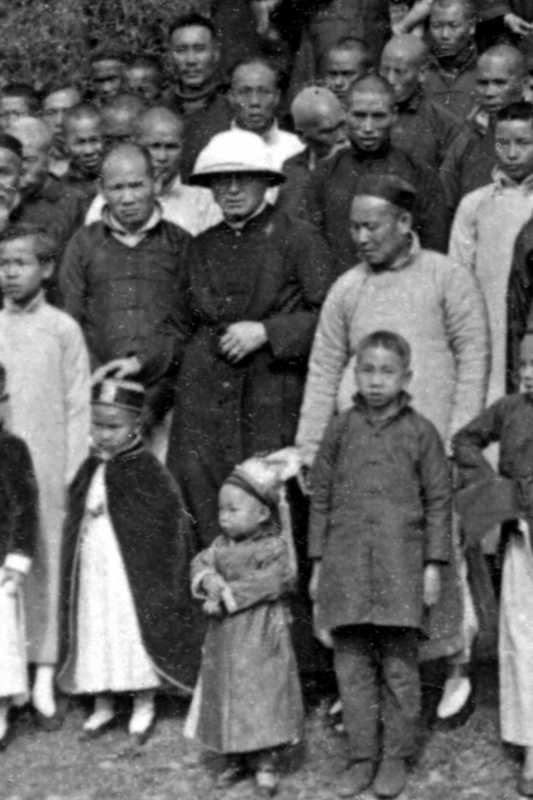
During missionary season when the parish was visited by a priest, brother or nun who had been converting the heathens in poor countries, we would watch black and white films of the missionaries at work. I clearly remember a movie about a Maryknoll brother and the work he was doing he was doing to bring Christ to the pagans in China. In this movie, an army of Chinese peasants surrounded a tall, strong, dark-haired Maryknoll in a black cassock. They carried sticks, waving them angrily above their heads. and marching CO-FOUNDER OF MARYKNOLL FATHERS AND BROTHERS PICTURED IN CHINA IN 1918in a circle around the priest on a dusty barren hilltop. His head was bowed and his hands were tied behind him. The film was very grainy and the camera seemed to jump around. The narrator spoke deliberately about the priest and his devotion to God, how he had not betrayed his faith despite being tortured to renounce Jesus. The crowd led him up the hill where a wooden cross stood. I cannot remember if the film showed the priest on the cross but to the mind of a second grade, it seemed like this would be next step in the story.  I remember that we were terrified and that some of us were crying.
We walked back to our second grade classroom saddened and silent, filing quietly into our seats. When Sister Frances stood at her desk, she placed the small tin missionary box on a student’s desk. On these Fridays, we were told to bring in a donation for the missions. The children who had spent their money on candy and treats at lunch sunk in their seats, their souls stained with the sin of greed and filled with regret. They quickly passed the can over a shoulder without looking at it. Children, who had saved their money, shook the can, loudly clanged in their nickels and passed it back with a smug look of victory on their faces. We were warned against this sin, a demonstration of pride, but some of us could not help ourselves. The nun pretended not to notice all this and busied herself with an attendance chart or something on her desk. After the bank made its way around the room, we placed our hands on our desk in anticipation of the last lesson of the day and homework for the weekend. Instead, she spoke about the film and about the beautiful sacrifice that was only available to God’s chosen people. She told us about courage and the importance of living our lives as children in Christ. “Denying the Lord is the very worst sin you can commit, children. You have been blessed to be born in the Faith.” We had heard this many times and took it seriously.

Then she asked, “How many of you are willing to die for your faith?” Our hands shot up as fast as they could. The boys yelled out, “Me, Sister! Me, Sister”, competing with each other to be the first to be sacrificed. The girls were quieter, polite, stretching our arms, waving them to catch her attention. She had us. We were all going to be martyrs and saints!

No child hesitated and said, “Excuse me, Sister, I will have to ask my parents.” No child asked, “Can you tell me when I will die and if it will hurt a lot?”

We were ready to go, happy to, in fact. Today, I try to put myself in that teacher’s place and I think, “Oh, my God, they are ready to go wherever we will take them! Do they know what they are saying? Do I know what I am asking?” And, I think, “What kind of game is this nun playing? What a crazy insane thing to ask a child!”

I also consider other parts of this scene. I think about being in the first row, third seat down, a member of the top reading group, looking at the other students so eager to die for Christ, feeling very grown up. I was proud of making this courageous and correct decision on my own. This was my way to certain sainthood. There were other paths, of course, but this was offered in a manner that we could understand. It was compelling and seductive. Being slaughtered by a pagan because we refused to renounce the Holy, Catholic, and Apostolic Church seemed noble and good. I don’t remember a second of doubt. I filed away this promise to die for my faith expecting that the good Sister would inform the proper authorities when the time came for me to go, to be crucified, burned at the stake, buried alive or otherwise disposed of in the most gruesome manner.

Perhaps, children at that time were more susceptible to adult direction. Perhaps, adults were less careful about the terrors they willingly placed in the paths of children. Perhaps, both contributed to our growing up terrified, not of the man next door, or the predator down the street, or the gun toting madman at the fast food restaurant––but of large, mysterious things, like the heathen anti-Christs, communism, and polio.

And, of course, we were frightened by the atomic bomb. We did exercises in school, practicing in the event of an attack by the Russians. Sirens would go off and we would file into the fallout shelter at school. We asked the nuns where our parents would go when the bomb went off and they comforted us by reminding us that our parents could take care of themselves. I worried that my father who drove a service truck around the state would not be able to remember the location of each and every fallout shelter when the bomb fell. It seemed to me that he was always in danger.

At the distance of almost fifty years, I can see clearly how children are trapped by the fears of they adults they grow up with. Our own terrors create demons for them to avoid. Children can put off some of these fears to parental weirdness, but others resonate for a long time. When the whole culture creates and animates these bogeymen, children must take heed. They must take cover and run.

In addition to warning us away from big noses and wishing us blue eyes and lighter skin, my mother also guarded us against profligacy, against pride and gloating, against being too pretty, too smart, too anything, lest this draw the attention of God and engage his punishments. Sometimes, I wonder what terrors and frights I would have instilled in my own children had I given birth.

It seems that children survive childhood by creating play and joy to counter the admonitions and fears visited upon them by their parents and teachers. Sometimes they do this deliberately. They cannot figure out why adults are not happier than they are. So, they act silly. They giggle. They try to entertain and distract us. At least for a time, children face their parents without fear, with abiding trust, with the assumption that they are loved and lovable. Although we adults think we are amusing and comforting our children, it is, in fact, the exact reverse. The truth is that children assure us as their caretakers. Children enter a world that we have created and they begin to build it again, weighing all that we have taught them and tossing off what seems wrong headed and mean spirited. And so, a seven-year old can pledge her faith in afternoon, take her teaspoon of cod liver oil at night, bite her tongue when someone calls her a bad name, and still sneak a book to bed at night when she is supposed to be asleep. She can read this book of stories about St. Dom Bosco, who juggled for Jesus, and about Saint Theresa, the Little Flower, who would rather die than entertain impure thoughts. She can try to make sense of those tales of childhood heroics. And, she can struggle to be a model of virtue while scheming to avoid detection and punishment from vigilant adults.

And in these conflicts, children work things out. They soon understand that there is the world that adults would like them to fashion, where you as a child are kinder, more forgiving, more tender, and wiser than the adults guiding you. And, very quickly, children take their own counsel and assemble their own views of the world, their own stories that set them apart from the place their parents know the world to be.