Announcement New of Policies from British Airways: The Regulation of Seat Behavior


It has come to our attention that as the size of passenger seats has declined that the number of complaints about passenger behavior in those seats has increased. While not rising to the level of a terrorist threat, these complaints have been the subject of an inquiry by Her Majesty’s Commission on Good Order in Seats under the Dominion of the Empire.  Accordingly, today, we are issuing draft regulations that we hope do make our expectations clear about the right order and decorum in the passenger seats. Such regulations only apply to the leisure traveler and neither to those in business nor first class where order appears to be maintained by a more genteel breeding. The timing of these regulations is a matter of urgency as increasing numbers of people all over the globe are turning to the British for guidance in these troubled times on matters of decorum and manners. How else to explain the popularity of Downton Abbey?  We British simply have the market concerned on civility and good manners, despite some recent high jinks in the royal family. These simple rules can surely return to the plane cabin some of the glamour of jet travel that existed before too many people could afford to fly.

Rule #1

The arm rest

In a typical seating arrangement on a flight, there are fewer armrests that there are arms. For example, for a three-seat wing accommodating three passengers with two arms each, we would expect six armrests. However, to save money, the airlines install only four armrests, leaving an undercount of two. This is not our fault; register a complaint with Boeing and Airbus. This shortage requires that EVERYONE share. The occupant of the middle seat bears this especial burden since that individual has no armrest of his own. Despite a common belief, the first person to arrive in the seats has no right, under national law or Geneva Convention, to claim the armrest as his. Neither does membership within a racial group or religious organization constitute such a claim. Similarly, the larger arms found on most men does not bestow upon them any endowed right to the armrest. It is our policy that all the arms of our travelers have equal call and claim to armrests.  Accordingly, a timing device has been installed. A small really negligible electric shock will be administered every ten minutes to assure proper sharing of the armrest. In the event that this fails to move the recalcitrant resistant arm, the cabin attendant can adjust the current. Technology has evolved to allow this system to work efficiently and effectively.

Rule #2

The rightful allotment of seat space and its environs

Contrary to U.S. law on this issue, British law and custom argue for a circumscribed space that is purchased with a standard airline ticket. In other words, under the British system, one buys his seat but that does not allow one to claim the penumbra around the seat. This stands in opposition to American jurisprudence and practice which suggests that it is not only one’s seat that one is purchasing but the area around and into the other’s seat if one is big and pushy enough. Clearly, we see the American doctrine of Manifest Destiny still rules the American traveler. Our seats are NOT selected to accommodate your specific height and weight. For that, you buy a wet suit. Our seats perfectly fit the average male in Great Britain (determined by the British census of 1920) and so should fit women as well. 

Overwhelmed by complaints from passengers that other passengers were taking up more than their fair share of breathable air and seat real estate, we are hereby providing enhanced procedures. A passenger may request from the cabin attendant a PROOD, a passenger-restrain-of-other-device. This instrument fits in between seats in accordance with British law on property and boundary rights on an aircraft.  A full-body version can also be requested to guard against passengers whose body frame leaks into another’s as well as those passengers who fall asleep with their heads on the shoulders of strangers.  Such activity is seriously disapproved by this airline. 

Rule #3

General communication protocols

It should be noted early in this paragraph that we were one of the earliest airlines to accommodate digital devices in our cabins. This is despite our deepest reservations that this move would lead to a further diminution of civility and correct behavior. We had expected nothing better than the worst that has emerged.  We have waited as long as we could before issuing guidelines.       

  • To game players. Despite the fact that you have your earphones on, the rest of us can hear the guns, the shouts, the senseless music, the crashing cars. Please lower the volume or risk having your gaming device tased on our armed staff. 
  • To the viewers of pornography, this should be done in your home, in your bedroom, if at all. Our cabins are full of children and people of good taste who really have no need to see what turns you on.  
  • To traveling salesmen. Do not coyly bring up your latest website so you can cleverly poke your neighbor in the ribs, saying “Oh, man. Look what the IT guys have done. Our next Turbo Filter looks awesome. It replaces the older mode.” Blah. Blah. No one cares.
  • To grandparents. Only one person on the plane wants to see hundreds of pictures of your grandchild and that person has just locked himself in the restroom after seeing hundreds of pictures of someone else’s grandkids.

Our overall advice: keep to yourself. Pretend you are carrying state secrets and imagine that this is the case for your seatmate, as well. Imagine that he will have to kill you if he reveals anything at all to you. Who knows? It may be true.  

Enjoy the flight. The cabin attendants will be serving refreshments if they think you deserve them. Thanks for flying British Air.
Do You Believe in Magic? An Older Woman’s Brush with Beauty. 4 of 6 essays for writing prompts

I came from a family where wearing makeup and caring much about one’s appearance was frowned upon and considered vain. I knew that I was not a great beauty. I was one of those “she has such a nice personality” girls, encouraged by my mother to develop my brain and housekeeping skills because youthful good looks wouldn’t last forever. She failed to tell me that my brain and housekeeping skills would also fade with time. (Thank goodness for the latter.)

I successfully resisted makeup and even paying much attention to my appearance until much later in life. Then I relented in my early seventies. Maybe it was my very pretty dermatologist. We had tried lotions and cremes for aging spots, and nothing worked. One day, she suggested a chemical peel. The results sounded promising. Clear skin! My heart swelled with expectation. I remembered what Charles Revson, the founder of Revlon, said about the cosmetic industry. “We don’t sell lipsticks. We sell dreams.” Or “Perfume is made in the factory, ‘hope’ is sold in the store.” So, I bit the bullet, believing in magic. The promise, dream, and hope of a better me. 

Even after bottle after bottle and tube after tube fails to make us beautiful, we again and again put our faith in the magic of potions and creams and procedures, resting on a shaky foundation of that improbable fix.

I signed for the least intrusive chemical peel, as I called it, the baby peel. My lovely dermatologist and her aide prepped me with alcohol and brushed the peeling agent over my face, paying special attention to the darkest areas. The whole thing took less than thirty minutes. I went home with discharge instructions and suggestions to stay out of the sun and take it easy. I should be back to normal with some redness in just a few days. Imagine that!

The discharge instructions and the calm counsel from my dermatologist were completely inadequate for what followed, like the instructions that Marie Antoinette might have gotten before her beheading, “You feel a sharp pinch in your neck that will end quickly, and you will fall into a deep state of rest and relaxation.”  Follow-up instructions generally fail to describe what really happens in post-surgical recovery. Doctors are woefully inadequate in describing pain. Maybe, they figure no one would sign up for any surgery if they told the truth or maybe they resolve to leave the theatrics to the fiction writers of the world. If I wanted to really know the truth about a chemical peel, I could watch a Lifetime movie.

I resolved to catalog my agony and suffering. I took photographs and maintained a log. I have had several surgeries, some quite serious and nothing was as painful as this. I was actually crying in the anguish that I had gone through this suffering for vanity and nothing else – my punishment for believing in magic.

In the follow up visit to the pretty dermatologist, I am eager to share my misery. I have photographic evidence on my phone and paper documentation. However, before I can answer her question, “So, how was the recovery?”, she interrupts, looks kindly at me, and says “Horrible, right?” I nod in disbelief. All that was normal? I suggest to her that she needs to rewrite the discharge materials to more accurately describe the burning, the tightness in face, the frightening peeling of the skin.  

 Before she can disagree, I begin, “Here’s my version, Doctor.”

First, they pour acid on your face. 

Then your skin lifts off your face and dies right in your hands. 

Then your face burns no matter what you do. 

It will seem that the procedure has gone completely wrong but that is entirely normal.

And please don’t sneeze because we have no idea what will happen. 

Clinical results will vary.

We suggest that your loved ones take a short trip while you are recovering because some partners may suffer from nightmares from seeing the patient on days three and four.

Results will vary and are unrelated to your suffering.

The procedure may be repeated in six months because the spots are likely to reoccur.

Abracadabra.

Inspired by Do You Believe in Magic?

Where have all the flowers gone: Two of six

Her days were undistinguished except for the afternoon sun. As the seasons passed, she watched the shadows shorten and lengthen gliding across the floor in her tiny sitting room. At her side, a basket of knitting sat untouched. The last time she picked it up, she had no memory in her fingers of how she once made blankets and hats for every member of her family and many of the babies at the church.  

She felt the warm June sun and looked out to the garden. She struggled to recall the year when she. was strong enough to dig a two-foot trench for the asparagus bed. It thrived for years when the children were small and began to fail when she could no longer tend it lovingly. Where did that lovely asparagus go, she wondered. 

She surveyed the yard, once resplendent at this time of year — every bed a surprise of color and form, her peonies with the grace of ballerinas, those dahlias uncompromising in their bold colors and shapes. Where had all those flowers gone?  Or maybe, she didn’t recall this so clearly. A fleeting thought poked into her mind, perhaps this beautiful garden in her memory was actually someone else’s garden. Not hers at all, perhaps. 

The neighbor’s children, the age of her great grandkids, were screaming with delight, splashing into their backyard pool, celebrating the birthday of the youngest, Liam. She recalled such parties when she was young but not much about them. She couldn’t recall the name of her favorite cousin or remember when she had last seen him. Had he died? Maybe so. Could that be that I wouldn’t remember? She knew she had a happy childhood but the details, of it like so much else these days, escaped her. 

So much had passed by in her long life. Friends. Wars. Struggles. Great joy. Great books. Love. Being a mother. A productive career. Losing a husband. Losing all but one of her siblings. She tried not to dwell on the past, but her future seemed short to her. She did remember her high school friends. “We were such a gang of girls, full of energy and delight and not a little sassiness” she thought. “We were so lovely although we didn’t know it at the time.  Where did those girls go?” When she saw the few friends that remained, she saw old women, with their youth like phantoms beside them. 

She was willing to accept that life was full of loss; that fact she could accept with equanimity. More than anything, she missed her words, her clever mind, her intellectual power. Once, she could summon a rich vocabulary and choose words that delighted her, like a captain commanding his troops to attention, those words bold and perfectly fitted to her ideas. Now, those words were fewer, wandering, and remote and painfully slow to appear. That loss she felt deeply. 

But even as others saw her depleted and elderly, she felt something else. A favorite author of hers wrote at the end of her life, that she was herself, as never before, with fierce energy and intense feelings. Everything was profoundly beautiful to her. Even her own children weren’t as captivating as the children she saw these days. Last year’s Mother’s Day flowers drew her attention like never before. Music brought her to tears. She wanted to draw the world close, to live each minute with all the passion and light that was remained. 

What’s Tina Got to do with me? One of six assignments

Growing up in the fifties, I am given more freedom than I deserve. My distracted mother, a recent widow with three young children to raise, ignores my adolescence. I explore far and wide. I pal around with boys and the girls. I am athletic years before Title IX. I am crazy about music. I teach myself guitar. We write plays and perform musicals at my little high school. We sing and play music on our bus rides home, me playing bongos on my math and English textbooks. We know all the moves of those girl groups and can mimic and even embellish their dances. I can harmonize. It is magic for me. 

I don’t give this up at eighteen. In my twenties and thirties, I find another group of women friends who also love to do this. It was a heady time for the women’s movement. We want to be in and celebrate each other’s company. We sing and dance for our friends and perform at women’s conferences. We perform Aretha, the Shirelles, the Supremes, the Dixie Cups, Gladys Knight and the Pips. We never tried to do a Tina Turner song She was too far a reach for us. Which of us white working-class girls imagined dancing like Tina did? None of us. I had seen her on TV with Ike and the Ikettes. She was too sexy. Too crazy. Too beautiful. Unreachable as an icon with those long legs and warrior woman body. She was just too hot.

That all changed. She survives her abusive relationship with Ike Turner and returns to the music scene with ground-breaking album Private Dancer, with the hit What’s Love Got to do with it?  She rises strong, confident, strutting. A music critic writes that this album “reeks of attitude.” I can’t read that as adoration. George Bush awards her the Kennedy Center Honors and notes that she has the “most famous legs in show business”. They still don’t understand what Tina is all about. At 44, she becomes the oldest woman to receive a Grammy for Best Solo performer. That doesn’t sound that old to me. 

I see her anew. She is just ten years older than me. In my youthful eyes, I saw her a giant. I learn that she is a tiny 5’ 4” tall and weighs 120 pounds. That is exactly me. In her emergence, Tina gives me strength. I am finally ready to bust out of my good girl, Catholic obedient, uniform wearing, background singing self.  Tina creates the space for me to come out to my friends. To feel flirtation for the first time in my bones. I let myself be attracted and attractive. And maybe for the first time, I think, “That can’t be love. What’s going on? We just met!” But there is something powerful and worth paying attention. 

And not just me. Liberation is recognizing that is always time for re-birth and reinvention. My troupe is done with happy songs about “Going to the Chapel” and waiting for that boy to call. We’ve been burned and are ready to claim power and respect. Turner steps out and we follow. We sing Tina Turner in our comfortable shoes, with our short legs and choreographed moves until my group falls apart, with heart aches, broken marriages, wayward children, cracking voices, slower paces. One of us has cancer. Another, a husband certain to die with a brain tumor.  We are well prepared for the next transition. 

Finding Elizabeth

It was one of those days when everything is beautiful.

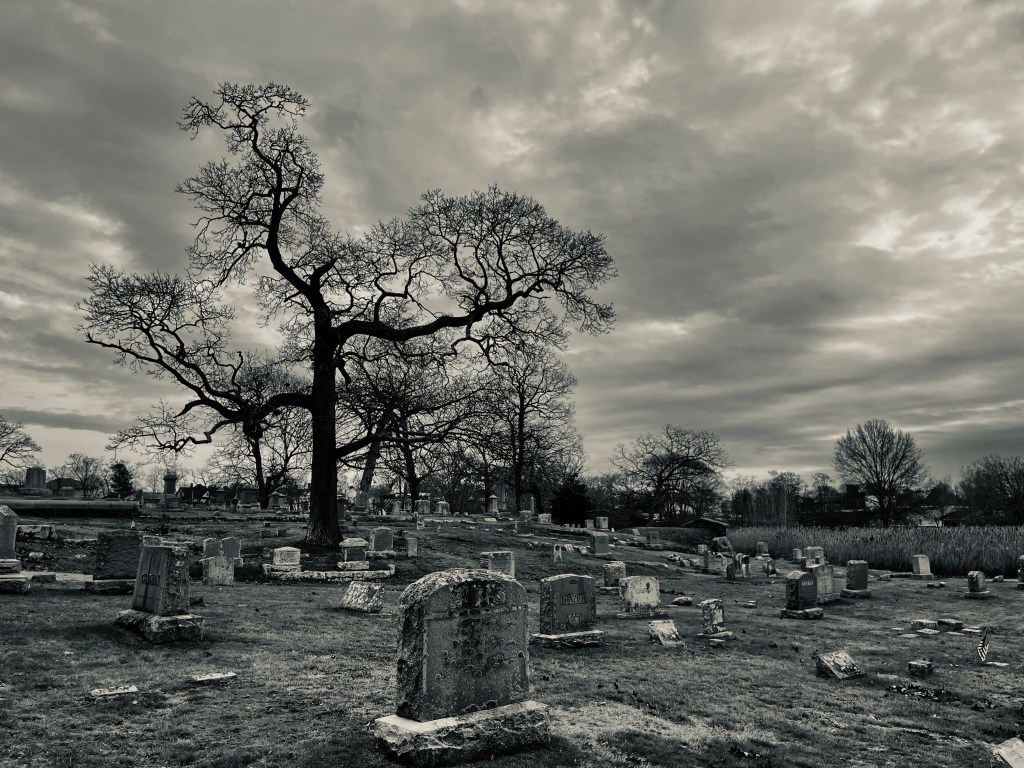
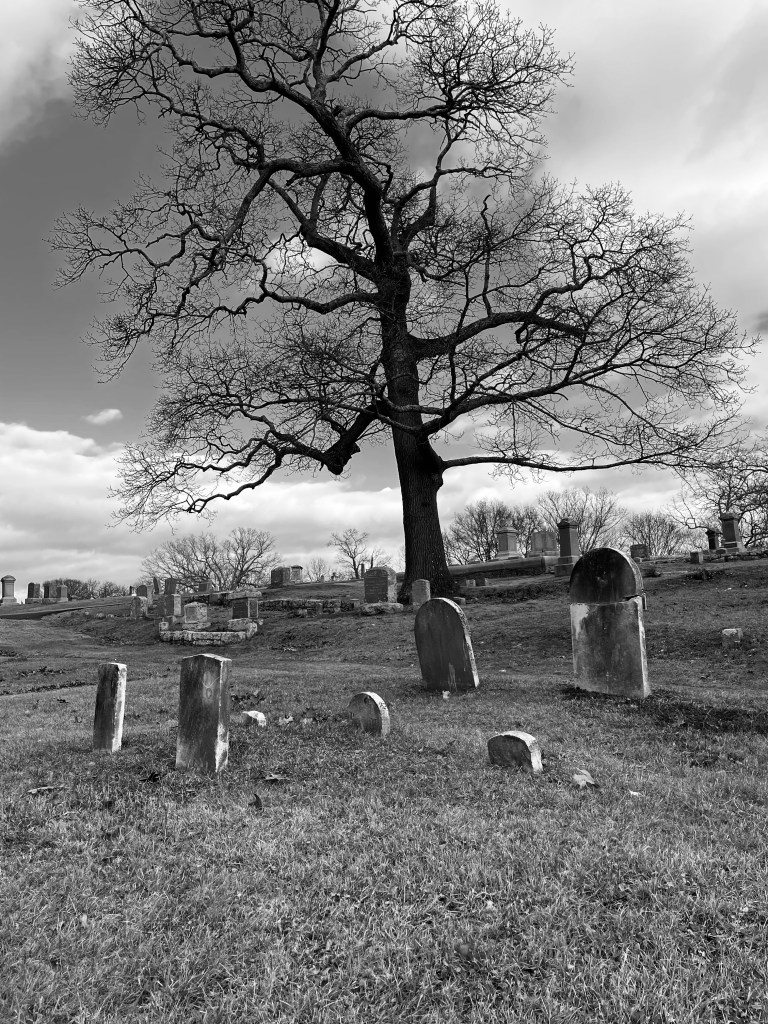
Our graveyard features tall spreading oaks.

Linking heaven and earth.

My daily walk along the bike path

Runs along the edge of that cemetery.

The path follows the one laid down

By a railroad that took passengers to the edge of the ocean.

It much quieter now without the traffic of the railroad.

Now the dead have the company of dogs and children.

And older walkers like me

Who make their way around the tombstones.

I used to walk here for my health.

The elderly should keep moving, the doctors advise.

But these days I greet the deceased

Not as ghosts but instead as

My interred neighbors.

Sharing our place on our earth together

If not our time.

Each gravestone tells a story.

I read their names and say them aloud.

And before I complete the word

An image comes together in my mind.

Ebenezer – Ah. To live with that name.

Mercy and her husband, Pardon. 

Elijah and his son, Elijah

Gideon

Anizetta

Freelove

Wager 

Phineas and his sister, Lillian

Minnie

“Kook”

Matilda

Caleb and older brother, Isaac.

Quickly, I am in a village and am walking in a community.

Perhaps, they know each other or know their families.

Maybe, they played cards or went to church last night. 

Maybe, they married the pretty girl next door.

All these names have disappeared.

Their flair and fashion and folly

A lost generation of characters

Down near the river are newer graves.

I see that the Mellors lost two children.

A baby and a toddler

I feel their sorrow.

Children died the years my siblings were born.

I find a memorial for another child.

Dead not more than two years.

The boy’s parents have made a shrine.

Of toy cars and little figures

Solar lights in each corner to keep the boy safe at night.

I find a large tombstone at the top of the hill

At the foot of the huge oak

A monument to Doctor Robinson

A great man it seems on this scale.

In bold letters, I see his birthday and birthplace.

I see as well the dates and place of his death.

I see that he served in the War.

Near the base of the stone I see

“Devoted wife” and beneath that

Eli……

Mud and grass have erased those traces of his wife.

Her name buried in the dirt.

Perhaps, if he had one less accomplishment

There would have been room for her.

Tomorrow I will bring a spade and reveal  

Her place and time to the world.

It matters to no one else this clearing

Away of mud and earth.

Neither does it matter to anyone else that I 

Have made these friends in the graveyard.

But to feel these connections means everything to me.

I have long renounced a cemetery plot of my own

Thinking about the burden of a grave for my loved ones

Maybe, they’d feel a need to visit. 

Just now, I am rethinking this resolution.

Allowing the idea to take root in my mind. 

I don’t need to be remembered but

I do need to rest with my neighbors and friends. 

A tribute to my dear friend, Marion Wrye

A friend of nearly fifty years died earlier this month after a long struggle with a difficult illness.

Last summer, on a visit with Marion, I asked if there was anything on her mind. She remarked that she had to write her eulogy. I offered to help, and she proposed that I wrote that eulogy, which is a great honor. But imagine the challenge of writing a tribute for someone so wonderful and so special, so dear to our hearts. I had planned on writing this sometime in the far-off future. But Marion’s death came too early. Anytime would have been too early. I do know, like so many of you, that this eulogy would have been much better if Marion had written or edited it. It would have been stronger, and clearer, maybe even poetic. She was, after all, a genius at making us all better in her kind and gentle way.

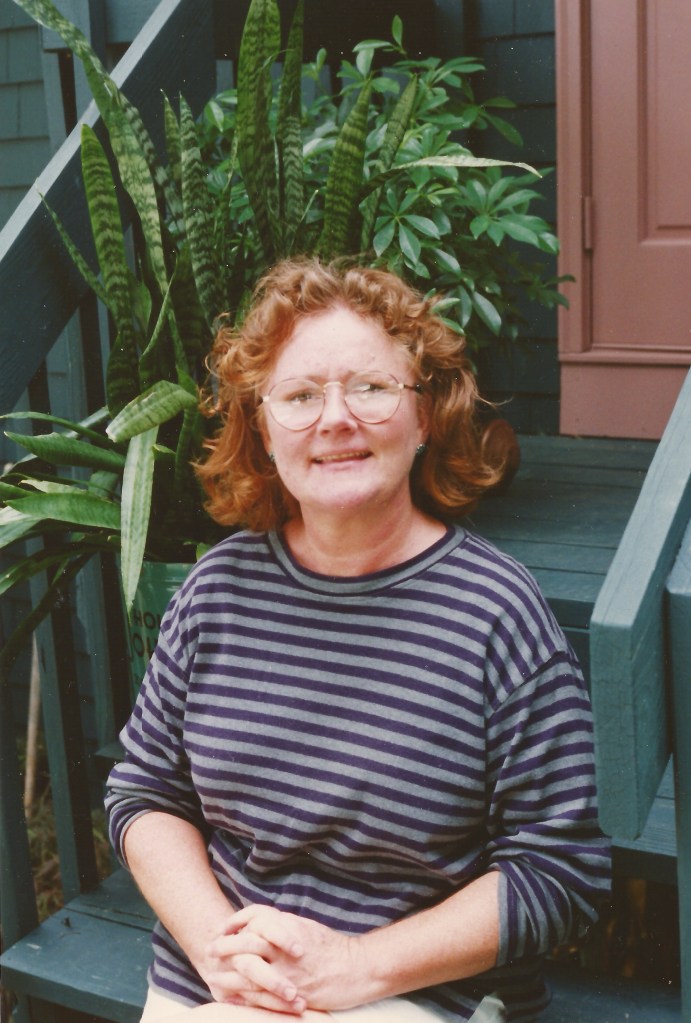
I met Marion in the fall of 1973 — almost 50 years ago. Right away, I recognized that she was brilliant — like no one else I’d ever met. She was also beautiful and stylish.  The consummate conversationalist. You were never bored in her company. Unmatched intellectual curiosity. A beautiful writer. Interested in all of us and everything. In fact, you became more interesting in her company. At home with big ideas about the universe and meaning and purpose and completely delighted with the silly and inane. I used to love that raised eyebrow and the tilt of her head when something delighted her. 

Since that first meeting and in all the years that have followed, I recognized the treasure that Marion was in my life. Recently, as I have met the friends and former students that I have heard so much and read the beautiful comments from her Bayview community, I realized that she was treasure to all of us — not just my dear and special friend.  The lovely community she has gathered around her is testament of how much she mattered and how much she matters still. Her close friends have remarked on her ability to listen carefully with support, to always be there in difficult times, to see us as the vulnerable and irreplaceable people we were to her. We felt cherished. She was a symbol of light and love.  

A great teacher will inspire you to fly and give you the tools to do just that. You can’t be a beloved teacher with just a command of content and a mastery of material. You need to be deeply present in the classroom aligned with the students teaching them about something you love. You need to be your authentic beautiful self. Parker Palmer, the educational philosopher, wrote, “Whoever our students may be, whatever the subjects we teach, ultimately we teach who we are.” And that indeed was true about Ms. Wrye. She was deeply and profoundly in love with her subject, enchanted by her students and alive with the challenge of creating a beloved community in her classroom.  Her unique and lovely spirt and soul were completely revealed in her friendships, in her writing and in her teaching.  

What and how she taught in reflected in the tributes that former students and fellow teachers have left on the Bayview Academy’s Facebook pages.

Miss Wrye gave me a voice

Inspired me and my career

My favorite teacher ever

No one ever taught me so much

Her lessons remain with me today. 

She created a safe space for us.

Miss Wrye changed the way I thought.

A student wrote that she incorporated Marion’s kindness in feedback into her own teaching.

Another wrote, she believed me to be better than I was or am and I will always want to live up to her opinion. I wanted to more like her. 

And directed to Ms. Wrye,

I am so grateful to you for the gift of yourself.

You opened my eyes to great storytelling and literature.

And there so many comments about how kind and loving she was after the death of a parent, or a classmate or a during serious illness or a family difficulty. One student remembers Ms. Wrye reaching out to the Alumni Association to raise money when own family couldn’t pay tuition in her senior year. Thanks to Marion, the student walked with her graduating class.

Miss Wrye also had her wonderful quirky style. A former student recollects one Christmas celebration where the school sponsored a classroom decorating contest. The students dressed up Barbie dolls as angels and hung them from the ceiling fan. When Marion turned on the fan, the angels spun around at breakneck speed. The fact that the students felt that this creative act would delight Miss. Wrye says a lot about the wonderful connection she had with her students. 

Marion was an inspired path-breaking educator, as passionate and as thoughtful about teaching as anyone I have ever met. As an educator myself, I was constantly impressed by the thought, the love, the fun she brought to the classroom. How I would have loved to have been a student of hers. She published several important essays about teaching in prestigious journals. Within the past year, she wrote a well-received article about teaching the essay form. She received a national award for her inspired teaching. Many of her students received prizes for their writing. Unfortunately, she did not finish her own story, a memoir she had been working on which would have given us all another glimpse of this amazing woman. 

All of us visiting Marion these past years acknowledge the beautiful caretaking of her by Jayne Martin and her close friends. To take on the responsibility of caring for someone you know will pass away in your care is the truest act of love. Because you know on some level, this story will not and cannot have a happy ending. But the kindness, patience, the daily drone of chores, the hard work of caretaking, the demands on your energy and time, the challenge of taking care of someone who is suffering, watching a loved one fail – takes immense sacrifice and generosity. Sometimes, it takes more than we have to give but we do it anyway. So, on behalf of all of us, Jayne, thank you so much for taking care of our beloved friend with all her quirks and foibles. And thanks as well to Marion’s visitors who delighted her with their company and conversation and comforted her in so many ways. 

Marion was extraordinary, wasn’t she? 

Of course, it is one thing to write a eulogy for Marion and to actually deliver it, to acknowledge her death means facing a  bitter and unreal truth, that our friend and teacher has passed away. It is hard to reconcile any loss that is as painful as this one. Some of us have the comfort of a belief in the afterlife. If so, Marion is in heaven, starting great conversations with her favorite poets and philosophers. Maybe she is making some wonderful new friends, like us. I can picture her there in a small carefully organized room with a beautiful window view with her books, a journal and a favorite pen, some Barbie Dolls, a cup of coffee, and maybe the Bee Gees, playing in the background. A chair pulled up close for a friend’s visit. I am certain that everyone in heaven agrees that it is much more interesting place now that Marion is there. Also, I am so certain she misses us. How could she not? She loved us so much. 

But even if there is no afterlife, she is always with us. I believe that we pass along some of ourselves to people we have loved and cherished.  It is not genetic DNA but something as precious and as powerful – we pass on our unique way of being in the world.  I also believe that we have all been written into her spiritual will. We are her legacy. It doesn’t take a lot of effort to find the strands and traces of Marion in our hearts and souls and minds – that thrill at being alive, a loving awe and curiosity about the world, the beauty of a poetic soul, an orientation toward the good and the generous, a love of our friends and family. I know that I am a much kinder, more reflective, a more full-of-life person because of her. I think you are, too. 

Of course, you cannot make such an impression on people without leaving an immense gaping hole for us all to fill with love and kindness and a love of life, celebrating our great good fortune of knowing Marion and being embraced by her. How lucky we were!

Marion’s friends are working on developing a scholarship or writing prize at Bay View to recognize her immense contributions to the Bay View community.  We want to develop a tribute that really reflects her legacy of exceptional teaching. More about that later.

Over these nearly fifty years, Marion and I exchanged a lot of our writing. I have folders full of her essays, reflections, and poetry.  A few years ago, I wrote a poem about her and sent it along for her review. She read it carefully and kindly made it better. She urged me to publish it right away. Instead I let it sit and mature and ripen with time. I am hoping she would have approved of this new version. It is called At the beach, without my poet

At the beach, without my poet

This precious morning beach walk

You were on my mind.

If you were here, my poet, we would toss out lovely names

Of what we see

And hear 

And feel.

Like scattering bread for the birds

Our words taking aim at the truth in this very moment.

Fresh and awake

This morning

For the first or maybe

For the forever time.

You, my poet, would say, 

“Look, see how the tern folds, 

And unfolds his wings.

He sails and pivots

Like an origami bird.”

And I, would say

“Exactly, my friend. So perfect.”

And, touching your hand, I would whisper 

With a smile. 

“That bird makes his own magic.” 

Noting to myself, 

Like you the magic you make, my poet

With your words

Your poetry

Your love

Your life.

And I would say, 

And watching the sea shift and balance.

“Listen, hear, how its heart beats

The exhale and inhale of waves 

The wash of warm water at our feet.”

And you, my poet, would say,

“Exactly. Just so.”

And we would stand in veneration 

In full regard of our shared time here. 

Blessed in the grace 

Of embracing our friendship

This ineffable and irreplaceable space

That we have built together.

Just ours

With the gifts we bring and bestow on each other. 

My poet adding her breath to the universe. 

Another sacred moment. 

Once hers, now ours. 

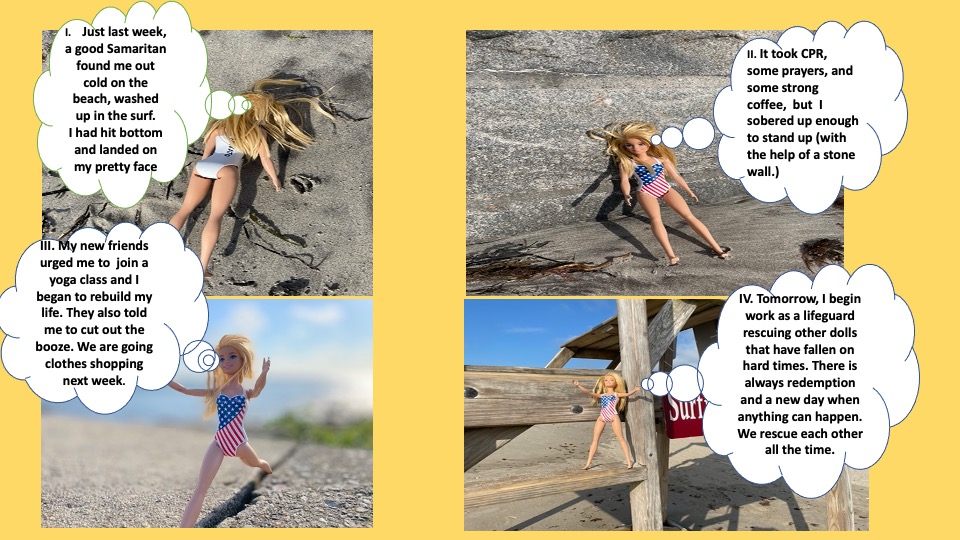
Rescued

Photograph by Sandra Enos July 2022

I took this series of photographs after finding this Barbie-like doll washed up in the surf at high tide. She was lying face down in the sand. I picked up and looked about for a little girl who made have left her but the beach was abandoned by then. I took her home, washed her up and put her to bed. I took her back to the beach the next day to take some more photographs, trying to tell a story of this girl who fell on hard times and was saved by some friends. I posed her on the lifeguard chair just after sunrise. This chair is usually populated by two young female lifeguards and thinking they could use some company, I left her with them.

A Chorus of Barnacles (informed by An Immense World by Ed Yong)

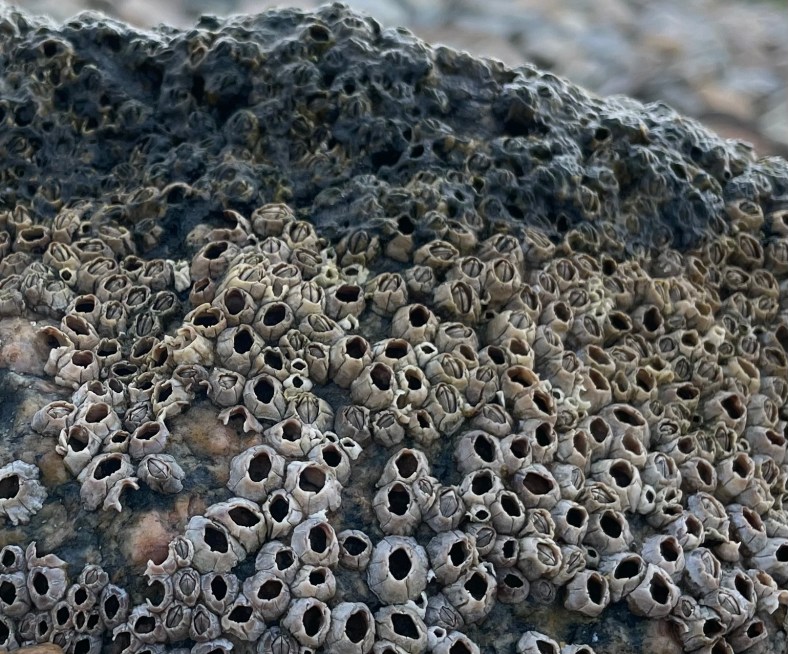
Photograph by Sandra Enos September 2022

Every day on the beach

I vow to see 

               hear

               smell

               feel

Something new. 

And like that rare resolution

That comes true

Each day something is revealed.

It takes patience 

              an open heart

              the time to spend more than a glance

            the wisdom to know that not everything

             will be revealed.

            Not right here, this moment anyway.

All the creatures on our planet 

Live in our own Unwelt.

The limitations and magic of our senses.

We are blinder than some birds

Deafer than many mammals

Less social than most ants

Less of a genetic soup than a tiny water flea.

And many of us despite our abilities

Are deadened to the world around us.

Just last week, I saw a dark grey rock at the beach

Still wet from high tide

Unremarkable. I had seen it many times before. 

As I bent over for a better look, I saw it covered in tiny creatures.

Coming closer, I saw these tiny six-paneled crustaceans opened for feeding.

Cemented to their home with nature’s strongest cement. 

Drawing closer still, I found a chorus of barnacles.

Was that the Hallelujah Chorus they were singing? 

Or maybe Ode to Joy?

There are so many choruses we never hear

So many sunsets we simply can’t see

We’d better pay attention before it all escapes us.

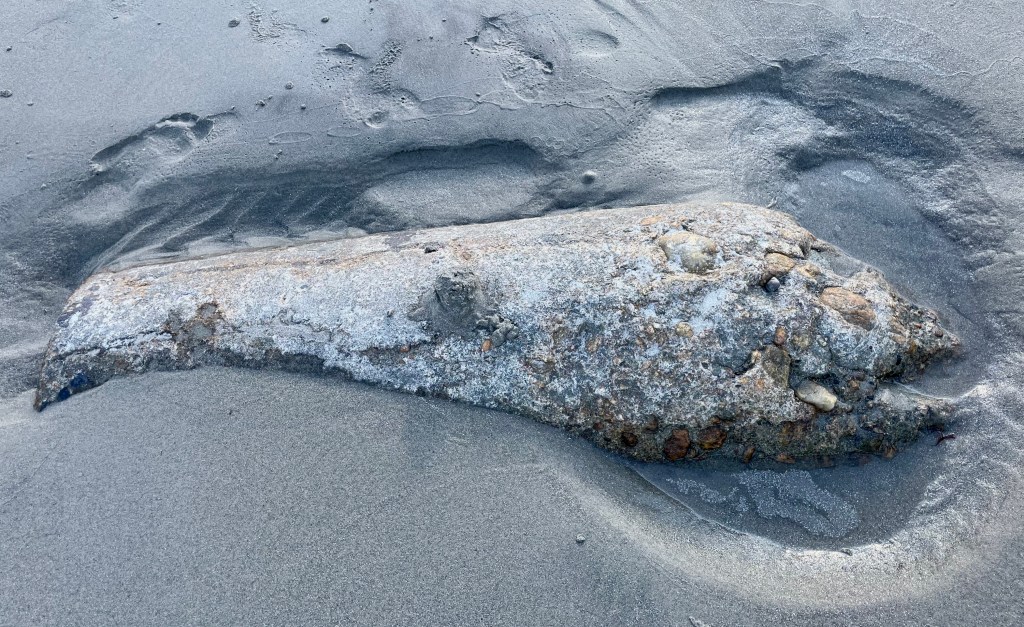
The Stone Fish

Photograph by Sandra Enos

In early summer 

On a sunny morning

An hour past sunrise

At deep low tide

A week beyond the full moon

Latitude 41.4373° N 

Longitude 71.4512° W

I discovered a buried treasure

Revealed by the receding tide

After a fierce storm.

A fish found half a foot

Under the surface.

An artifact in stone. 

His mouth open

A small eye

A beautiful body

With mottled scales.

I nearly dug him up to 

Take him home

For a closer look. 

Instead I took a photo.

Fearing my own over-active imagination, 

(As my mother characterized it.)

I checked my observations with an experts

(I did not want to put a fish mask on an

Ordinary stone.)

I asked my brother

A fisherman 60 of his 66 years on earth.

Does this look like a fish to you?

He replied in brotherly fashion,

Of course. A striper, I am sure.

That beautiful fish has haunted me 

Every day since. 

Poking at my heart with wonderings.

Who buried him?

For what end?

Is he a simple act of nature?

(As if there was any such thing!)

Every day since

I have looked for that fish

At the exact place 

Where I left him.

Searching at high tide

And low

At mid-tide

After a storm when the remnants

Of the old pier poke through the sand.

I pace and comb the beach

As if I am in a crime drama.

Looking for clues

No trace of him. 

I have asked other beach walkers

Have you seen the stone fish? 

No one has.

I fear that he has been revealed only to me. 

And like so much of life’s mysteries

We are obliged to share our own.

The way we see the world

How it is revealed to us.

Even if that magic moment never arrives again.

The blessing of it never ends. 

The comfort of knowing it rests

Just under the surface

Making it buried treasure. 

(A wise man once said

You need to see the flight, not the feathers.)

At the beach

2021, the second summer of COVID. I was hungry for human contact that steeped beyond my tiny world. I must have been radiating that vibe because my early morning beach walks were filled with surprise encounters. The humans I met regularly during these walks seemed completely free and eager to share with me their grand claims about the universe and their profound theories about the ways of the world. They were all sharing a bit of themselves, revealed to a total stranger. There must have been something in me that drew them out without fear of contradiction or challenge. Some people I saw every day, others for one moment, not longer than that.

To be fair, in this second summer, I emerged shell shocked from confinement. Certainly, I connected with people on Zoom calls, but those meetings like I was watching a movie with some friends cast in unfamiliar roles. I was distracted watching myself watching everyone else.  None of it felt real.  As the months wore on, my colleagues turned off their screens. It was too much exposure and not enough real exchange. We all dove into a huddle with ourselves, it seemed.

 Exchanges with strangers on the beach felt like the only true contact I had, and I relished these. I was open and eager for spontaneous conversation to lighten my day. Until that point, I was never that person to begin a conversation with a stranger. I would smile and nod but no more than that. However, based on the conversations I was having, I seemed to present myself as a 72-year-old naïf, like someone brand new to the world. People told me stories and I was enchanted.

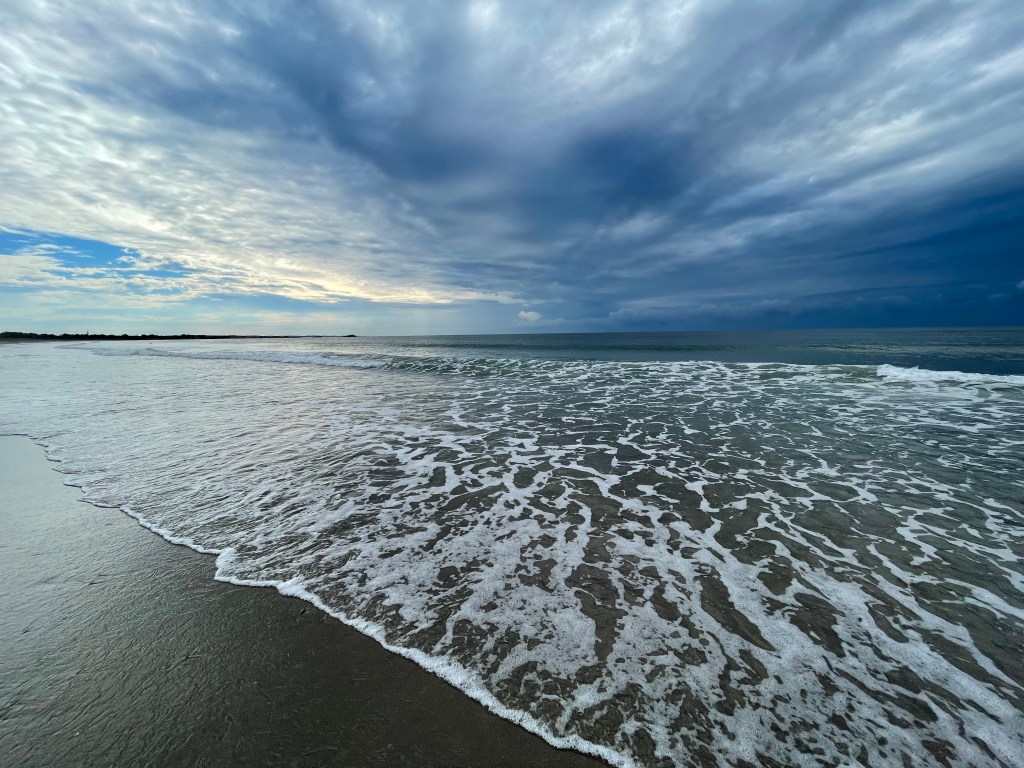
Narragansett beach between weather patterns

One woman, I will call her Hailey, was always splendidly adorned, as if she were attending a party with others similarly dressed. Her disappointment with dress code of the rest of us beach bums was obvious. She sported a giant gold necklace, evocative of a Roman gladiator, and wore well-fitting matching tops and tights. She had the excellent bearing of someone who was not only born into money but also married into it and likely earned some her own. She spoke of afternoons at the Club. She told me about her friend, Billie, her dyspeptic dog, and her former husband who met a fitting end at a hospital in the Philippines. Maybe, this was interesting to me because my father had served there in World War II, although she didn’t know that.  Hailey kept asking me if I knew people from the Club, “Do you know Marsha Dawson?” “Have you seen the Clements since they came back from Florida?” Nope.  Never. I didn’t even know there was a Club. She shared a story about an albino deer who was especially fond of her. Maybe, albinos are just that way, like some dogs are people dogs and some deer are people deer. This deer had so much regard for her that he never ate her hydrangeas. He also hid from the guests when she was entertaining, keeping him exclusively hers.  He sounded like an ideal combination of a gardener and a younger boyfriend. 

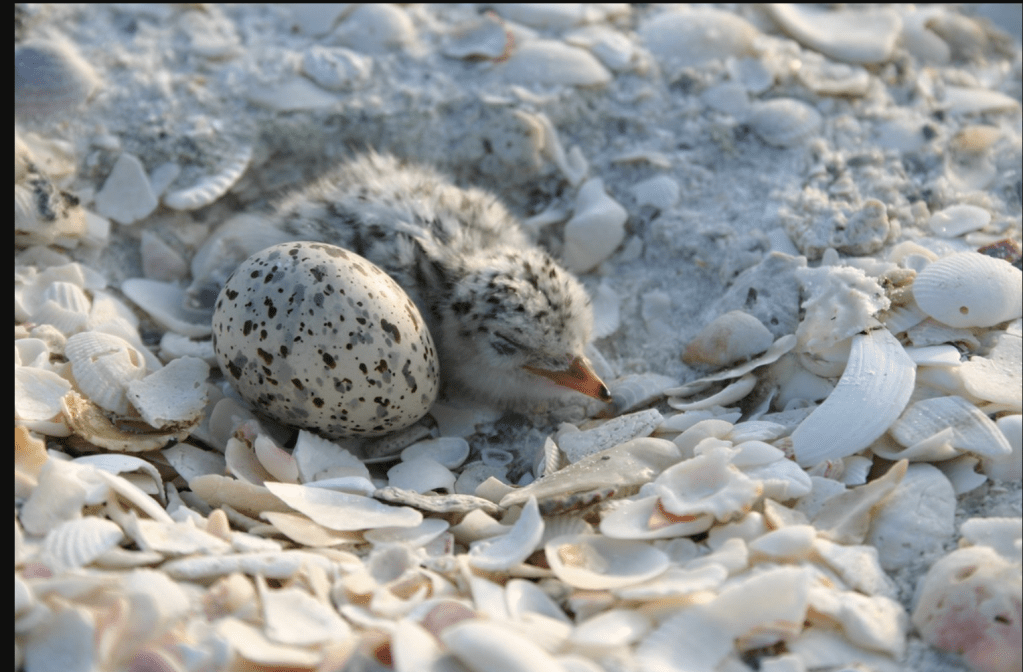
Tern egg with hatchling

As the summer wore on, we stopped on the beach to chat every day. No matter how early I arrived, she boasted that she was there well before sunrise. (At the of beginning of summer, that would be about 4:30 in the morning). No matter how far I had walked, she had walked farther and faster. No matter what I had discovered on the beach—sea glass, an egg from a lesser tern nest abandoned on the beach, fishing lures caught up in seaweed – she had discovered other better things just the day before. How did a beach walk get so competitive? I was tempted to wear a necklace myself made of shark teeth and shrunken heads, just to show her that I was interesting, as well. 

Another morning a woman paced one stretch of the beach over and over again, head down and picking at the sand, like an egret looking for food. I learned that she collected sea glass. These people are easy to spot once you know what they are looking at and looking for. I do a lot of beach exploring on my own and will pick up anything of interest. We chatted about sea glass and the perfection of those mornings. I remarked to her about a lovely violet piece of sea glass I had just found, and she replied, “Well, of course, you did. The universe offers these pieces to you, and only you, when the glass is ready to be found, not a minute sooner.” I could have countered with my own analysis, but some minutes in our lives are best spent letting go and listening to how others see the world. She then passed on a chant to me (and only me) and told me how much her dog loved my vibe. I liked his vibe, as well, I suppose. I think he really appreciated that I knew how to scratch his ears but that is part of our vibe together, I suppose, for some of God’s creatures, anyway. 

Another woman with a scarf wrapped around her neck and I smiled at each other. We were down at the far end of the beach, dazzled by the light on the water, where the river empties into the bay. The currents and the tides flowing in the opposite direction make for exquisite patterns with light and water and sand.  After a few minutes of shared bliss, we acknowledged that we were sharing a beautiful moment. I broke the silence. I said I had seen her yesterday for the first time and she told me in a low voice that she was living out of a van, just like the movie, Nomadland. [1] She was just recovering from melanoma surgery on her neck and chest, aiming to enjoy the day’s light without further damaging her skin. She lived in New Mexico and was visiting her sister who was dying of cancer. This woman was convinced that the cancer was self-inflicted, the result of unresolved childhood trauma. She observed that we can be both victims of trauma and perpetrators, as well. She couldn’t bring herself to care for her sister like she wanted to. Leslie felt she was battling for her own life in the company of her sister. She was bristly about human company although she commented on my gentleness and openness. She also liked my energy. 

On the same day, I ran into Tim who practices meditation on the beach. He has a lovely beard and a kind smile. He invites me to join him. I pass and claim that I do a walking meditation. He salutes that intention with a small bow of his head. My next encounter was with an older couple I had been seeing for a few years now. They have a European accent which despite lots of conversations, I have yet to identify. She is wearing a pair of short orange overalls which I recommended to her last year after she complemented me on mine. She said just a few years ago she would have never worn something so comfortable and utilitarian. I congratulated her, nearly hugged her actually. We are always growing together as humans; there is no other way.

For two years now, I’ve seen a lovely couple who are here on summer weekends. They swim at the end of Narrow River floating with the current, into the ocean where the waves guide them to safety. We comment on the wonder of this perfect day, just as beautiful as the day before and the day to come. “How can this be?” I ask. “How can things be so good?” Greg answers, “Gosh, I am so good, there should be two of me.” Exactly. Me, too.

My daily rounds were topped off by speaking with David, a patent attorney whose wife has multiple sclerosis. He so wishes she could join him on his walks. When she does, she is completely exhausted, but maybe in a good way, he thinks. We talk about sea glass which he also collects. “How do you know when you have collected enough?” I ask. “Do you have a plan for it when you die”? He has asked his children to mix the glass with his ashes and to dump both in the bay. That idea really appealed to me. This may be illegal, he fears, not the glass, but certainly the ashes. Legal training sometimes makes you too aware, I think. That sort of thinking can stifle your dreams.[2]  

I can say that this daily practice of encountering strangers has added immeasurably to my life in surprising ways. We encounter so many people in so many ways that they can blend into an undistinguished crowd of “people I don’t know.” But each of them has a story and a perspective. Those minutes together are improvised stories, an exchange that brings us both to the present and keeps us here long enough for a true encounter. These are blessings in each morning. 

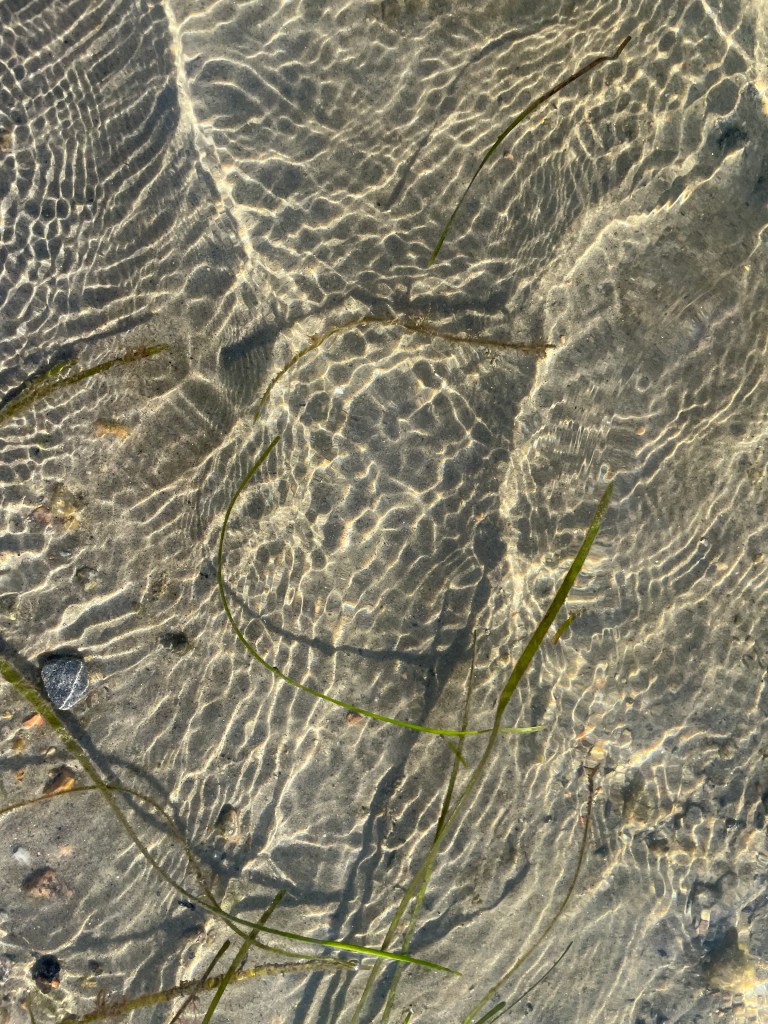
And, of course, there is the simple beauty of the beach, where a careful eye and ear and an open heart with reveal something new every walk, like shimmering light on the water.

Sandra Enos

[1] Nomadland is a wonderful film with a perfectly scored soundtrack. 

[2]  The EPA has a policy about burial at sea. Cremated remains must be disposed three miles off the coast and reported to the EPA. You cannot simply toss remains off the side of a fishing pier or take them along with your lunch on a nice kayak paddle. I think the Mafia must have scared the EPA into regulating these burials at sea, even cremated remains. They are silent on sea glass.