This blog includes essays about life, aging, humor, inspiration and creativity. These things capture my attention and I hope are worthy of yours. Sandra Enos.
Although I don’t believe in the unified theory of creation, I do embrace the notion that patterns characterize our lives, giving them coherence. In fact, our brains are always making sense of our surroundings — not in ways that always render the truth — but having a working theory is better than the disorienting feeling that all is random and chaotic.
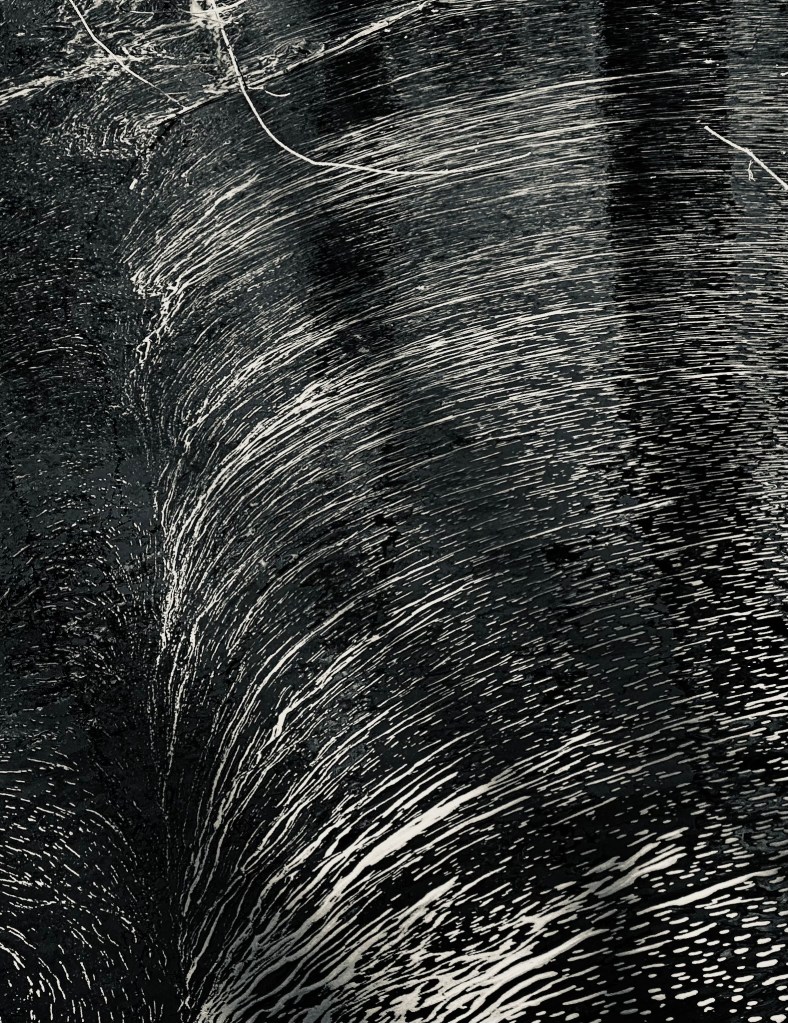
Seeing this image reminds me of the Milky Way or a Ferris wheel at night or a vortex of particles swirling in a magical mixture. When in fact, what I captured is a tiny body of water near Asa Pond and off the bike path after a heavy rain, bringing soap suds into the stream and down a half-foot waterfall. The more you look, the more you see the connections and the deep surprise of everyday encouters.
When I was a child growing up in the fifties, it seemed that everyone in my life – my parents, my teachers, my aunts and uncles, and grandparents – and everything in my life – from the movies I watched to the books I read to the things I dreamed about – were all aligned in a project to make me a very good person. I resisted these influences in my childish ways but overall, I bought in. I embraced their hopes and dreams for goodness for me, but that wasn’t enough; I wanted to be a Saint.
My little sister and I shared a tiny bedroom and, on those nights, when my mother had a late shift at work, I would read to her at bedtime. I had the upper bunk and with the streetlight falling brightly onto my pillow, I could read as late in the evening as I wanted without detection. Our favorite book was given to me by my aunt Gaby. Without her own children, she had plenty of time and energy to devote to my development and guidance. She gifted me The Children’s Book of the Saints for my First Communion. Every day of the year, there was another story of a Catholic saint, a simple guide for us to inspire goodness and courage. It was perfect for my dreams of sainthood. We loved best the stories of the saints who were martyrs. Stories of Saint Ignatius who was a rich boy and a soldier who then repented and found the Society of Jesuits did nothing to excite us. Saints like him seemed to us good enough but not bold or inspiring. We need saints who had visions and who suffered. We loved stories of saints like St. Bartholomew who was skinned alive, St. Ignatius of Antioch who was fed to the lions, or St. Lawrence who was burned at the stake. Never denying their faith. We relished stories of saints, like St. Juthwara who’d been beheaded and walked away with her head in her arms, on her way to church to pray. Our favorite was St. Thecia. When they tried to burn her at the stake, it rained. When they fed her to the lions, they laid down and licked her toes. She kept trying to kill her with snakes and swords but protected by her faith, not torture not the work of man could kill her. She lived to her eighties. As a child, I hadn’t yet worked out just how I would get myself into situations where I be given a chance at martyrdom but my mind was firmly made up to do whatever I needed to do to become St. Sandra of Rhode Island.
Recognizing the power of movies over our generation, the nuns gathered us together in the cafeteria every month to watch an inspirational film like Boy’s Town, Captain January, or TheMiracle of Fatima. When I was in the second grade, we watched a film about the Maryknoll Brothers doing missionary work among the pagans in China. At the end of the movie, the Chinese marched a Maryknoll Brother up a hill and crucified him – “He refused to deny his faith”, the narrator intoned. We were stunned; I was inspired. Our nun talked with us about the movie and about our faith and passed around the little metal box where we were supposed to drop our change to support the missions. Some of the kids had spent theirs on candy; not me. Then, she asked, “Children, how many of you are willing to die for your faith?” Almost all our hands went up. “Me, sister! Me, sister!” I was so proud of myself for offering my life for Jesus Christ. I never told my Mom, although maybe she would have been proud of me, as well. She knew about my sainthood thing.
From that moment on, I have never doubted for a minute that children could be recruited into Brown Shirts or an army of child soldiers or into the Children’s Crusade. Children may be innocent but they are engineered to be socialized into groups well-intended or evil seeking. I gave up on sainthood when it seemed the pagans were disappearing from the planet and emerging as Buddhists, Muslims, Hindis, and people of other faiths. There were other diversions from sainthood, as well, but that is a much more common story.
Even though I keep a daily journal, my notes on the pandemic are sparse. I recall best those very early days when neither science nor faith could stem the tide and terror, fear, and dread of the virus. As an older person, I felt my age for the first time, as both a high-risk target for the disease and as a vulnerable elder requiring careful watch and extra protection. I’ve learned that children can be just as paternalistic as their parents in that caring but condescending way.
I do have an entry in my daily notes for Sunday April 5th, a few weeks after the federal government declared a national emergency, just a week after the U.S. had more COVID cases than anywhere else in the world. We were in the early days of lockdowns, travel bans, shortages. Fear of the disease and of each other. Daily briefings. Panic. On that day, I spoke with my sister in Florida. A few weeks prior, we had set up bi-weekly check ins. That Sunday, we talked about how these could be our final days. That sentence sounds melodramatic when I write it, but it rings true to my experience. On that day, we broached the subject of final plans. She had organized a box full of important documents with my name on it on the second shelf of her guest room closet. All her contacts– professional ones and personal ones – to be notified when she passed away. Emails, phone numbers, passwords, online accounts. She had thought of everything – so kind. I committed to doing the same thing as soon as possible, yet still to this day, four years later, I have left most of this undone.
She considered almost everything. I asked her about her eulogy. Had she thought about who would say those final words? As soon as the question left my lips, I knew what I wanted to hear. As her older sister, I prayer it would me. She confirmed that hope. I would deliver her eulogy and she mine. We wondered together whether we knew everything we should know about each other. I made these notes in my journal. Committed to writing Marcia’s eulogy. That sent me down a rabbit hole of wondering. Was I really the best person to write this? Did I really remember the important points in her life? Did I underestimate how painful those early illnesses were for her? Did I comprehend how deeply she at age twelve felt my father’s early death? Did I know the whole story about her marriage? Did I appreciate how deeply others loved her? Did I know only my special sister-side of her? Did she know I’d nearly been hospitalized for depression? That I came close to suicide more than once? Those eulogies may reveal more than we have told each other so far. These can be reckonings.
I delivered my first eulogy for my mother. I asked her parish priest if I could say a few words after Mass. He told me that this wasn’t the custom in his parish but since my mother was a parishioner, he’d allow it. I could have three minutes. Three minutes? For my mother? And then I thought of her, so hating attention in any of its forms. She would tell me to take no more than two minutes, more than enough to say what needed to be said. So, I delivered that eulogy from my heart as I knew my Mom to be, underestimated, full of broken strength. I learned during the reception in the church basement how much I didn’t know about her. How kind she was to a neighbor. How much attention she paid to a lonely resident in assisted living. How crazy funny she was. That she was a wonderful dancer in her twenties. How she was a complete person separate from me—a richer, deeper, more complex story than I knew. I wished I had done better for her. Reaching beyond what I know or think I know; I will do better for my sister.
Setting: September 1971 to May 1972, rural Alabama
Characters: Twelve northern-born VISTA Volunteers sent to the South to fight poverty. After a week of training, they cut their hair, put away their bell-bottomed jeans and prepare for work as teacher’ aides, family planning specialists, construction supervisors and community organizers. They are full of idealism and brotherhood and the wonderful feeling that they are doing something important. However, their ideas about doing good, about being comfortable in the world are challenged in this culture that is confusing, frightening, and disorienting. They spent that year and the rest of their lives wondering what’s going on.
Soundtrack; Marvin Gaye’s What’s Going On
Act 1. Three days after arrival. The VISTAs are placed with host families while they look for housing. The third night one of the women is raped by a teenage boy. She tells her friends. They debate what to do. Reporting this to the police guarantees that the boy will be arrested and may pay with his life. It will also mean the VISTA site is shut down. Not reporting it means that the violation goes unpunished, that the other women may be targeted for other attacks. It is just three days and already they are in over their heads. They make up an excuse to the supervisor to move her to another host family. This event has repercussions all year.
Act 2. End of September. A cell in the local jail. Sheriff Wilkins welcomes the VISTAs to Lee County. He tells them he can recognize a Yankee at a half mile away – the walk, the swagger, the clothes. He wonders why they would come all the way to Alabama when they have so much trouble with the “coloreds” up north, rioting and all of that. He knows that as outsiders, the VISTAs will be troublemakers and that he will be watching them carefully. Her reminds them that last year, the house that the VISTAs were living in in Beulah, a Black community, was firebombed. He sure hopes they doesn’t happen to them.
Act 3. Early October. Three women are renting an old farmhouse from the Belks, a prominent family in Lee County. Bubba Belk, the youngest of four brothers and like the VISTAs, a recent college graduate, visits and brings along the gift of a rifle so the women can have some protection. They refuse his generosity. He insists, reminding them that they have no phone, that the nearest police station is twenty-five miles away, and that everyone knows that three white girls are staying together alone in this house. He reminds them that they are living in Alabama, not where they come from. He walks them to the backyard, shows them an old whipping post and has each of them learn to load and shoot the rifle. They each take a few shots. They thank him and promise each other to hide the gun away.
Act 4. A warm May late afternoon, three VISTAs and six Black families gather together to work out the day’s schedule at the self-help housing site. A young man arrives in a pickup truck, yells at them to gather around, jumps into the back of his truck and says, “the Governor’s been shot. Governor Wallace has been shot!” One of the men leads the group in prayer and song. They are praying for the soul and deliverance of the Governor. The VISTA volunteers are quiet, wondering how these folks can be praying when their own hearts are so full of hate.
Her days were undistinguished except for the afternoon sun. As the seasons passed, she watched the shadows shorten and lengthen gliding across the floor in her tiny sitting room. At her side, a basket of knitting sat untouched. The last time she picked it up, she had no memory in her fingers of how she once made blankets and hats for every member of her family and many of the babies at the church.
She felt the warm June sun and looked out to the garden. She struggled to recall the year when she. was strong enough to dig a two-foot trench for the asparagus bed. It thrived for years when the children were small and began to fail when she could no longer tend it lovingly. Where did that lovely asparagus go, she wondered.
She surveyed the yard, once resplendent at this time of year — every bed a surprise of color and form, her peonies with the grace of ballerinas, those dahlias uncompromising in their bold colors and shapes. Where had all those flowers gone? Or maybe, she didn’t recall this so clearly. A fleeting thought poked into her mind, perhaps this beautiful garden in her memory was actually someone else’s garden. Not hers at all, perhaps.
The neighbor’s children, the age of her great grandkids, were screaming with delight, splashing into their backyard pool, celebrating the birthday of the youngest, Liam. She recalled such parties when she was young but not much about them. She couldn’t recall the name of her favorite cousin or remember when she had last seen him. Had he died? Maybe so. Could that be that I wouldn’t remember? She knew she had a happy childhood but the details, of it like so much else these days, escaped her.
So much had passed by in her long life. Friends. Wars. Struggles. Great joy. Great books. Love. Being a mother. A productive career. Losing a husband. Losing all but one of her siblings. She tried not to dwell on the past, but her future seemed short to her. She did remember her high school friends. “We were such a gang of girls, full of energy and delight and not a little sassiness” she thought. “We were so lovely although we didn’t know it at the time. Where did those girls go?” When she saw the few friends that remained, she saw old women, with their youth like phantoms beside them.
She was willing to accept that life was full of loss; that fact she could accept with equanimity. More than anything, she missed her words, her clever mind, her intellectual power. Once, she could summon a rich vocabulary and choose words that delighted her, like a captain commanding his troops to attention, those words bold and perfectly fitted to her ideas. Now, those words were fewer, wandering, and remote and painfully slow to appear. That loss she felt deeply.
But even as others saw her depleted and elderly, she felt something else. A favorite author of hers wrote at the end of her life, that she was herself, as never before, with fierce energy and intense feelings. Everything was profoundly beautiful to her. Even her own children weren’t as captivating as the children she saw these days. Last year’s Mother’s Day flowers drew her attention like never before. Music brought her to tears. She wanted to draw the world close, to live each minute with all the passion and light that was remained.
Growing up in the fifties, I am given more freedom than I deserve. My distracted mother, a recent widow with three young children to raise, ignores my adolescence. I explore far and wide. I pal around with boys and the girls. I am athletic years before Title IX. I am crazy about music. I teach myself guitar. We write plays and perform musicals at my little high school. We sing and play music on our bus rides home, me playing bongos on my math and English textbooks. We know all the moves of those girl groups and can mimic and even embellish their dances. I can harmonize. It is magic for me.
I don’t give this up at eighteen. In my twenties and thirties, I find another group of women friends who also love to do this. It was a heady time for the women’s movement. We want to be in and celebrate each other’s company. We sing and dance for our friends and perform at women’s conferences. We perform Aretha, the Shirelles, the Supremes, the Dixie Cups, Gladys Knight and the Pips. We never tried to do a Tina Turner song She was too far a reach for us. Which of us white working-class girls imagined dancing like Tina did? None of us. I had seen her on TV with Ike and the Ikettes. She was too sexy. Too crazy. Too beautiful. Unreachable as an icon with those long legs and warrior woman body. She was just too hot.
That all changed. She survives her abusive relationship with Ike Turner and returns to the music scene with ground-breaking album Private Dancer, with the hit What’s Love Got to do with it? She rises strong, confident, strutting. A music critic writes that this album “reeks of attitude.” I can’t read that as adoration. George Bush awards her the Kennedy Center Honors and notes that she has the “most famous legs in show business”. They still don’t understand what Tina is all about. At 44, she becomes the oldest woman to receive a Grammy for Best Solo performer. That doesn’t sound that old to me.
I see her anew. She is just ten years older than me. In my youthful eyes, I saw her a giant. I learn that she is a tiny 5’ 4” tall and weighs 120 pounds. That is exactly me. In her emergence, Tina gives me strength. I am finally ready to bust out of my good girl, Catholic obedient, uniform wearing, background singing self. Tina creates the space for me to come out to my friends. To feel flirtation for the first time in my bones. I let myself be attracted and attractive. And maybe for the first time, I think, “That can’t be love. What’s going on? We just met!” But there is something powerful and worth paying attention.
And not just me. Liberation is recognizing that is always time for re-birth and reinvention. My troupe is done with happy songs about “Going to the Chapel” and waiting for that boy to call. We’ve been burned and are ready to claim power and respect. Turner steps out and we follow. We sing Tina Turner in our comfortable shoes, with our short legs and choreographed moves until my group falls apart, with heart aches, broken marriages, wayward children, cracking voices, slower paces. One of us has cancer. Another, a husband certain to die with a brain tumor. We are well prepared for the next transition.
I was at a perfect age when I wrote my first eulogy, just a few months after I officiated at my first wedding. I was just sixty years old, the oldest in my family of three children, just old enough to understand my mother as a mature adult, beginning my own aging journey. For the first time in our shared history, I could see her life from a larger more generous perspective. If you are blessed with some wisdom, you understand that understanding your mother is not all about you. She has her own history, of which you are only a tiny part, perhaps. If I had been younger, I would have missed much of this and written a good enough eulogy, but not one so deeply felt. If she had lived longer, I might have done better.
I wrote that eulogy for my mother and conducted that marriage ceremony for two former students. For a brief period, it felt like I was doing so much officiating that I should look into becoming a minister. I had developed a nice demeanor and a warm appropriate manner, according to those attending these ceremonies. It is a lovely feeling to be of comfort or to be a handmaiden of joy and commitment.
My mother died soon after falling in her apartment: she never recovered. In a short two weeks, she was hospitalized and went to a nursing home where she picked up an aggressive infection. We were planning for her return to independent living, but things took a different turn. She failed fast, not eating, or communicating. I think she died of exhaustion, loneliness, loss, and fatigue. The moments in her life that felt full to her were dwindling, like they do for so many older people. She was tired of living. At my age now, mid-seventies, I completely understand that. I am losing my life-long friends, not because of betrayal or disinterest, but because their lives have ended. Somehow, I never expected that one of us would die before the other. And if I had imagined it all, I would have me dead first. That appealed to me as tragically just right.
I took on the assignment to write and deliver my mother’s eulogy by default and by design. I had grown to be the closest to my mother, seeing her every week, sometimes twice. My brother was busy with his family; my sister lived a thousand miles away. I was the writer in my family, although any of us could have done the deed, each in our own way. In fact, I believe that I could have written versions of what I would have imagined by brother and sister would have said about our mother. Siblings experience their parents quite differently and I presented my eulogy as my own, not speaking on behalf of the family, except to express our thanks to everyone in attendance who cared for her, as a friend, and a relative.
Her Mass was at the church near where she lived in an elderly high-rise. I accompanied her to Mass on holidays and special occasions so knew the pastor there. When we were arranging her funeral, I asked if I could share some remarks. He said that I could, after the end of Mass. I had three minutes no longer.
I loved doing that eulogy. It gave me an opportunity to set the record straight, to tell those gathered that snowy morning, how funny, how smart, how underestimated she’d always been. I got to claim some territory for her that she had ceded to us children. I don’t think I have ever met anyone who was as humble. Even after she raised three children on her own after my father died at fourteen, she was convinced that we raised ourselves. There is something about wanting to be nearly invisible because of anxiety that puts that person into a place where they can’t feel their impact on others. That was my Mom; it took me way too long to understand her. I sometimes think if she had been born a generation or two later, that she would have found some refuge and respite in therapy or maybe some better friends or a more accepting community.
Eleven years later, I delivered my second eulogy for a very close friend, Marion. She was dying of a terminal pulmonary disease, and I was visiting weekly. I asked if there was anything on her mind that I could attend to on her behalf.
“Well, I have to write my eulogy. Could you do that for me?”
I was stunned. She handed me this assignment which I said I’d be honored to do. I wasn’t really thinking that she was near death. We never talked about it again. But, it was the most that any friend had ever asked of me – the most important mission of my life as a friend. However, because of the error every living person makes – thinking we had more time together — I never asked the questions that I should have.
“Marion, my dear friend, how do you wish to be remembered? What would you like me to say? What quotations should I recite? What message would you like to pass along? Do you need to set the record straight? Is there a secret you’d like to reveal now? What would you like people to know about you that you haven’t quite gotten around to telling us yet?”
So, none of that got asked or answered. I didn’t even properly tell her how much I loved her. Over the course of our fifty-year friendship, we pledged our fidelity to our truth- and beauty-seeking over and over again. That intense interest in each other’s mind was our deep love. She was such a treasure in my life. I am always reading something or writing that I want to show her. I want to know what she’s reading and thinking. I want to be filled with all the love and attention she poured into me. If you know and love someone deeply enough, they simply can’t be replaced; there is no one else. We often forget that is true about our closest friends and family members is also true for us, as well. We will be missed when we pass on.
Of course, my heart was broken when she died so quickly but one’s pain in the loss doesn’t make for a real eulogy. The standard ritual of a funeral may serve as the perfect balm for some. The familiar cadence of the Mass. The prescribed readings from the Psalms and the Gospel. The final anointing and blessing of the soul to be reunited with God as he welcomes her in the everlasting glory of the chosen with Him. But that doesn’t serve all of us well. A eulogy begs for something different.
A eulogy is a tribute. My friend was a published writer and an English teacher at an all-girls high school. She was brilliant and beloved. The tributes that were posted about her were glorious.
She changed my life.
She opened me to literature.
I became a teacher because of her.
She really saw me., like no one else.
She helped me see the beauty of stories.
I so wanted to be just like her – smart and funny and kind.
My friend was a brilliant conversationalist. She found almost everything interesting, except small talk and narrow people. She wanted your mind to fly like hers did, so you could explore together and wonder and then wonder some more.
She had a hard childhood but she never wore that damage. It simply made her curious about families and love and attachment. Later in her life, she explored her roots and her father, especially in his service in the Canadian army.
When you spend all of your adult years with a friend, you watch them grow and change. If you are lucky, the qualities you loved about them are there for the duration. They don’t grow bitter or self-pitying. They allow you to grow with them. You see all the passions and interests that once absorbed you both float along like that Buddhist cloud that contains fleeting thoughts and feelings. You grew together step by step along a journey that you don’t realize until later in life is one we all take. I see this more and more clearly as I watch my elders and juniors all with their generationally-specific concerns and anxieties and challenges. We change so much over a lifetime that we are barely recognizable to ourselves when we look back and wonder how we raised three kids under the age of six or got our Ph.D. part-time over ten years or hitchhiked across the country or drove too fast one night and nearly killed our little brother. It is all in the memory; it is just hard to see that it is us sometimes.
So when you are writing a eulogy, you are also writing your own history, as you consider what your life would have been like without this friend. And often that is unimaginable, not because the imagined emptiness is so sad but instead because your mind has been so shaped by this individual, your ideas so intertwined with hers, that you really can’t separate them. It would be like observing just the water in the brook, trying to block out the rocks, the movement of the water, the sand at the bottom, the banks at the side. It is just impossible; it is all of one piece.
I think this is what makes writing a eulogy so challenging. I consulted with Marion’s friends about what made her so special to them. These were a handful of people who visited with her during her last months of life. Long-term friends. Work colleagues. Former students. Several themes surfaced but it was clear that Marion was not just a treasure to me. She was a treasure to many people. We were caught up in a circle of her love but didn’t know each other, like planets governed by gravitational pull and not aware of that force. I wanted to write a eulogy that would be unmistakably hers. No one in the audience could say, “Oh yes! That sounds just like my friend, Margaret” if I did my job correctly. I wanted to plot out exactly the size, dimension, character, and nature of my loss. Something impossible to fill; someone impossible to replace.
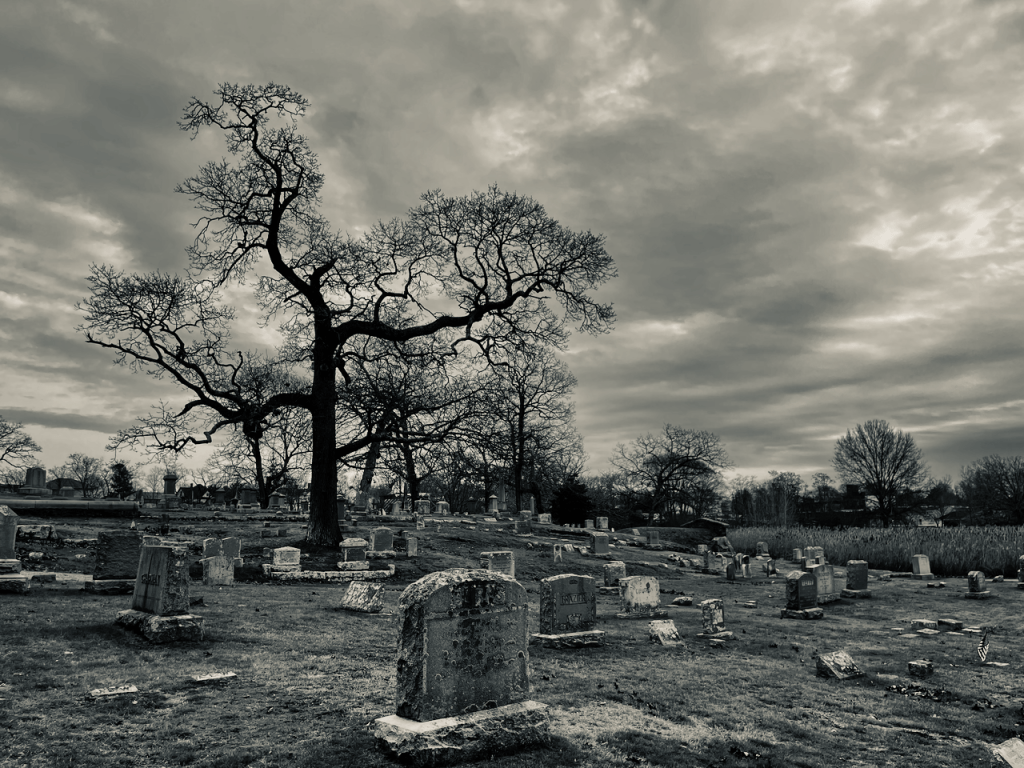
Writing a eulogy is the very start of facing your undeniable loss. Your entry into a lifelong process of missing your friend, remembering at so many turns of their absence. Sitting down to write them a letter and aching for the notes they used to send along. Because their place in your world was so unique, there is no filling that void. It remains a hole in your heart. And the eulogy delivered with tears and grace reminds you as well that others are feeling the same or even greater loss than yours. And that you are connected with all of those who have suffered similar losses. I walk once a week through the cemetery just off the bike path and I pay more attention to the names and dates on the graves, marking all those lives that have come before, loved and buried, with some memories still echoing. Each tombstone its own sliver of a eulogy.
2021, the second summer of COVID. I was hungry for human contact that steeped beyond my tiny world. I must have been radiating that vibe because my early morning beach walks were filled with surprise encounters. The humans I met regularly during these walks seemed completely free and eager to share with me their grand claims about the universe and their profound theories about the ways of the world. They were all sharing a bit of themselves, revealed to a total stranger. There must have been something in me that drew them out without fear of contradiction or challenge. Some people I saw every day, others for one moment, not longer than that.
To be fair, in this second summer, I emerged shell shocked from confinement. Certainly, I connected with people on Zoom calls, but those meetings like I was watching a movie with some friends cast in unfamiliar roles. I was distracted watching myself watching everyone else. None of it felt real. As the months wore on, my colleagues turned off their screens. It was too much exposure and not enough real exchange. We all dove into a huddle with ourselves, it seemed.
Exchanges with strangers on the beach felt like the only true contact I had, and I relished these. I was open and eager for spontaneous conversation to lighten my day. Until that point, I was never that person to begin a conversation with a stranger. I would smile and nod but no more than that. However, based on the conversations I was having, I seemed to present myself as a 72-year-old naïf, like someone brand new to the world. People told me stories and I was enchanted.
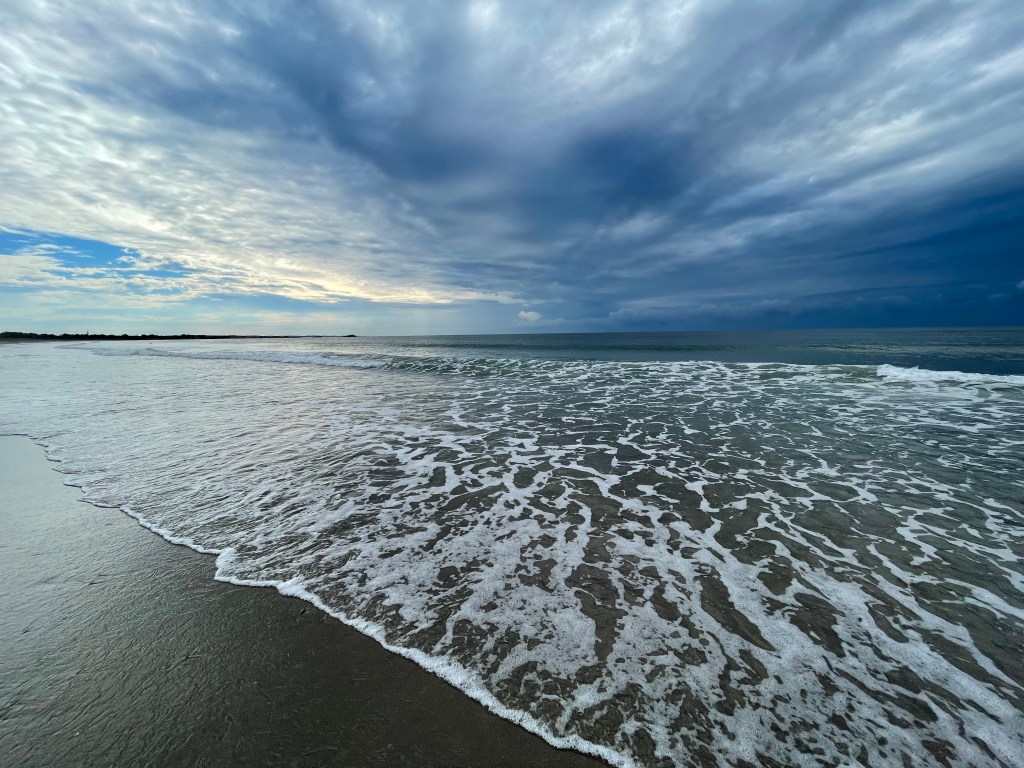
Narragansett beach between weather patterns
One woman, I will call her Hailey, was always splendidly adorned, as if she were attending a party with others similarly dressed. Her disappointment with dress code of the rest of us beach bums was obvious. She sported a giant gold necklace, evocative of a Roman gladiator, and wore well-fitting matching tops and tights. She had the excellent bearing of someone who was not only born into money but also married into it and likely earned some her own. She spoke of afternoons at the Club. She told me about her friend, Billie, her dyspeptic dog, and her former husband who met a fitting end at a hospital in the Philippines. Maybe, this was interesting to me because my father had served there in World War II, although she didn’t know that. Hailey kept asking me if I knew people from the Club, “Do you know Marsha Dawson?” “Have you seen the Clements since they came back from Florida?” Nope. Never. I didn’t even know there was a Club. She shared a story about an albino deer who was especially fond of her. Maybe, albinos are just that way, like some dogs are people dogs and some deer are people deer. This deer had so much regard for her that he never ate her hydrangeas. He also hid from the guests when she was entertaining, keeping him exclusively hers. He sounded like an ideal combination of a gardener and a younger boyfriend.
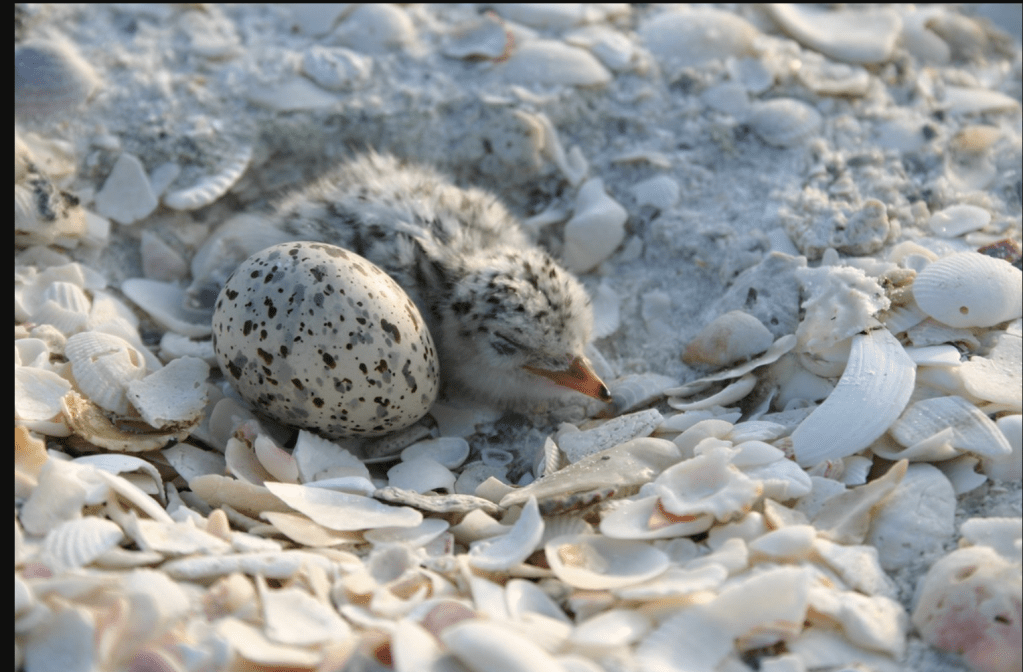
Tern egg with hatchling
As the summer wore on, we stopped on the beach to chat every day. No matter how early I arrived, she boasted that she was there well before sunrise. (At the of beginning of summer, that would be about 4:30 in the morning). No matter how far I had walked, she had walked farther and faster. No matter what I had discovered on the beach—sea glass, an egg from a lesser tern nest abandoned on the beach, fishing lures caught up in seaweed – she had discovered other better things just the day before. How did a beach walk get so competitive? I was tempted to wear a necklace myself made of shark teeth and shrunken heads, just to show her that I was interesting, as well.
Another morning a woman paced one stretch of the beach over and over again, head down and picking at the sand, like an egret looking for food. I learned that she collected sea glass. These people are easy to spot once you know what they are looking at and looking for. I do a lot of beach exploring on my own and will pick up anything of interest. We chatted about sea glass and the perfection of those mornings. I remarked to her about a lovely violet piece of sea glass I had just found, and she replied, “Well, of course, you did. The universe offers these pieces to you, and only you, when the glass is ready to be found, not a minute sooner.” I could have countered with my own analysis, but some minutes in our lives are best spent letting go and listening to how others see the world. She then passed on a chant to me (and only me) and told me how much her dog loved my vibe. I liked his vibe, as well, I suppose. I think he really appreciated that I knew how to scratch his ears but that is part of our vibe together, I suppose, for some of God’s creatures, anyway.
Another woman with a scarf wrapped around her neck and I smiled at each other. We were down at the far end of the beach, dazzled by the light on the water, where the river empties into the bay. The currents and the tides flowing in the opposite direction make for exquisite patterns with light and water and sand. After a few minutes of shared bliss, we acknowledged that we were sharing a beautiful moment. I broke the silence. I said I had seen her yesterday for the first time and she told me in a low voice that she was living out of a van, just like the movie, Nomadland.[1] She was just recovering from melanoma surgery on her neck and chest, aiming to enjoy the day’s light without further damaging her skin. She lived in New Mexico and was visiting her sister who was dying of cancer. This woman was convinced that the cancer was self-inflicted, the result of unresolved childhood trauma. She observed that we can be both victims of trauma and perpetrators, as well. She couldn’t bring herself to care for her sister like she wanted to. Leslie felt she was battling for her own life in the company of her sister. She was bristly about human company although she commented on my gentleness and openness. She also liked my energy.
On the same day, I ran into Tim who practices meditation on the beach. He has a lovely beard and a kind smile. He invites me to join him. I pass and claim that I do a walking meditation. He salutes that intention with a small bow of his head. My next encounter was with an older couple I had been seeing for a few years now. They have a European accent which despite lots of conversations, I have yet to identify. She is wearing a pair of short orange overalls which I recommended to her last year after she complemented me on mine. She said just a few years ago she would have never worn something so comfortable and utilitarian. I congratulated her, nearly hugged her actually. We are always growing together as humans; there is no other way.
For two years now, I’ve seen a lovely couple who are here on summer weekends. They swim at the end of Narrow River floating with the current, into the ocean where the waves guide them to safety. We comment on the wonder of this perfect day, just as beautiful as the day before and the day to come. “How can this be?” I ask. “How can things be so good?” Greg answers, “Gosh, I am so good, there should be two of me.” Exactly. Me, too.
My daily rounds were topped off by speaking with David, a patent attorney whose wife has multiple sclerosis. He so wishes she could join him on his walks. When she does, she is completely exhausted, but maybe in a good way, he thinks. We talk about sea glass which he also collects. “How do you know when you have collected enough?” I ask. “Do you have a plan for it when you die”? He has asked his children to mix the glass with his ashes and to dump both in the bay. That idea really appealed to me. This may be illegal, he fears, not the glass, but certainly the ashes. Legal training sometimes makes you too aware, I think. That sort of thinking can stifle your dreams.[2]
I can say that this daily practice of encountering strangers has added immeasurably to my life in surprising ways. We encounter so many people in so many ways that they can blend into an undistinguished crowd of “people I don’t know.” But each of them has a story and a perspective. Those minutes together are improvised stories, an exchange that brings us both to the present and keeps us here long enough for a true encounter. These are blessings in each morning.
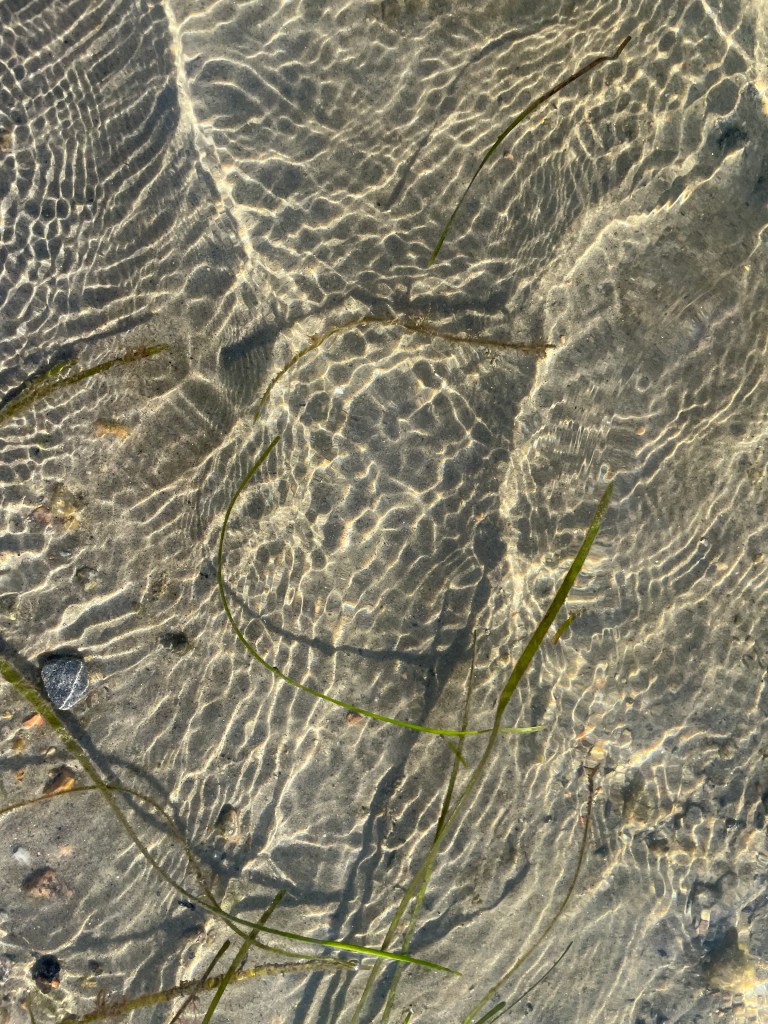
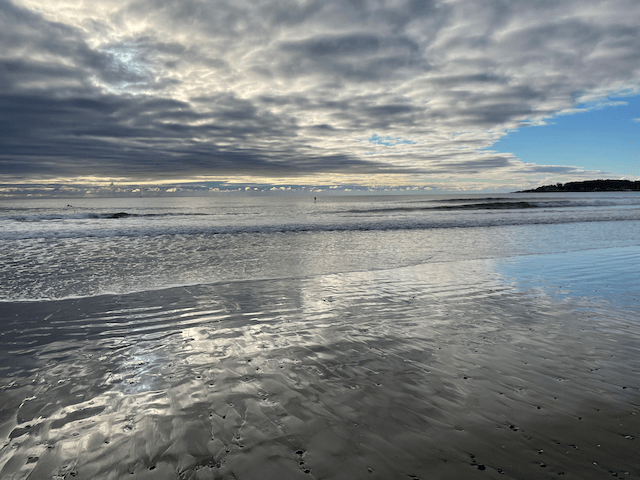
And, of course, there is the simple beauty of the beach, where a careful eye and ear and an open heart with reveal something new every walk, like shimmering light on the water.
Sandra Enos
[1] Nomadland is a wonderful film with a perfectly scored soundtrack.
[2] The EPA has a policy about burial at sea. Cremated remains must be disposed three miles off the coast and reported to the EPA. You cannot simply toss remains off the side of a fishing pier or take them along with your lunch on a nice kayak paddle. I think the Mafia must have scared the EPA into regulating these burials at sea, even cremated remains. They are silent on sea glass.
In our present culture, we seem oriented to believe that our children are special. Maybe that is a biological imperative. We want them to feel special all the time for everything they do. But I think children see through that pretense. They feel the deep fake in it. They are embarrassed when their parents present them as gifted and talented and better than their peers. On some level, children know differently. They know the difference between careless praise and really accomplishing something for themselves.
Although I think a brief study of the history of parenting would lead us to the discovery that our ideas about what children need from us are very much the product of this cultural moment. The history of childhood is a fascinating tale of the history of ourselves as a species. Even a generational change can make an enormous difference in the expectations for parents and children. This may be my nostalgia for my rosy-colored baby boomer childhood, but I am feeling very grateful for my mother’s parenting of us. She did a lot of this as a widow when my father died in an auto accident leaving her with three children – me, the oldest, at fourteen, my younger sister at twelve and my little brother at eight. My mother had no suspicion that any of her children were special in any way. It caused her not one sleepless night that we were perfectly average. And, she might argue that since no one is perfect, we were all actually averagely average. She would have found the idea that you are special just because you are you to be completely insane and especially wrongheaded when it came to raising children. I am inclined to be completely in her corner here.
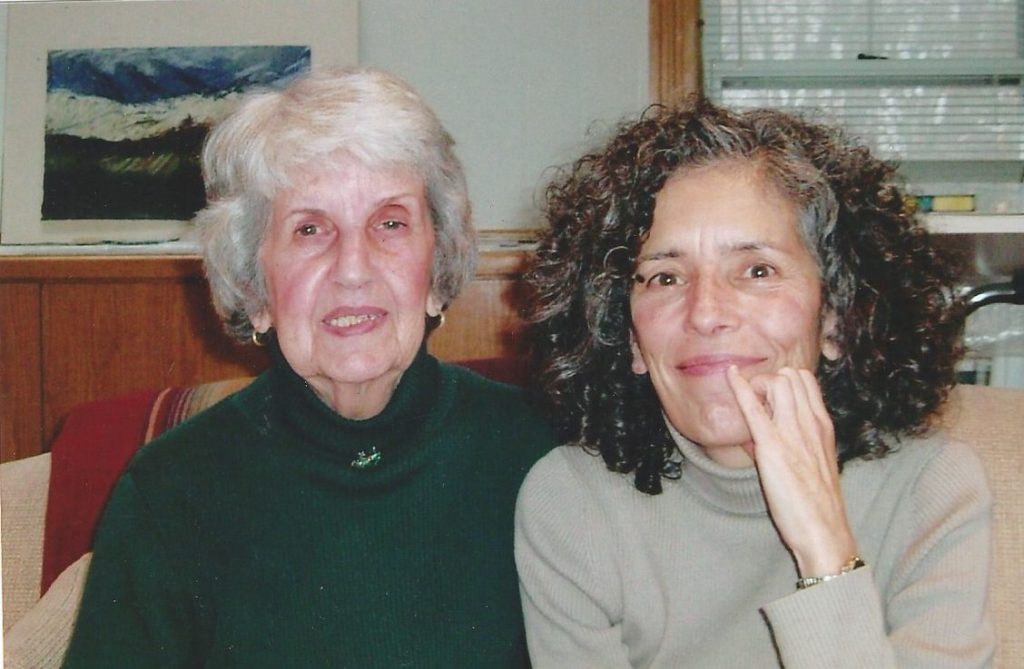
My mother and me
If no one tells you that you are special, that you are musical or artistic or beautiful or funny or smart or just really talented in any way, you are left to discover those things through your own exploration. Without those early and (perhaps) misleading observations about you from your parents and relatives and whomever wants to make such a comment, you are on your own to discover your people, your interests, and talents. You play guitar or basketball and go on long bikes, and you discover things about yourself without much parental support. My mother never attended one of my basketball games. I never sought her advice about pursuing a degree in college because she never had any sense that I would be particularly good at anything. When I did go to college, my mother bet the lady next door ten dollars that I wouldn’t last a semester. I never resented that wager when I learned about at the end of my freshmen year. Given her experience of not knowing anyone personally who had gone to college, she was imagining that college students were very smart, and that I certainly wasn’t.
I worked in a series of factory jobs during the summers, many of which she was familiar with. She had worked in rubber and jewelry factories and knew very well the tedium of those jobs. She had friends who worked in these places, sometimes they were my bosses. I am pretty certain they told her I wasn’t showing much promise cutting huge pieces in rubber into rectangles to be glued onto to the bottoms of welcome mats; I might as well go to college. They may have also shared that the thing I was best at was reading a book. During coffee breaks and lunch, I found some refuge alone outdoors on a picnic bench to escape harassment and bullying as “college girl.” I didn’t feel so special there, either.
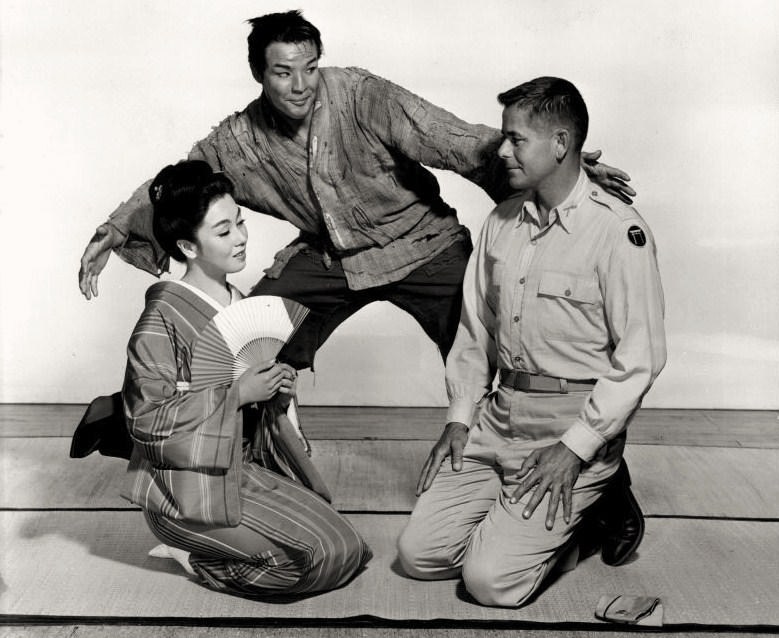
When I was elected class president in the ninth grade and rushed home to tell my mother, she responded. “Well, that’s nice. I am sure everyone in class will get their turn.” When I brought home good grades, she would nod and say, “That is good. You are doing your job studying. I think you could be studying more.” Or when I was the star of the senior play, she was proud enough but wondered why it was I had to play the role of a man. (In my defense, I would have to say here that I attended an all-girls school and not just anyone in class could have made a convincing man by simply painting on a mustache.) In fact, to toot my own horn here, I played the role of Sakini, the Okinawan interpreter, in Teahouse of the August Moon. The great Marlon Brando played that role in the movie of the same name to his great embarrassment I would imagine. Here he is. I am very glad I didn’t see the movie before I played that role.
Marlon Brando as Sakini in Teahouse of the August Moon
When I was in the 10th grade, I saw an advertisement in thelocal newspaper for the Famous Writers School and sent away for the aptitude test. The premise here was that America needed a lot of writers and that by working with distinguished writers like Rod Serling, Faith Baldwin, Bennett Cerf and Phyllis McGinley, you could learn to write and make a big success of yourself. There is an interesting video on You Tube featuring Serling in a promotional piece. I figured if I get into that correspondence school, maybe I could be a famous writer. But more importantly, maybe I could see if I had any talent. I did very well on the test which I recall asked the applicant to describe a scene prompted by a photo, write some complete some items that tested grammar and vocabulary. I don’t know how it happened, maybe it was because of my excellent test results, but a man came to our house and told my mother and me that I was indeed a very talented young person and could be a famous writer. I was so excited. My mother not only doubted the test’s validity, she also zeroed in on true scheme behind his discovery of me as a young talent.
I learned recently The Famous Writers School was actually a cover for a giant fraud. Most students did very well on the test and many signed contracts that they couldn’t escape from. If my Mom had any faith in all in my talent, we would have all been bamboozled. I can imagine many parents falling for such schemes today where their children’s TikTok videos may be used by some random “talent agent” as a key to swindle them out of their savings. Instead, my mother said to me and the salesman that we wouldn’t sign up for Famous Writers School. Rather, I would study harder and learn to learn to write at school where I was studying this every day away. No special talent to coddle here. Soon after he left, she wondered out loud, “what sort of people make a living by writing? What kind of work is that anyway?”
I would also come home with dreams to be something I had heard about in school. One of my classmate’s fathers was a lawyer and that was her dream, too. I asked her about that, and it seemed like a very interesting job to my seventh-grade self. When I told my mother, I thought I would like to a lawyer, she suggested I think of something else. “Don’t get your hopes up too high”, she would caution. I came slowly to understand the source of this dissuasion. With the Great Depression and the Second World War, a difficult childhood and maybe a challenging marriage, she’d had plenty of dreams that went nowhere. Her possibilities were so constrained. My most successful relative was a foreman in a factory. I don’t think she could imagine the possibilities I might have. I didn’t realize those myself until my third year of college.
My mother kept my self-image within tiny bounds, safely trimmed from getting in the way of others. And even though I attended Catholic school, her parenting set me for a Buddhist orientation to life. I have never thought I was exceptional in any way. I think many of us set a goal or attach our hopes to a dream, like writing a book, or earning a PhD. Then, when you do, you learn that lots of average people do these things all the time. That is not to diminish the achievement, it is just to put it all in context.
The gift of those lessons from my mother was that suffered no heartbreak later in life when I recognized that I wasn’t so special after all. I wasn’t as smart as many of my classmates. I was never a great beauty. I was never one to stand out in a photograph or to turn heads when I entered a room. The great gift here is that you have to discover those talents by yourself. You can carve your own path which certainly will be a winding one. You find that in your seventies that great passion is music or theatre and that your long career and several paged resume hardly matters any longer. It is mental furniture for another time and place. You find your specialness in the network of friends you have built around you, all indicators of who you really are. Maybe more self-aware. Maybe more aware of the natural world and the connections. Maybe appreciating your tiny place in the universe.
I have hit that time in my life when I less production-focused and more aligned with delivering the summary report. I have fewer things to do that are connected to larger purpose and complex organizations more to do with observing that the spit at the beach extends a little farther to the north today because of yesterday’s storm and rip currents. I do the later as part of my daily walk at the edge of the Atlantic Ocean on Narragansett Bay, which reminds me of a story. That is another artifact of this life as an elder. Much of what happens reminds you of another thing that happened a while ago. I don’t think I have ever heard a twelve-year old say, “Oh, yes. That reminds me of a story? Have I told you about walking home from school in a blizzard and nearly dying of frostbite?”
Back to that story. A few ago, I served on the board of an organization whose mission was to provide job training and employment for refugees. I was speaking to a middle-aged woman called Maria whose husband was killed in during the Iraqi war. She was left to care for her four children and because of her dead husband’s work, she needed to leave Iraq as soon as possible. She spent years in a refugee camp in Jordan with her extended family. Many of them were eventually sent to Germany but for some unknowable reason, she and her children were to be sent to Rhode Island. She asked a fellow passenger on the flight to New York City about this place called Rhode Island. He asked her if she ever saw the movie Titanic. She replied that she had. He then said, “Well, if you remember, the Titanic sank when an iceberg hit it. That was the Atlantic Ocean. Rhode Island is at the edge of the Atlantic Ocean where the Titanic sank. Right at the edge.” Marie would refer to that orientation point for years when as she told people of the Iraqi diaspora where she lived – here on the edge of the Atlantic Ocean where the Titanic sank. As I look out from the water, I imagine the Titanic and Marie and much more. I can hardly see the horizon without a memory, allusion or poem flooding to the surface. That amazing neural networked, hyperlinked three-pound brain, sitting at the top of seventy-two years of lived experience.
On a recent holiday, I brought my iPad along so that I could do some writing. I have been writing all my life without much synthesis. It is a good thing there is no editor in our Word programs that would remark in a little bubble “You are repeating yourself. Please don’t write this again!” And then it would refer you to a document or many documents from decades ago where you surfaced the same complaint or delivered the same brilliant insight. I suppose we cannot help but echo the same themes that pass through our lives; they are defining. Mary Catherine Bateson writes that our lives are not so much linear progressions as the re-circling and development of themes we live out and through. However, in this encounter with my iPad, I decided to do some digging and exploring. Instead of writing something new (Ha!), I thought to explore files I hadn’t looked at in a while — essays, poetry, observations, drawings from years ago. I found ideas I had abandoned, essays I really loved to read, stories I swear I have no recollection of and more. It was better writing than I remembered creating. I found a beautiful memoir from a painful time in Chicago. I found humorous essays that made me laugh out loud. I was gathering bits and pieces of who I was decades ago and what remained just now. I was trying to reassemble myself the way an archeologist might put together artifacts of a vanished species. I wanted to get a clearer view of who I was with less of a reconstructed pre-formed narrative story. As researchers have established, none of our memories are pure. All are constructed in the way we would write a movie script. We edit out the parts that don’t fit the story we wish to tell. I wanted to confront these former lives in another way.
And there is so much of this writing. Some are like the ones I find on my computer files. Others rest in repose in my large rattan chest of journals. Others in scraps of paper here and there. I have to remind myself that is somewhat unusual. I don’t know anyone else except maybe a friend who was a high school English teacher who has kept a journal for so long. And what would one do with all of this, this enormous collection of a lifetime? It is an amazing record, I imagine of something, of a single surprising and completely average life. If I were a researcher writing my biography, (let’s put aside the question of why anyone would), what would I find? Would my writings be an accurate and telling account of what was on my mind? Would I be disturbed by this telling by another’s hand? Just writing that sentence taps into my defensive nature. I am already primed to argue. Or maybe, that blessed biographer would be gentle and put things in warm perspective.
At the same time that I am collecting these writings wherever they lay and hide, I am reading The Practice by Seth Godin about sharing your work with an audience that will or may care, comforting myself in the knowledge that my writing is not for everyone but that doesn’t matter much. I just need to find a following that is large enough to feel worthwhile for me and them. So, reacquainting myself with all of this work has put some wind under my sails. I just need to get into a completion habit. I can’t really just put things in a TO DO file and imagine they will get done by themselves. That is probably my first and deepest resolution, the result of a life-long bad habit. I see it all over my office and in cabinets. And it weighs on me more than I think.
So returning to the archeology idea, one finds at the end stage of a life, having evolved good and bad habits. If we had archeologists of our personalities, they could assay your long life and conclude, “Well, that lifelong optimism worked for the first five decades but after that, this was a failure.” Or “On balance, the making of new friends all your life made sense, but you lost more than you made. You were careless there.” And then maybe a medical archeologist as well, to say, “Well your chronological age is 72 but you have a 62-year-old heart, 86-year-old hair, 90-year-old hearing and a liver that is over 100. This will all get complicated very soon.”
 Delight/ Awe and other things