Extraordinary Heroes

We are surrounded by extraordinary heroes. Here are mine. Do you recognize their names? 

Ramsey Orta

Feiden Santana

Jamil Dewar

Karina Vargas

George Holliday

Darnella Frazier

No, these are not names of unarmed black men killed by officers of the law. Every one of these individuals was behind a camera photographing a black man, woman or a teenager being beaten or killed by police officers.  

  • Randy Orta captured the choking death of Eric Garner in 2014. 
  • Walter Scott’s murder was photographed by Fieden Santana in 2015. 
  • Jamil Dewar and Karina Vargas shot videos of 22-year old Oscar Grant in 2009 when he was killed at Fruitvale Station.  
  • George Holliday’s video captured Rodney King’s beating in 1991
  • Seventeen-year-old Darnella Frazier took the footage of Derek Chauvin pressing the life out of George Floyd in May 2020. 

I believe that these individuals are heroes.  With courage and composure, not certain of their own safety, they recorded events as they transpired — for others to see and maybe for justice to be done. If it were only so simple. 

Watching these videos should sicken us. The video of the the casual evil that we see in the George Floyd’s killing shines a glaring light on the use of police powers on unarmed black bodies. This imagery has enraged millions of people who have viewed it.  Are these videos so powerful because white people are seeing the violence for themselves, as if Black witnesses to these daily onslaughts are not to be trusted to articulate their own experiences?  

And, as compelling as these videos are, they don’t tell the whole story.  I would like to challenge filmmakers and truth tellers — ordinary heroes — to create and chronicle compelling accounts of other tools of oppression, just as powerful, just as corrupt and perhaps, even more effective as tools of subjugation and marginalization. 

Where’s the Money? I am arguing that we need compelling videos of board meetings where bank presidents plan to hide drug money, fueling not only the delivery of drugs into poor neighborhoods but also enabling the War on Drugs targeted at these communities. I also want to see how banks and financial institutions loot black neighborhoods.  I want footage of the ways in which generations of policies—corporate and governmental — have robbed Black families of opportunities to create wealth.  I want to watch the way payday lenders congregate in these neighborhoods and how banks serve communities of color so poorly. I want to watch the mechanisms that work to pay black men sixty-seven cents for every dollar a white man earns.  I want to see the STOP those stark differences in wealth where the typical white family holds $171,000 in wealth and the typical Black family owns $17,000 come from.  We know that without wealth, families and communities are bereft of safety nets of their own, relying on inadequate, ineffective, and punitive streams of public and private assistance.


Democracy under attack. I am also looking for a video that shows clearly the instruments in place for denying and suppressing the right to vote for people of color.  We need to cast a bright light on town halls and city meeting rooms and sessions of law makers for that video. As dull as gerrymandering may be to examine in process, I want to see the “room where it happens” where voters are sidelined into voting districts that work to undermine the principle of one person, one vote. I want to see it in full color how publicly elected officials undermine the democracy they are supposed to uphold. I want to see how a made-up threat of voter fraud masks the work of taking away a central right of citizenship. 

Ideology. I have been thinking about the genealogy of ideas in America.   What does our family tree of ideas about race look like in America? What is the root of all the ideas we have about race? About people of color?  And what do those ideas begat? And what actions? And what narratives? How do understand our own minds, our biases, our baked-in-the-cake regimes of superiority and inferiority. The hardest footage to capture is those stories and narratives put in place by those in power, our nation’s creation myths, that suggest that the status quo is the nature of things. That hard work makes you successful. That we are playing on an equal playing field. That white folks earn everything they get. Those powerful ideas that explain to us why some of us are at the top of the hierarchy and others at the bottom. White folks can’t understand what it is like to be Black in our nation; we hardly appreciate what it is to be white. 

We need ordinary heroes to tell these stories and others about housing and health care and criminal justice and education. To be sure, we need new tools to fight this fight. We need Oppression Impact Statementswhere we carefully critique and understand the impact of our laws and policies on vulnerable communities of color. We need to understand that even if our ancestors didn’t hold slaves, our ancestors benefitted from programs that advantaged whites and sidelined Black opportunity. And to be sure, white guilt is not the key here. Taking responsibility is—for creating a complete accounting and imagining how we address the wrongs that have created our present. 

Post-script. Darnella Frazier was issued a special award and citation by the Pulitzer Prize board for “courageously reporting the murder of George Floyd, a video that spurred protests against police brutality around the world, highlight the crucial role of citizens in journalists’ quest for for truth and justice.
Be Your Own Crash Test Dummy

About a year ago, I nearly walked into the path of a car that was entering traffic from a parking lot. The driver was edging into the road and had carefully scoped out his exit. I am certain that he had looked up the street and down. I was the surprise—a blind spot—in his field of vision. He was moving south; I was headed east. One half-second earlier and I would have gone sailing into his car and over the hood. I am a small woman, somewhat fit and maybe athletic. I saw myself arcing in a gymnastic tumble. Except, unlike those tiny bouncy teenagers who land on their tiptoes, I imagine that my head would have hit the pavement first, a non-sanctioned Olympic move called The Double Concussion Flip and Fall. Maybe, I was too distracted with my earbuds playing Moby’s Wait for Me; it is a mesmerizing tune. I was over-dressed on this seventy-degree autumn day. 

I stretched out my hands to cushion the crash. When this failed, my chest hit the hood of the car. I bounced back up and tried to resettle myself. What was I doing before I marched onto the hood of this car, I wondered? The driver waved his hands in apology; I waved back. It was like a silent movie. All gestures, no talk. I wanted to dance a bit, maybe skip in front of the car as I left the scene, just like Charlie Champlin might. It was a magic moment. A minute before we had been invisible to each other; now we separated each with a little memory, a shared story to tell our spouses, and maybe a wee lesson, depending on our temperaments.  

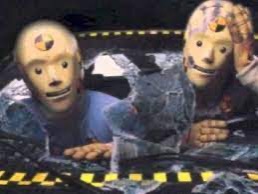
As we live our lives, we collect stories like this all the time. The older you are, the more you have of these. There are accidents, near-misses, losses and what-could-have-beens. Some we bounce back from, others less so. For me, all these brushes with illness and death bring to mind me those public service announcements from the ‘80s with those crash test dummies, Vince and Larry. 

I see much of my life a series of crash test dummy trials. This encounter with the car put my mind on the path of other near misses—a series of events that could have led to some serious trouble. I have sped through a stop sign late at night, distracted and tired. I have twice driven the wrong way down a busy street at twilight. If it had been earlier in that day when I walked into the car, I would have without doubt faced a lot more traffic and a much greater probability of getting hurt. I would have been like a little cat facing the running of the bulls. We could all have been seriously hurt. Well, not all of us equally. 

I have been in cars that have spun out, flipping on their heads in slick Alabama clay. I have been held up at gunpoint in Texas on a little walk in the good part of town. The man who did this looked upset enough to hurt me. I have dodged so many medical scares, that I am pretty certain that my health insurance company thinks that I am messing with their premium calculation algorithm. I have had so many tests and been diagnosed with so many wrongly accused major illnesses, there must be an office pool somewhere betting on my demise. This includes brain aneurysms, stomach cancer, pancreatitis, and more. I could go on and on here, but it seems with every incident I recount here, I am feeling both dizzier and bolder. To me, each of these is a like a crash test. With so much good fortune, a karmic calculation would have me dead pretty soon. As they say, I may be running out of good luck. Or maybe in that cosmic computation, or my good fortune comes at the costs of another’s unearned bad turn of chance.  

Which gets me into the meat of what is really on my mind.  Earned and unearned good fortune. the movie Funny Girlwhen Fanny Brice finds early renown, she says to her lover, the fabulously dreamy Nicky Ornstein,  and supporter that she can’t be famous yet because she hasn’t suffered enough. I understand this feeling. It is that sentiment that much of what we have is unearned. We moan, “Why me?” when bad luck strikes but when good fortune strikes, we smile, “I so deserve this.” Personally, I have unearned good health, undeserved energy, unnatural optimism. I don’t know if others feel this way about the gifts they have. I think we mainly focus on what’s missing.

It seems to me that most of us have experienced good fortune we have neither earned nor merited and of course, the reverse is trueI used to joke with a friend that I had the Luck of the PortugueseWhen that friend remarked that he never heard of the Luck of the Portuguese, I would simply reply, “Exactly.” John Rawls suggests that in considering systems of justice, we imagine that we don’t know where in a social system we may stand.  He calls this a veil of ignorance. How would we want the world to distribute its bounty if we didn’t know whether we were rich or poor or white or Black or male or female or a U.S. citizen or a citizen of another county or abled or disabled? If a thought experiment like this were possible and if it could influence social policy, we would have to be convinced that we actually could stand in someone else’s shoes. Hale doubts this can be done because of what he calls the veil of opulence—the blindness that we all have to the privileges of birth and position. We fall victim to the comfort of believing that if we fell on hard times, we would work our way out of it. The veil of opulence works like the Just World Hypothesis. It creates that delusional narrative that we are self-made, deserving human beings whose unearned good fortune insulates from caring more deeply from others who we see as not as worthy or deserving of what we have. Lots of us dodge bullets thinking we are lucky and blessed; not imaging that the cards are stacked in our favor. Like all those crash tests that I have survived, many have to do with an advantage of class or nationality or gender. Others have to do with random events completely out of our control. And like the crash test dummies, we often do not take good advice or live in a manner that reduces the risk we visit upon ourselves or others. But, as humans endowed with some degree of reasoning, we can do more than our best sometimes to avoid doing the worst. 

All the time

If I had all the time in the world

Such an interesting phrase

As if we did

As if we ever had.

As if we were God on the Eighth Day of Creation

When He spun out time.

The rest of his made world must have had a vexing week

Waiting for things to begin

When he crafted a vast universe 

Then cast upon the world

An uncountable galaxy of time.

But to dream and imagine

If I had all the time in the world at my dispensation

(Had God taken the day off and I stepped in his stead)

I would have a busy day

Spending my time in an inspired frenzy.


Taking time from here and placing it there

Until the world was set on a schedule that seemed to me 

Better.

Some harsh judgments

Some kind gestures

And like God’s version of the universe

Neither fair not just

Perhaps, not for the best.

But in my mind, better enough.

I would take eons from the years in takes to decay nuclear material and

Add them to the years of dogs’ lives so we would have them as life long companions.

I would tack on years to the lives of poor children who needlessly die from diseases a rich child knows how to cure and

Deduct the years spent on our planet by over-privileged individuals who have taken more than their share of the planet’s riches.

I would delay on the arrival of homo sapiens on our planet another 100,000 years hoping that the other animals can develop better defenses to our domination.

I would extend the lives of butterflies and dragonflies and

Bring to an early end the mountains of disposables 

Whose use is momentary and whose legacy is centuries long. 

I would add time to the lives of species going extinct and

Send to its death that most dangerous of all ideas

That because we pass by this way once

We can be ignorant of what comes next.  

That our obligations don’t exceed our vision.

In my own tiny life, I would underline with arias and symphonic movements 

All those moments when others had been deeply generous and kind to me and

I much less so.

The rapture of the cello and the high soprano slowing moments down 

So I can take full measure of those gifts.

Fully alive in mind that our lives that are short. 

We need to do what’s right when the occasion presents itself.

I would bless myself with the magic feeling of the summer’s start

Ten years old

The season stretched out

Time without end

Of untimed swims and bike rides

And discovery and play

And stories in books 

With late nights, capturing lightning bugs in jars

Releasing them just before a deep child’s sleep

When time disappears into another world.

I would add moments to the lives of people who have passed away so I could tell them the story of how much of themselves they have left behind

Ripples of being echoing forward.

I would interrupt time so that I could ask questions of those who have passed resolving for me great mysteries in my own life.

And I would step back almost finished with my work and 

Imagine a trial run where I see an evolving planet

The world made manifest in orchestral form.

Our beautiful tumultuous planet

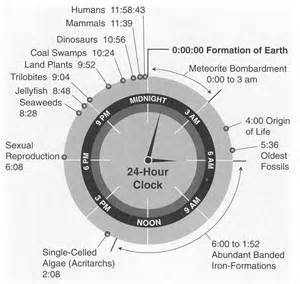
Four billion years

Laid forth in a grand four movement symphonic gesture. 

All wonderfully paced

First a single microbe 

Alone here for three billion years

In our symphony

This accounts for three quiet one note one beat movements.

Now in our final movement, the algae emerge

Followed by multicellular organisms

This, the Cambrian period, explodes into millions of species

Swimming in our seas

(Sound the cymbals: rouse the entire orchestra)

Then a mass extinction

(Quiet the horns and woodwinds:  a solo for the cello.)

Plants emerge on land

Amphibians follow.

Great diversity in plants emerge

Another extinction.

We are half-way through our last movement

245 million to 65 millions years ago

The parade of reptiles

Mammals

Dinosaurs

Birds

Primates

Speed up to seven million years ago

The apes are walking upright

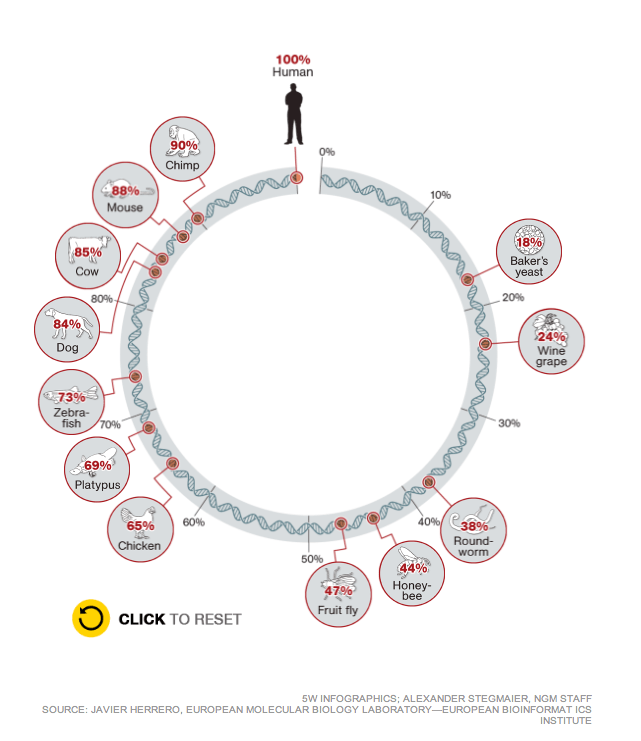
Our complex family tree includes all life

The last stanza occurs in our last 15-minute movement in a matter of seconds

We will have the orchestra play this as fast as their talents allow them.

And the music in its final movement

Gliding to the end, when the universe work is about to finish

With just seconds left

 A recent 13,000 years ago, the humans arrive

Civilizations arise.

Political organization

Religions.

The printing press.

Science.

The Industrial Revolution.

The great Wars.

Globalization of the world economy. 

I enter–a millisecond of a note

One of five billion at the time of my birth

106 billion of us once occupying the planet.

All this perfectly played in time. 

All the time in the world to reconsider another plan. 

Our tiny moment of life

Manifested in the long span of our universe

Forever before us and after. 

Paying it forward and backward

I started my life as a Baby Boomer member of a working-class family in a mixed class neighborhood in a factory town in New England.  Through fortuitous circumstances, few of my own doing, I entered the white-collar class soon after graduating from college. I was the first in my family to graduate from high school and college. With that degree, I no longer worked factory and waitressing jobs that I held in high school and during college summers. I moved into low-level jobs in organizations where my brain was occasionally put to use. Through a series of positions in nonprofits, public service and the tech world, I was able to buy a house, a car and save for retirement. A late in life PhD. allowed me to earn a better salary as I neared retirement.  

Somewhere along the way, I had accumulated stocks and bonds into a portfolio, where my savings were invested by my financial advisor. I am putting these words in italics because they still seem so foreign to me. When I was in the seventh grade, my father advised me to start saving for a house as soon as I could and to never ever put any money into the stock market. “The stock market is a rich man’s game”, he argued. “It is no place for people like us.”  He also warned me against getting rich or wanting to. “Nothing good can come from that,” he cautioned.  I still think my father was right about the stock market and the desire for wealth but with an economic system that simply doesn’t reward savings in a bank account any longer, I opted for the tools available to me. Thankfully, every job I had that came with a retirement plan; there was no way to escape investing in the markets.

So now, over seventy years old, I am faced with figuring out what happens to my portfolio should I die before my modest fortune disappears. I have the chance to bequeath money to my heirs (I don’t have children of my own, but I do have relatives and beloved friends that could benefit from these funds, I am sure). If I pass along wealth to my family, those assets join whatever wealth they already have. Although neither of my siblings is wealthy, we are all comfortable. So maybe some of my fortune could go to nieces and nephews who in their thirties and forties could use an infusion of cash for a house or a car or their own retirement and college planning. 

Alternatively, I could donate money to worthwhile charities or create some fund to distribute those dollars after I pass away.  If I donate them carefully, maybe I could share the wealth with others who didn’t have the advantages I and my family enjoyed during our careers. As I have been thinking about all of this, I recognize that I am not the only one with this challenge. To understand just how important these decisions are we can look at some larger trends.

Research shows that the passing of the Baby Boomers will lead to the greatest intergenerational transfer of wealth we have ever seen. No generation has been wealthier than the Boomers. Between 2018 and 2042, members of this generation will transfer $70 trillion dollars of their wealth, approximately $61 trillion to their children and grandchildren and the rest to charity. That passing on this great wealth can’t help but contribute to growing inequality. We have never before seen more wealth concentration in this country than the present moment. Estate taxes are virtually zero for most Americans and those with sizable assets are usually armed with accountants and financial planners that work to preserve assets. Perhaps, this transfer of wealth will generate great innovation and entrepreneurship. However, we do have some data that shows that giving wealthy folks more money, like we do with tax cuts, doesn’t necessarily lead to creation of new jobs or social betterment. In fact, it may encourage more second homes, exclusive educations, cooler cars, expensive hobbies, moon shots, along with increased concentration of political and economic power, and other mischief.

As I consider this intergenerational passing on of wealth to our children, I am also thinking about the impact all of this wealth creation has had on the planet. I believe the term externality as used by economists can be helpful here. Externalities are impacts created by producing energy, for example, that is not reflected in price charged for that good.  Externalities are also borne by third parties.  In this case, it could be environmental degradation.  Neither the producer nor the consumer pays the price of this instead it is passed along to the local community, or maybe to the larger society in terms of unhealthy air and water. What externalities have been created by virtue of our accumulating wealth? 

 If accumulated wealth is what we have earned while on the planet, what unpaid debts can we incurred? What sorts of impact have we had living on the earth, making our living, enjoying ourselves, and raising our children? We can assume that this impact is great if we live in an advanced economy. Research shows the big economies, like the U.S, Europe, and Japan have contributed by far the greatest amount of greenhouses gases to degrading the environment, but those other economies, like India, China and Brazil are catching up. And while these nations are the chief contributors to climate change, it is highly likely that the poorest nations will bear the great burden from these changes. On a more personal level, we can also assume that if we are middle- to upper-income that our impact on the planet is greater than if we were lower income, because we are able to travel more, consume more, have larger houses, demand more products and services, and more.  

Oxfam estimates that the world’s richest 10 percent of people have carbon footprints that are 60 times higher as the poorest 10 percent. Any estimation that generalizes large populations is difficult to make, but researchers at Oxfam also estimate that the emissions of the world’s richest 1 percent create an even larger emissions gap: the 1 percent could emit 30 times more than the poorest 50 percent and 175 times more than the poorest 10 percent.

So, imagine as we near the end of our lives, we could calculate the debt we owe to the planet.  Suppose when we died, a report issued that measured our environmental impact over the course of our lives. That would include our lives as individuals on the planet, in our households, at our jobs, as we traveled and consumed. It would also take account of the waste we have generated and left behind in landfills, as well as the impact of our investments, and more. Imagine if we can all the water, gasoline, plastic, minerals, food, and other resources that we have consumed or that have been consumed on our behalf. 

Text, letter

Description automatically generatedWhat if there was a reckoning at the end of our lives based on a valid and reliable calculation of our environmental footprint?  Smart economists could determine a monetary value for this. This could be presented at the reading of your will by your executor. First, there would be a statement of your wealth at your death, a total count of your assets and obligations, all set forth and ready for distribution to your lucky heirs and a few selected charities. Second, there will be a fair accounting of your environmental footprint which your children will be obligated to pay off in terms of taxes and other assessments. If they don’t pay it off, it gets passed down to the next generation, just like accumulated wealth. Perhaps knowing that own descendants will be responsible for own environmental impact would lead some of us to care more about the environment than we do now. We would be incentivized to avoid passing down what would be onerous burdens to our children. Those families with parents who had the greatest impact on the environment would pass on their children the greatest burden of accounting for their parents’ impact. It would be likely that those with the largest inheritances would also be those with the largest environmental burdens. 

On the other hand, those who trod softly on the earth, who used less than their share, who lived in less resource-intensive economies would pass on credits to their children. Similarly, those who were the victims of environmental harms caused by others, would also receive credits. Those with debits and credits could settle up in some marketplace yet to be devised. 

This proposal is way too radical to work, I imagine, but it is a good exercise to begin to take account of the fact that those of us with “portfolios” haven’t earned them out of thin air. We do have an obligation to leave the world a better place than we found it. For the Baby Boomers, I think our time is running out. 

The Lamentations of Santa

As the Gifter-in-Chief at Giving Beyond the Box, LLC, I hear from a lot of people who want our help in giving a gift that really matters to a loved one.  That means it has to matter to the person giving the gift and the one receiving it. And, in our case, it also has to do good in the world. I love these calls and emails because I can tell from how much the person I am communicating with loves and cares about the other person. A gift after all is a vector of love and appreciation. 

You can imagine my surprise when Santa Claus called just the week before Christmas, our busiest time of the year. Santa sounded defeated and overwhelmed. To use a term that is popular right now, Santa sounded like he was languishing. He put aside that jolly “Ho! Ho! Ho!” pretense and spoke frankly. 

As he was speaking, I was remembering how much Santa meant to me as a child and recalling that special magic that Santa made. I was late giving him up and resisting not believing in Santa for as long as I could but, I hadn’t really ever thought about the challenges and pressures that face him every year. What follows is my summary of what I am calling the Lamentations of Santa. This is what is keeping Santa up late at night. I am writing this both to document the situation and to appeal to my readers for help on Santa’s behalf.

Worries about the workforce. According to Santa, it is getting harder and harder to keep a dedicated and talented workforce of elves. Some young elves from families who have been in the elf business for generations are no longer interested in these careers. They want to go out and explore the world. That is understandable, of course. And in a moment of hard self-reflection, Santa has also come to recognize that there really is not much of a career path for elves. No elf has ever in the history of the world ever been a Santa. A critical elf recently told Santa that he ran his operation like a monarchy, not like a well-tuned modern organization where employees are treasured and given the flexibility and support to be, to be anything they wanted. So, like everyone, the North Pole is experiencing the Great Resignation, as well, with lots of elves becoming life coaches and baristas. How to replace that workforce remains a big challenge. 

Concerns about sustainability. There is no place more affected by climate than the polar ice caps where Santa lives. If the ice completely disappears, Santa’s Home is in danger to being wiped out. And, after planning his 2021 Christmas route, Santa calculated his carbon footprint and was horrified to learn what impact his travels all over the planet in one frenzied night had on the climate. He has concluded that this long-term practice of distributing gifts is simply no longer sustainable. Alternatives must be found which get us to our next issue.

The cage-free, free-range reindeer movement. As we all know, reindeer have pulled Santa’s sleigh since Santa first pioneered this whole gift-giving industry. However, with each passing year, Santa becomes more and more aware that his reindeer really belong out in the wild, not confined to his workshop, even though he treats them well and kindly. (He was slammed a few years ago by PITA but it is hard to keep them happy.) So, in the spring of 2022, Santa is releasing his herd of reindeer and replacing them with all-electric sleighs. Better for the reindeer and better for the environment, as well. 

Moving Diversity, Equity and Inclusion into the heart of operations. After attending some sensitivity trainings with other cultural icons, like the Easter Bunny, and Davy Crockett, Santa is having a moment of wokeness. Here is a direct quotation that really expresses his thinking here,

Whatever let me think that I, a white cisgendered man living in the global north, could really imagine what children all over the world really wanted for Christmas. This hegemonic approach truly reflects my unearned privilege in this position. It is way past time for me to share the limelight here and champion a whole new generation of Santas that reflect our diverse community and experiences. 

Santa has established a small advisory group, exploring regional distribution centers with culturally competent Santas. More to come here, for certain. We could be looking forward to Santas that upend our traditional model of what Santa should be. We may in fact see a wholescale revolution! The Lose-the-Lap Campaign popular on some social media sites is an early indication of changes we can anticipate. 

Mission drift and the commercialization of Christmas. While all these issues were important, the one that took up most of our conversation was about the true meaning of the holiday. Here, Santa was nearly in tears, regretting his role in making Christmas a delivery system for late-stage capitalism and the deification of corporate power. He argued that by asking children what they wanted for Christmas, he was simply falling into the hands of marketers, training children to be aggressive consumers from the first moment they sat on Santa’s lap to their dying wishes. The Santa brand was in serious trouble, he worried, in danger of becoming just another Ronald McDonald or Tony the Tiger or Kim Kardashian, a shill for big business and worthless products. So, Santa is working to reclaim the true meaning of the holiday in a campaign next year where he is refusing to deliver Amazon gift cards, overpriced toys, fast fashion, cocaine, and more. (You can read about the Santa’s Naughty List and can suggest other items to exclude on Santa’s webpage.) Santa wants you to shop local small businesses, to make some of your own gifts, and to truly share some of your wealth not with the already wealthy people but with others who could use your help. That would make Santa happy.  

So, in summary, Santa has lots on his plate. If you have ideas for him or would like to help in some way, please be in touch. You know that he reads your letters. Your own childhood proved that to be the case.   Merry Christmas!

Almost the end

One day after Christmas

Early on the day after Christmas, I went to Narragansett Beach, at the peak of low tide. The walking is always best for me at low tide, especially during the six months out of the year when I am barefooted. I start this ritual on the first day of April and end it just after Thanksgiving. My aim is to sense through my feet the warming water and the coming of summer as well as the water cooling and the settling in of winter. Once in a while, there is a day out of order when a December afternoon feels more like September, and I take my shoes off and enjoy the cold water until my feet go red and numb. 

A picture containing sky, outdoor, water, beach

Description automatically generated

But on this morning, the sky gathered a full palette of clouds. The sun was just rising above the horizon so that objects in the distance — gulls flying over the water or a surfer catching a small wave – were backlit, like a silhouette. The beach was empty except for one other walker, and I felt in solidarity with the figure on the paddleboard here in the photo. He was so small set in the landscape of the water and the sky. I wanted to welcome him to the New Land, just a traveler, finally arriving in the beginning of winter, looking for a port before he set sail again. 

I felt very small myself, dazzled by the light.

The metallic shine of the sand and the water. 

The bands of light through the patches of the clouds. 

The mesmerizing shuffle of the waves.

My own breath in concert with the beat of the universe.

Even for just one moment.

That is just enough sometimes.

There is great comfort in recognizing your insignificance, in taking full measure of your size and weight in the universe, not as false humility but as a path to giving proper due to all that came before and that will come again, of all we will never know or understand, of all the possibilities not lived and of all the hearts we will never touch or be touched by. 

I finished that walk on the beach with a little prayer for my tiny soul and for all the foolishness of my young life where after a little study I renounced the works of on faith and went to embrace ideas that were more easily forgotten, readily replaced with others. Until coming full circle, I may arrive where I started, as a babe, just baptized.  

COFFEE, CLASS AND CULTURE

Coffee, class and culture

I am sitting on a tiny plane in seat 2A, a prime piece of real estate. I have just transferred from a red eye five hour fully sold out flight from Oakland where I also enjoyed an aisle seat. “Enjoyed” as it is used here is employed in the way one would say that she had a good pelvic exam. I don’t think I slept at all. I ached to sleep but a desire is never as satisfying as the real event, no matter what St. Augustine wrote about this issue, although lust is a nice run up to the real thing.

Dulles Airport, where we landed, has its own culture. I almost ran off the long flight, banging my feet on the jetport to wake up my legs to the task of carrying me into the concourse. It is just before 6 a.m.

In concourse D, few concessions are open. These include the Great American Bagel, Burger King, and for some unaccountable reason, Borders Books. Every individual staffing the fast food counters was a person of color. All the check out people was persons of color. Because our plane was so small, we walked down two movable ladders. All the baggage haulers were persons of color. I was being overly race conscious here, I guess, but it was startling. A bunch of weary travelers had lined up at Burger King begging the lady servers for breakfast. At the bagel place, they were struggling with a power outage and because of that couldn’t sell anything because their cash registers were off-line. A few of us offered cash way in excess of the cost of a plain, unsliced, untoasted, un-crème-cheesed bagel but the staff refused saying they’d get fired if they processed a transaction like that. So, we all moved on.

A clique of weary travelers made our way to the Burger King, the only show in town. The Burger King staff, maybe they are known as nourishment interfacing agents or convenience food expediters, spoke several languages which I think is a beautiful thing in our diverse welcoming society. We monolingual Americans were being served by a variety of individuals with command of a multiplicity of tongues and dialects. This is the way we liberals think about migration. We believe it is all to the good or will be some day, if not this morning or later today. However, one problem here was that the food preparers were all Hispanic, I think. I was not certain of the country of origin. The check out lady was from Southern Asia, maybe Pakistan or Bangladesh. The lady taking the order was from Eastern Europe, I think, maybe Poland. I thought how lovely this was that those striving for freedom and life in a democratic state could find themselves joined together in common cause behind a counter at Burger King. I don’t remember many details from my history about the war between Hispaniola and the Indian sub-continent, but if the interaction between the food staff and the check out lady was any measure, there is a reservoir of very bad feelings from this conflict. The Hispanic women making the breakfast sandwiches could not get the Pakistani lady to understand what they were saying to her, no matter how loud they shouted, no matter how many of them spoke together, and no matter how many swear words they borrowed from English to try to make their point. The point in question can be boiled down to a simple one, “Does a breakfast sandwich contain meat just because the wrapper says it does?” And this moves us directly to the subsidiary issue, a simple episode that reveals class conflict, globalization, the hegemony of the West, the failure of our educational system and the need for universal training in sociology.

I joined the ordering queue at Burger King at approximately 6:15 a.m. I was fourth in line. In a matter of minutes, the line had grown to twenty and it appeared that without a miracle, the staff at Burger King would fail to serve any customer at all this morning and certainly, not the requisite share of billions. Almost every one of us in line was white. There was a black woman in line just ahead of me and she fared no better in getting her food from the staff. The customers in line were displaying typical consumer behavior in twenty-first century U.S. Although we know that behind the counter stands a gigantic corporate entity whose only interest is to make money in this transaction, to convince you to several dollars for food that costs a lot less to prepare, we present ourselves to these corporate monoliths like children before a doting mother. Actually, this is only true of some of these transactions in the commercial feeding industry.

The upper and middle upper classes constitute a special category. Starbucks has created the model here transforming what had been a simple cup of coffee to a drinking experience that conveys and celebrate class distinctions. The upper class aesthete delivers his order with instructions detailed enough to execute D-Day. What I saw this early morning was what happens when the Starbucks crowd finds itself at Burger King, or in other words, what occurs when the upper class takes its consumer behavior and preferences to a typically lower class setting. The first man in line had evidently never been to Burger King or any equivalent fast food joint. He looked at the menu and considered not like the Ten Commandments, which it is—written in stone, the word made food–but instead like an opening for further discussion. He wanted scrambled eggs and whole wheat toast. He wanted a latte. He wanted to know if everything was fresh. He wanted soy milk. The ladies behind the counter gave him that sort of big arching eyebrow look that black women deliver most effectively. “What, are you kiddin’ me?” Translated: “You must be insane to ask me that because if I had the time, I would whip you’ ass good.” The first man exhausting his welcome asked if they had anything wrapped, like a Devil Dog or something. The second man tried something simpler. He was asking the staff (to whom I will refer as the fat and carbohydrate assemblage engineers-FCAE) to put together a breakfast sandwich, a croissant, one of the standard choices, without meat. The woman who took his order nodded and titled her head indicating that like the rest of the cattle, he should move along to pick up his sandwich. I ordered the same thing. We traveled down the line and found two English Muffins with sausage. I took mine and moved to the checkout. The second guy decided to rectify the situation. He cut in front of someone and reordered. The same lady nodded and he picked up the new sandwich which now had ham and was on an English muffin. Partially victorious, he moved to the checkout where another backup was in the making. I had also ordered coffee but that wasn’t ready yet so a bunch of us were waiting around like drug addicts looking for a new dealer. One man actually had the shakes and we had to calm him down. The line continued to grow. The man behind me ordered five sandwiches, all different and specialized.   The lady nodded and pointed him down the line. These customers eventually reached the check out lady who was either praying or swearing to herself. The sandwiches were piling up in the chute. The check out lady would ring the purchases up coming up with widely different prices. I thought this was all supposed to be automated but there were big breakdowns this morning

It was clear that things were not going to work out this morning at Burger King. The FCAEs should have adopted the stance of my working class mother which is, “Listen, you little brat.” This is what I have made you for breakfast. Either it now or go to your room. I don’t have all day to cook this and that for you and fussy brother, missy. This is not some fancy restaurant and I am not your slave!” That would have set us straight.

If I had had more time, I would have suggested to the line of customers that we take whatever the cooks made us and paid whatever the Pakistani lady charged us and then gathered our food at the nearest gate. We would dissemble all the food and then remake the sandwiches to our liking. This would have led to a happier outcome and also would have tapped into another bit of my mother’s sage advice, which is, “God’s sake, make your own damn sandwich!”

As I watched the customers, they were slow to learn the drill. They insisted on tailoring their orders. “What kind of tea do you have?” one nice lady asked.

The eyebrow look again, glancing up at the menu,

“Lady, we have hot tea. Hot tea in a cup.”

The lady smiled apologetically, understanding that she had asked the wrong question.

“Oh, no, I’m sorry,” smiling her liberal educated smile, “I meant do you have any green tea? Or maybe something herbal?”

The counter lady didn’t have time for this.

“Listen, lady, I don’t know what color the tea is. It looks rusty to me. I don’t nothin’ about herbal anything.”

“Well, OK, then. Could I have a cup of hot tea with a two ice cubes in it?”

Thinking that today is the day that she has heard everything from these crazy customers, she makes a show of putting ice in hot water, making certain the other ladies see this!

“Now, you want ice in here, right?”

She glances at all the customers to demonstrate clearly to them that they are in the company of a bunch of fools and idiots.

So, in a brief few minutes, at this Burger King, we have a glimpse into the class dynamics in fast food. Unsophisticated people may see the scene as bad service but that is a wrong interpretation. What this is is class conflict. A sociologist can see the big things simmering here–the significant differences in the privileges and customs of class, even in something as prevalent as fast food. My mother won’t go to Starbucks. “They ask you too many damned questions there,” she complains. “They makes you feel stupid” The ladies behind the BUGER KING counter must feel the same way, confronted on these occasions by the upper classes who are demanding accommodations that are unknown in the world of the fast food shoveler. It takes certain denseness on the part of the privileged to expect this. Sort of an ugly American thing going on.

A minute before class warfare broke out, the feeling of the crowd changed.   Word was spreading that Starbucks was open for business in the adjacent concourse. A businessman stopped his order in mid-sentence to abandon his place at the top of the Burger King queue. Others followed in hungry pursuit. The scene was reminiscent of footage of the American exit from Cambodia. That loyal Starbucks clientele was rescued. They could go home to a place where they spoke the language, where their every desire for foam, and cream and shots, for sprinkles, and would be respected and fulfilled.

It is good to go home, even if that is Starbucks. I believe the Burger King and Starbucks were stand-ins for different parenting styles in our culture. Starbucks, the indulgent parent who seeks to give his child as much variety as possible and allow him to make his own choices. The psychologists say that this style of parenting leads to great success since the children learn decision making skills early on in their careers. The other style of parenting, more the subject of criticism by the scientists is where the parents make the choices and preach obedience, a bending of the child’s will to a larger authority.

I am not certain the Freud would agree with this analysis but I am quite certain the marketing geniuses know that this is the way fast food culture plays out and that they are betting market share on it.