This blog includes essays about life, aging, humor, inspiration and creativity. These things capture my attention and I hope are worthy of yours. Sandra Enos.
The rest of his made world must have had a vexing week
Waiting for things to begin
When he crafted a vast universe
Then cast upon the world
An uncountable galaxy of time.
But to dream and imagine
If I had all the time in the world at my dispensation
(Had God taken the day off and I stepped in his stead)
I would have a busy day
Spending my time in an inspired frenzy.
Taking time from here and placing it there
Until the world was set on a schedule that seemed to me
Better.
Some harsh judgments
Some kind gestures
And like God’s version of the universe
Neither fair not just
Perhaps, not for the best.
But in my mind, better enough.
I would take eons from the years in takes to decay nuclear material and
Add them to the years of dogs’ lives so we would have them as life long companions.
I would tack on years to the lives of poor children who needlessly die from diseases a rich child knows how to cure and
Deduct the years spent on our planet by over-privileged individuals who have taken more than their share of the planet’s riches.
I would delay on the arrival of homo sapiens on our planet another 100,000 years hoping that the other animals can develop better defenses to our domination.
I would extend the lives of butterflies and dragonflies and
Bring to an early end the mountains of disposables
Whose use is momentary and whose legacy is centuries long.
I would add time to the lives of species going extinct and
Send to its death that most dangerous of all ideas
That because we pass by this way once
We can be ignorant of what comes next.
That our obligations don’t exceed our vision.
In my own tiny life, I would underline with arias and symphonic movements
All those moments when others had been deeply generous and kind to me and
I much less so.
The rapture of the cello and the high soprano slowing moments down
So I can take full measure of those gifts.
Fully alive in mind that our lives that are short.
We need to do what’s right when the occasion presents itself.
I would bless myself with the magic feeling of the summer’s start
Ten years old
The season stretched out
Time without end
Of untimed swims and bike rides
And discovery and play
And stories in books
With late nights, capturing lightning bugs in jars
Releasing them just before a deep child’s sleep
When time disappears into another world.
I would add moments to the lives of people who have passed away so I could tell them the story of how much of themselves they have left behind
Ripples of being echoing forward.
I would interrupt time so that I could ask questions of those who have passed resolving for me great mysteries in my own life.
And I would step back almost finished with my work and
Imagine a trial run where I see an evolving planet
The world made manifest in orchestral form.
Our beautiful tumultuous planet
Four billion years
Laid forth in a grand four movement symphonic gesture.
All wonderfully paced
First a single microbe
Alone here for three billion years
In our symphony
This accounts for three quiet one note one beat movements.
Now in our final movement, the algae emerge
Followed by multicellular organisms
This, the Cambrian period, explodes into millions of species
Swimming in our seas
(Sound the cymbals: rouse the entire orchestra)
Then a mass extinction
(Quiet the horns and woodwinds: a solo for the cello.)
Plants emerge on land
Amphibians follow.
Great diversity in plants emerge
Another extinction.
We are half-way through our last movement
245 million to 65 millions years ago
The parade of reptiles
Mammals
Dinosaurs
Birds
Primates
Speed up to seven million years ago
The apes are walking upright
Our complex family tree includes all life
The last stanza occurs in our last 15-minute movement in a matter of seconds
We will have the orchestra play this as fast as their talents allow them.
And the music in its final movement
Gliding to the end, when the universe work is about to finish
With just seconds left
A recent 13,000 years ago, the humans arrive
Civilizations arise.
Political organization
Religions.
The printing press.
Science.
The Industrial Revolution.
The great Wars.
Globalization of the world economy.
I enter–a millisecond of a note
One of five billion at the time of my birth
106 billion of us once occupying the planet.
All this perfectly played in time.
All the time in the world to reconsider another plan.
As the Gifter-in-Chief at Giving Beyond the Box, LLC, I hear from a lot of people who want our help in giving a gift that really matters to a loved one. That means it has to matter to the person giving the gift and the one receiving it. And, in our case, it also has to do good in the world. I love these calls and emails because I can tell from how much the person I am communicating with loves and cares about the other person. A gift after all is a vector of love and appreciation.
You can imagine my surprise when Santa Claus called just the week before Christmas, our busiest time of the year. Santa sounded defeated and overwhelmed. To use a term that is popular right now, Santa sounded like he was languishing. He put aside that jolly “Ho! Ho! Ho!” pretense and spoke frankly.
As he was speaking, I was remembering how much Santa meant to me as a child and recalling that special magic that Santa made. I was late giving him up and resisting not believing in Santa for as long as I could but, I hadn’t really ever thought about the challenges and pressures that face him every year. What follows is my summary of what I am calling the Lamentations of Santa. This is what is keeping Santa up late at night. I am writing this both to document the situation and to appeal to my readers for help on Santa’s behalf.
Worries about the workforce. According to Santa, it is getting harder and harder to keep a dedicated and talented workforce of elves. Some young elves from families who have been in the elf business for generations are no longer interested in these careers. They want to go out and explore the world. That is understandable, of course. And in a moment of hard self-reflection, Santa has also come to recognize that there really is not much of a career path for elves. No elf has ever in the history of the world ever been a Santa. A critical elf recently told Santa that he ran his operation like a monarchy, not like a well-tuned modern organization where employees are treasured and given the flexibility and support to be, to be anything they wanted. So, like everyone, the North Pole is experiencing the Great Resignation, as well, with lots of elves becoming life coaches and baristas. How to replace that workforce remains a big challenge.
Concerns about sustainability. There is no place more affected by climate than the polar ice caps where Santa lives. If the ice completely disappears, Santa’s Home is in danger to being wiped out. And, after planning his 2021 Christmas route, Santa calculated his carbon footprint and was horrified to learn what impact his travels all over the planet in one frenzied night had on the climate. He has concluded that this long-term practice of distributing gifts is simply no longer sustainable. Alternatives must be found which get us to our next issue.
The cage-free, free-range reindeer movement. As we all know, reindeer have pulled Santa’s sleigh since Santa first pioneered this whole gift-giving industry. However, with each passing year, Santa becomes more and more aware that his reindeer really belong out in the wild, not confined to his workshop, even though he treats them well and kindly. (He was slammed a few years ago by PITA but it is hard to keep them happy.) So, in the spring of 2022, Santa is releasing his herd of reindeer and replacing them with all-electric sleighs. Better for the reindeer and better for the environment, as well.
Moving Diversity, Equity and Inclusion into the heart of operations. After attending some sensitivity trainings with other cultural icons, like the Easter Bunny, and Davy Crockett, Santa is having a moment of wokeness. Here is a direct quotation that really expresses his thinking here,
Whatever let me think that I, a white cisgendered man living in the global north, could really imagine what children all over the world really wanted for Christmas. This hegemonic approach truly reflects my unearned privilege in this position. It is way past time for me to share the limelight here and champion a whole new generation of Santas that reflect our diverse community and experiences.
Santa has established a small advisory group, exploring regional distribution centers with culturally competent Santas. More to come here, for certain. We could be looking forward to Santas that upend our traditional model of what Santa should be. We may in fact see a wholescale revolution! The Lose-the-Lap Campaign popular on some social media sites is an early indication of changes we can anticipate.
Mission drift and the commercialization of Christmas. While all these issues were important, the one that took up most of our conversation was about the true meaning of the holiday. Here, Santa was nearly in tears, regretting his role in making Christmas a delivery system for late-stage capitalism and the deification of corporate power. He argued that by asking children what they wanted for Christmas, he was simply falling into the hands of marketers, training children to be aggressive consumers from the first moment they sat on Santa’s lap to their dying wishes. The Santa brand was in serious trouble, he worried, in danger of becoming just another Ronald McDonald or Tony the Tiger or Kim Kardashian, a shill for big business and worthless products. So, Santa is working to reclaim the true meaning of the holiday in a campaign next year where he is refusing to deliver Amazon gift cards, overpriced toys, fast fashion, cocaine, and more. (You can read about the Santa’s Naughty List and can suggest other items to exclude on Santa’s webpage.) Santa wants you to shop local small businesses, to make some of your own gifts, and to truly share some of your wealth not with the already wealthy people but with others who could use your help. That would make Santa happy.
So, in summary, Santa has lots on his plate. If you have ideas for him or would like to help in some way, please be in touch. You know that he reads your letters. Your own childhood proved that to be the case. Merry Christmas!
Let me say right off that I am not what people consider a classic beauty. I have, despite my best efforts, been appreciated more for my wit and intelligence than loved for my beauty or body. Not that I’ve resented this. I remember my mother told me that it was a good idea to develop your mind because even if you were good-looking, it was very likely that your looks would fade with age. She neglected to tell me that even if you developed keen intelligence and a wonderful memory, chances are that these would fade with age as well. If you grew up in the sixties, you can hear your mother saying about your lovely average-looking friend, “Well, she has a lovely personality.” That always meant that the girl in question was a girl like me. I do have to admit that in my family anyway, we weren’t supposed to be beautiful. That was reserved for movie stars. I would hate to be young these days when your image is plastered on Instagram, posing for glamor shots at 10 years old when the pressure is on young women, especially, to be beautiful and desirable.
Those of us not endowed with classic looks spend the first thirty-five years aching to look like someone else and the next fifteen years searching for our own style. This roughly translates into trying make the best of the assets you have. These are personal characteristics that are not recognized by the rest of the culture but of great comfort to one’s mothers and aunts. For example, while good looks don’t run in my family, my mother and aunts applauded themselves for having very thick dark hair, none of that stringy blond stuff some women have to deal with. We are also blessed with strong nails, a characteristic that I’ve used to attract legions of men to myside. And, best of all, we have very wide hips which make it very easy to us to carry children in our wombs. My Aunt Mabel reminded me all the time that when she’s at the mall and sees
these slim girls with long legs and slender hips having babies, she pities them. Well, lucky me.
So, in my fifties, I began to investigate my own personal style. I did this very deliberately. I stared at every one who might look a little bit like me and determined whether they looked better or worse than I did. My measure was very generous. If they looked worse, I maintained my haircut, style of dress and lack of makeup. If they looked better, I try to catch them on another occasion and see if they still looked better. If they did, it planted an idea in my head. Hmm. Maybe I needed a new haircut? A tattoo? Colored hair?
Or I may have looked at old pictures of myself to see if I’ve ever looked better than I did then. This is an insane thing to in late middle age and can be a depressing experience. In my search, I found a picture of myself with a very short haircut and that idea of cutting my hair really short lingered in my mind. Mind you, this photo was of me when I was six years old with a pixie cut and missing front teeth in a class picture. My aunt had just kidnapped from school and taken me to my first haircut at a salon. She did this because managing my too curly hair was driving my mother insane. She was tearing her hair out because she was tearing out mine, trying to comb through it. So, with no solutions sight, no conditioner, no hair management tonic, the only thing was to chop my hair off. When she saw with this tiny little hairdo, my mother was outraged on the outside and delighted on the inside. It seemed that usually, she was the opposite, pleasant enough on the outside and raging within.
So, with that image in my mind, I summoned up my courage, found a new stylist and resolved to get a really short do. I had to change stylists because my Beverly, my previous haircutter would never allow to me to do such a crazy thing at my age. Too radical! If it was awful, how would I show up at work? What would this do to my social life, to all of a sudden look like Joan of Arc on her way to the stake? Beverly was a worrier and my haircuts reflected that. Twenty years of the same style was enough. Time to go bold and beautiful! I could always wear a wig.
So, I submitted myself to the whims and caprices of a 21-year-old beautician named Tami. A recent graduate of beauty school, I figured she would have state-of-the art training and be completely up to date with all the cosmetology literature. All the women who were working at this new salon were about her age, and all spelled their names ending in ‘i’. That was a nice touch; it felt casual and cute. Tami and her fellow stylists were wonderful because even though I was a college professor from a very good school, had won several awards and published well reviewed books, she clearly held the floor, decidedly more confident and more knowledgeable about life and beauty that I would ever have been.
I entered the salon Hair Today and checked in the front desk. By the looks of the receptionist, I was clearly underdressed and undergroomed for an appointment. I had the feeling I should have entered through the emergency room or the back door which they reserved for hopeless cases. Nonetheless, we agreed that I was there for a cut and styling; the receptionist was clearly thinking, “Coloring. Highlights. Eyebrows. Make up. Facial mask. Manicure. Surgery is not out of the question.” She waved me into the waiting room.
I sat patiently waiting for Tami. She eventually called me to her chair and clicked the cape around my shoulders. I looked at myself in the mirror, with that big mass of hair, unruly and unkempt, curly and a bit of grey. She asked, “So what are we doing today?” Before I could answer, she pulled my hair back closer my head and then up and asked, “Let’s try this, shall we?” I had no idea. She came around to look at me from the front with a clump of my hair still in her hands and nodded, “This will be wonderful.” I nodded too, putting myself completely into her hands. I was wheeled into the shampoo bay where I got some important information about shampooing just my scalp, not my hair, about harsh detergents in the shampoo I was using at home and how I’d been neglecting my grey hair. How do these young people know so much? Why didn’t I learn any of this in college?
After my hair was treated with something God made on the first day of Creation so it wouldn’t be contaminated by other things, we returned to the stool where the clipping began. Well, after thirty minutes of intense clipping, my face began to emerge. This was frightening enough, but soon after, my neck began to surface, bare to the world. And, before I knew it, I had a new haircut, a radical pruning down of a concealing canopy of hair. I commented throughout the session while she was trying to concentrate. I tried to ask questions that would help guide her in a Socratic way. “Do you feel this is a bit much”, I asked? She just smiled. She told me to let her know immediately if I crossed my legs. She would stop cutting right away. She informed me that this sort of careless action could cut the line right out of the haircut. She warned me that it would be readily apparent to anybody that saw me that I had a very crooked haircut. She wanted no part of that. Besides, she said, her mother got varicose veins from crossing her legs. I guess she had me pegged. I nearly did it a couple of times but was too terrified of the consequences.
So, ninety minutes later, I emerged with a biodegradable bottle of biodegradable gel and a little cap of a haircut. With a great short haircut, I really saw the shape of was skull. It was very reassuring and comforting to rub my nearly bald head. Many of my friends asked for that opportunity; other people just rubbed my head for luck, I thought.
Overall, the haircut was a great success. One man at work came up and said to me that if my boyfriend didn’t take me to a fancy restaurant and dancing and that if he didn’t tell me how gorgeous I was, I should dump him immediately. Then, he wanted to know if I was married. Every time, he passed my desk, he whistled but, his whistles sounded like bird calls.
And, everyone else has been just as complimentary. One woman told me it was the best thing I could have done. Quite an assessment. So, Tami was right on target. She led me to the promised land of a great haircut entirely out of my own comfort range. Even now at the age of seventy-two, I think, maybe it’s time to go see Tami again. She’d be middle-aged by now, probably still a genius.
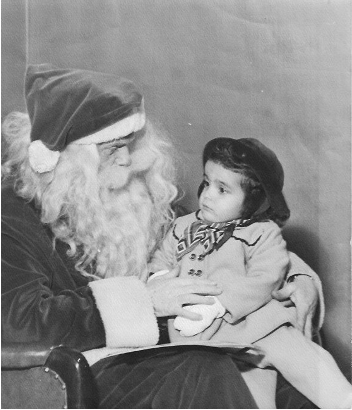
Here is a picture of me at two or three years old. I am sitting on Santa Claus’s lap. I am wearing a lovely little coat with a velveteen collar. This is a hand-me-down from one of my better-dressed cousins. My sister and I wore lots of these clothes and passed them on to other cousins. Like many working-class families of the time, we had an internal barter system that kept us with few pieces of clothing in our individual closets but with access to an ever-changing wardrobe of used clothes. I loved that coat and took care of it while it was in my care. I am also wearing a little hat and carefully tied scarf. I was so much better dressed when my mother was in charge than I am now. But my outfit is not what draws my attention, rather, it is the expression on my face.
Santa has introduced himself. He has been told my name and engages me in a typical holiday conversation. He knows the script and I have been briefed by my parents.
Santa: So, Sandy, Santa wants to know. Have you’ve been good this year?
Little Sandy Lee: Gosh, Santa. “Good” sounds to be me like an end state and how can that happen in human beings who are always changing? This year, I would call myself “goodish.”
Santa: Well, sure, that’s a fine point to make but I am sort of busy here. Little girl, what do you want for Christmas?
As I take in that photo, I am wondering how hard Santa and my parents may have worked to make me smile. I appear to be in a meditative mood. How was I to know what I want? Even at the age of 72, I am still pondering that big question. What do I want? I see a child that is perplexed. Why ask me what I want? Aren’t my parents in charge of knowing what I want? Besides, decisiveness has never been my strong suit and as the Buddha teaching, wanting is a sure path to suffering.
So, I reply,
Little Sandy Lee: Oh, don’t worry about me, Santa. My Mom and Dad have that covered. I’ll get more than I want. They’ll be clothes and candy and toys and if I am lucky, there will be some empty cartons to play with.
Santa: So, if you don’t want anything, why the visit today? You are not just wasting my time, are you? There are millions of children in China who would love to be sitting on this lap.
Little Sandy Lee: No, Santa. I really need your advice. I know that I am an over-indulged child and I live a life of ease. I don’t even have a job and although I’ve begged to have some chores to do my parents say I am way too young. Next year when I am four, that’s when opportunities will emerge.
Well, Santa, what I really want is to get some gifts for the people I love who care about the planet, the empowerment of women and social justice. I want to give some gifts that mean something. Do you know what I mean, oh, wise one?
Santa: Oh! I get it. Gifts that make social impact? What about Giving Beyond the Box? They have gift boxes full of products with meaning and purpose.
Little Sandy Lee: Wow! That would be perfect. And isn’t it true that you can’t buy their boxes on Amazon and that tiny little company is run by an overly energetic septuagenarian?
Santa: That is exactly right on both counts! Giving Beyond the Box is a tiny company in a tiny state run by a small woman who is old enough to be your great grandmother. Check them out as soon as the internet is invented. That will be in about fifty years. Your time is nearly up. Anything else?
Little Sandy Lee. No, thanks, Santa. No wonder we all believe in you. Next time, however, can we talk about your carbon footprint, your treatment of those caged reindeer, whether elves are really contract workers or employees, and whether you are help to create children addicted to hyper-consumerism?
Sociologists and political scientists are worried about us—all of us and some of us a lot more. Part of their compensation package is based on how many people they can convince to share the same worry. And, if that worry turns into a social movement, that is even better and actually miraculous. As a few of them might conclude about such a development, such progress would be “an unanticipated and not well predicted outcome given the variables under consideration and the logic model imposed upon the data.” Huh?
In any case, they are worried about the way we live our lives, especially compared to our previous settlements and interactions. For example, they report that our children used to play with the neighbor’s children; now children are matched up with like-minded and like-classed others and sent far away to the develop their talents, no matter how weak those gifts really are.Play dates are increasingly like arranged marriages.
They also note that where we live—our address in a specific community—has fallen victim to the “big sort.”If on Memorial Day weekend, we look to houses on the right and to the left, chances are everyone is cooking on the same type of grill and eating the same menu. We are organized by social class and hardly meet or interact with others who are living other circumstances. When I was growing up very working class, the dentist next door would always borrow our lawn mower, not because he couldn’t afford one but because my father was more “handy around the house” than he was and could keep a lawn mower running no matter what the challenge was. This allowed us to trade that favor into pretty good dental care.In academic circles, this is referred to as “social capital” and is as valuable as other forms of capital, only harder to commodify and certainly nearly impossible to put in your wallet.
They also complain that we are increasingly isolated and privatized.We don’t visit with our neighbors. We don’t drop in at each other’s houses.The world is so digitized and segmented and that the old days of people coming to your door without a pre-arranged mission are long gone. You could with great justification greet someone at your door these days with a salutation like “Did you NOT check my online calendar? Did I seem ready to accept visitors?” Now, when the doorbell rings it is for a special function—the UPS man, the cable guy, or people you’ve invited for a dinner you’ve Doodling, texting and Googling about for weeks on end. When those earnest signature collectors come from Clean Water Action is an exception. They are too young to know they are breaking some big rule.And, of course, there are the Jehovah’s Witnesses who must have special training to employ rejection as a source of connection to salvation. I admire their inability to know where they are not welcome.
Two weeks ago, on a busy Saturday morning (another observation by the sociologists—even our leisure time is way over-programmed) the doorbell rang. When I first heard it, I thought, “Do I have a text?” “Is the laundry done? “Is the smoke alarm battery calling in to let me know its days are numbered?” Yet another observation by another researcher, the average American adult hears 150 beeps/blurps/chirps/bings every hour, most of which he ignores, just as he should. Some days, when my electronic devices seem to all call out as if it is their mating season, I feel like a dog in a Skinner experiment, raising my little ears and salivating for no good reason. These days, like mothers of yore, our smart phones rings and we can call out “That’s my phone; I’d recognize its ring tone anywhere!” I think all primates, birds and even worms recognize these calls for attention.
So, the doorbell rang I made my way downstairs We don’t have any way in our house of checking out who’s on the front stoop except by running outside and seeing, which really blows your cover. So, I simply opened the door to find an elderly man and a younger one. I deduced that they were together by their outfits, neither dressed like the FedEx man. Initially, I thought, “Encyclopedia salesmen” but then I remembered there were no more encyclopedias and selling Wikipedias door to door seems sketchy. And, besides these men were more Fuller Brush than Face Book types. I gave them a quick look over and thought they posed no terrorist threat, so I opened the screen door as well and gave them a little smile and asked, “Can I help you?”
“Well, good morning, Ma’am. Isn’t it a lovely spring morning!”
I stuck my head out the door, looked around and agreed that it was.
“Ma’am, I am minister Bradford from the Calvary Baptist Church up the street and this is a parishioner from my church, Petey.” Petey couldn’t stop smiling and raising his eyebrows. They seemed nice enough so I let him continue his introductions.
“Ma’am, do you know Jesus as your personal savior?”
Gosh, the swarm of snarky replies that swept into my conscious brain was almost overwhelming. I have never ingested a really serious illegal drug but I imagined this was like that rush. Part of the problem of being a professor is the employment of quibbification as a tool of combat and partee. Quibbification, as defined the Professor’s Handbook, is the tendency to question every word and argue as long as breath will allow to answer questions that no one but you and another remotely quoted scholar has raised. So, when this nice man asked this question, I wanted to jump into a discourse about the disappearance of mainstream churches, the attraction of me-centered theology, the development of drive-in churches, God as a merchandising brand and so on.My brain spun on.
“I don’t know Jesus as my personal savior but I bet you don’t know Megan, my personal trainer or Siri, my personal assistant, either” was my second thought. That sounded like it evened the score but it had a taste of meanness to it. My third possible response followed.
“I don’t know Jesus as my personal savior; our relationship is more spiritual. I consider Him less a friend and more of a benevolent overload. Sort of like one of the heads of the Hogwarts school, but with an appeal process.”That kind of reply sounded like it could have launched a long conversation about schisms in the church and the changing character of religious faith. This pastor may have read the same sociological journals as I did and given his seriousness of purpose may have known the literature a lot better.So, I passed on that response, as well.
I simply replied, “Actually Reverend Bradford, this is a Jewish household.”
A light fell over his face, like rapture.
“My gosh, we love the Jews!” He nodded to his colleague, “Don’t we, Petey?” I think Petey nodded but mostly I think he was surprised at the turn the conversation took. Or maybe, he could just read my mind.
Then, he rolled out in quick order all the reasons why Jews such a gift to him.
“Ma’am, did you know that Jesus was a Jew?”
I am thinking, “Well, that’s the way the story goes but why was his last name, Christ?” I let it go.
“And all the apostles were Jews.”I nodded my head; I did know that.
“And, the Jews gave us the Old Testament.”Quibbification raises its head.“Gave?” I wondered. Maybe not exactly gave. Maybe, left it hanging around like a library book that gets read by lots of people. And, I didn’t want to get into the complications here with authorial attribution and the lost Gospels and the DaVinci code, so I let that go, as well.
I smiled in recognition of his kindness and openness to me and my faith. Of course, it should be said right here that I was raised a Catholic and live with a partner who is Jewish. So, quibbling again, we are not exactly a Jewish household but my claim to him that we were seemed like an easy enough way to not have a long conversation on the steps. I wanted to be kind and respectful.
“Well. Reverend, in this household we embrace all faith traditions and respect yours, of course.” I thought, gosh, it is so easy to sound inauthentic.
“I hope you have a good day and best wishes in your ministry.” I shook their hands and they left with a little wave or maybe that was a blessing.
I am learning the lessons of social media. Not only do I have a time-limited embodied life that keeps me busy enough—respiring, digesting, ambulating, interacting with others in real time and real places, and other tasks—I need to have a digital presence. As the young digital acolytes warned in a social media workshop I was made to attend by my employer, “If you are not on the web, you don’t exist.” I am not certain that these social media types are the students who majored in Philosophy; that seems like a different crowd but I am taking their advice to heart, however, fickle that heart is. If Rene Descartes were living today, instead of writing “Je pense, donc je suis” or “I think, therefore I am”, he might have penned, “Je clic, dons je suis” or “I click, therefore I am.” Or being French, he may have simply enjoyed a glass of Beaujolais and waited for this new fad to pass.
Being way too American and old enough to feel that I better keep up with the newest technologies lest I betray my age and foggeyness, I launched into an intensive self-improvement plan. So, the first step was to assess my digital presence. Who was I? What traces was I leaving? If I Googled or Binged myself, who would I find? The first results were a little shocking. Googling my somewhat unusual name (Sandra Enos, Ethnic Azorean, simplified at the border when we migrated here), I found lots of matches. I found myself as professor (good news for me) and I also learned that another me had recently died in Vermont and yet another me had been indicted in Virginia. You can imagine my confusion and dismay. Because I am so new to the etiquette of the web, if there is such a thing, I didn’t know if I was expected to send a note to the deceased and a cease and desist order to my felonious namesake. Suppose some remote contact was trying to find me on the web and didn’t have enough information to discern among the multiple me’s? I mean how is one to approach these things? Lots of indelicate situations can arise; I am certain of it.
Googling for web hits was one thing. I could also birddog my presence in photos and videos. Again, sort of shocking. I found images of myself that I never posted and didn’t recognize. I don’t have a press agent or a publicity team so I am not certain who is making me famous. In fact, I may not want a digital presence. Shouldn’t we have some rights to not have our bad pictures posted? This whole experience reminded me of that awful day when the high school yearbook came out and you learned two pieces of very bad news. First, you are so unattractive that other people cannot tell a flattering picture of you from an awful one. One photograph looks as unappealing as the other to the editor of the yearbook. Second, among all the stupid photos, inside jokes and lame stories, your pithy comments and brilliant insights about your fellow students didn’t make the final cut after all. The web seemed like that day in high school. I was stuck with two uncomfortable feelings—a disconcerting sense of loss of control and a bitter taste of revenge—just like in high school.
Given these early experiences, I was committed to setting things right. I figured that my web presence should be very much a matter of my invention. I wanted to be creative, cutting edge, entrepreneurial, integrated, all natural—whatever would make my digital presence cooler than my real presence. I mean creativity and innovation are all the rage now; they are the cat’s pajamas which given our recent over-the-top seduction by our house pets sounds like a perfect niche to explore. (Gosh, I am already feeling entrepreneurial.) So, my webself will be taller, more clever, more generous, more flexible, and more centered. And as a distinguishing marketing pitch, I will also suggest that while many twenty-year olds can multitask, that I can uni-task–do one only thing at a time and get it done. A uni-tasker is like a unicyclist. We don’t win races; we have amazing balance and we can do our tricks on a tightrope. Try that you thumb wielding texter, you!
If I understand the workshop leaders correctly, I needed to take charge and manage by web self. I need to Tweet. I need to Facebook. I needed to Reddit. I needed to blog and reblog. I need to Instagram. I need to do things that aren’t even popular yet. I need to be an influencer. I need to be an aggregator. I needed to have a webpage with a clear compelling design. Most importantly, the workshop leader insisted that I needed to drive eyeballs my way. Sounds like a cattle drive to me with cowboys and reluctant cows. It is brings up one of those creepy drawings of
One important question that the workshop leader failed to address at all, a deeply existential one to my way of thinking. What if your digital presence and your real self begin to drift apart from each other? What if they go their separate ways? What if your digital self finds better work? What if your digital self gets beaten up and bullied on the web, which I know is a real danger? How much does your real self feel that pain? I am thinking a great deal which I think may mean doubling the cost for therapy but maybe not for medication.
In an earlier blog post, I wrote about my transformation into Tech Girl, a mature woman who would swoop in to rescue digitally challenged elders who were being attacked by electronic personal assistants and harassed by poorly designed log in routines. And, while I am still looking forward to that superhero assignment once I retire and have the time I need to become a proper superhero–wardrobe, branding, licensing and insurance coverage—I am increasingly concerned that I am actually losing other superpowers. Actually, what seems to be to be superpowers at age 66 were talents I took for granted a few decades ago. These seem to be simple enough tasks but it should be remembered that even a genius like Siri can’t do these things very easily so I should give myself a break as well and not be too concerned with these changes.
These superpowers once in hand no longer easily accessed include:
The Begats. Keeping the names and the progeny of friends and family members straight and remembering without effort who gave birth to whom and in what order. Like the Old Testament in Genesis with all those begats. This contemporary version is harder because it seems back then everyone had his own name and you didn’t have to keep straight all the many Mallorys, Melanies, Melissas and Madison who are in your life.
Old dogs: no tricks. Adults are often surprised beyond reason when they hear a toddler speak perfect French. Well, maybe not like the French majors at the Sorbonne but French that is better than mine despite years of adult effort. While learning algebra or verb tenses seemed to be a normal part of growing up, learning some things grows harder as you age. It seems the memorizing part of your brain diminishes and the area of your brain some idiot designed for forgetting swells up. This is like saving something special in the refrigerator for lunch and having your partner pitch it in the trash (over and over again.)
Disappearing acts. In my earlier days, I could cavalierly reject the advice from Benjamin Franklin or Felix Unger—a place for everything and everything in its place. I could find things no matter I misplaced them. I had a great memory. My bathing suit? At the bottom of the swimming pool. My driver’s license? In that pair of pants I wore last summer. My keys? Somewhere in the house. None of these things were really missing. Just temporarily not in my possession. Now, I am seriously constrained. I spend way too much time putting things where they belong. The ease of the spontaneity has gone. Now, I have a Container Store mentality—I can’t not worry about storage and filing and I hate it. Now, when I lose things, I know right away that they are seriously lost. There is no mystery or hope or wonder.
Mindlessness. There is a lot written about the brain’s executive function. As I understand it, this is your brain’s control center. Like an air traffic manager, this function manages thoughts in and out; it lines up activities. It is a big to-do list maker, directing everything from brushing your teeth to ordering your bigger priorities. I used to leave this function to operate itself. I was confident in the management of my brain. In fact, I would be happy to give it a outsized salary and stock options; it was that high-performing. However, after a decade of disappointing results, I mounted a hostile takeover of operations. Never mind, I grumbled, I’ll do it myself. Now, I spend more time managing things—to do lists everywhere in every format. I write them over and over again. It is weird, no doubt. It is like ordering yourself to do work, like a memo from a manager who doesn’t want to deal with you face-to-face. I have moved from the pleasure of automatic pilot to to-do list automaton. I miss the mindless me.
A tale thrice (or more) told. There is no question but that I was blessed with a reliable memory. Not only could I remember a personal story, I could also recall when and with whom I had shared the tale. Now, when I am about to make a point with that story, I preface the presentation with, “I may have said this to you before” only to have the other party nod as quickly as they can so they don’t have to sit through another rendering. Not only is this embarrassing because it appears you have no recollection of this important conversation you had with your colleague, it is also makes it virtually impossible to lie effectively. To be a great liar, you have to keep track of your tracks and if you can’t do that, you need to be careful with your truth. Maybe, that is why the very young find their grandparents so lovely. Children sense that these elders are not as scheming as their parents because they can’t be. They don’t have good enough memories to cook up an airtight tale. They do, however, have enormous powers to make up things because the facticity of things seems to matter less.
In any case, all these powers came very easily to me in an earlier version of myself and now that they don’t, I am thinking I should make plans to cover my deficits and move onto to some important work legacy-like work. And, in fact, I think the powers that I will discuss below are sufficient compensation for any of the superpowers that I have lost.
I am thinking about the next stage of my life and what I need to leave behind. Erikson’s theories of development suggest that in the last two stages of development that adults are first directed to fashion accomplishments that will outlast them. These efforts are often directed to some work or activities that result in a positive impact for others. The final stage of life is a reflective one where a feeling of fulfillment and contentment may surface if one feels satisfaction from earlier stages.
To guide me in this important work, I draw upon two reservoirs of wisdom: first, the theory of mattering and second, the idea of the summoned life. Mattering is a social psychological concept developed and tested by Professor Gregg Elliott at Brown University. Of all the reading I have done in this field, the appeal of mattering stands out in its power and simplicity. Elliott’s work focuses on adolescent development and mattering explains much in a few empirically tested premises. Three elements are at play here. First, does this child feel that it matters to others that he shows up? Or does he feel invisible when he enters a room? Second, does she feel that other people are invested in her success? Do they indicate that they are on her team? Will they take an extra step for her? Will she feel that she is the object of their special attention? And finally, does the child understand that others can rely on her? That they depend on her to take care of them in some way? Does she appreciate those qualities that she has that others recognize but may be invisible to her?
In my read, mattering works in two dimensions: Am I important to them and are they important to me? Elliott proposed that for children, the former can balance out an absence of the latter. In other words, a child can be neglected by his parents (or the opposite—subject to the object of too much of the wrong kind of attention) yet feel as if he matters if he feels his little brother is relying on him for protection, if his aunt can trust with him to complete his chores, or if a teacher understands that this child will protect more vulnerable children and the child acknowledges that her faith in his goodness.
Although designed to help us understand the treacherous waters of adolescence, mattering has significant practical appeal at each stage of our lives. As an older adult and faculty member, I use every opportunity to help my students understand that they matter. I offer investments and interest–Can I write you a letter of recommendation?I missed you in class on Monday; are you OK? I help them to recognize their strengths, as I understand them. You have such strong analytical abilities, I say. Have you thought about graduate school? Or, I saw how upset you seemed by that comment from that other student. You showed great restraint and did a wonderful job returning our class discussion to a more productive exchange. That takes real emotional maturity. We are lucky to have you in this class.
I think about a younger generation of colleagues and the challenges they face in moving up and finding their place in the world. For someone with my career trajectory—finding my calling at age fifty—I am a good example of someone who has led a life of experimentation and ‘try and see’. But things seem much more serious for this generation I consider all the messages they receive about how to value their lives. E.E. Cummings once wrote, “To be nobody-but-yourself—in a world which is doing its best, night and day, to make you everybody else—means to fight the hardest battle which any human being can fight; and never stop fighting.”
That sense of constantly working towards who we are is a profound recognition of the second source of wisdom, lessons about the summoned life to use the term coined by David Brooks. On the surface of it, the summoned life appears to stand in direct opposition to living to execute one’s passion. Brooks suggests that there are two paths of living one’s life. The first is to drill down and find one’s passion and direct one’s energy toward fulfilling. This path seems to be the chief and only commandment adopted by career guidance services and admissions offices in colleges. We will help you put your passion into practice. You will never be happy until your passion aligns with your actions. But, the truth of is that we can move through many stages of development in our lives and that the individual who knows his passion early on may be the rare case.
The alternative path is the summoned life where contingencies and circumstances call you to action. We may be without a driving dream but we do have an integrity that is so strong that others seek to engage it. We may lack passion because we are divided among multiple interests but someone sees that we find connections they elude others. We are the sort of people who integrate ideas not dice them into tiny bits.
Like being inspired by mattering, I am likewise energized by this idea of the summoned life and the sort of work I want to engage people in. I would like to create flight plans for enrolling others in the summoned life and in embracing daily practices of mattering. I believe these are important tools for legacy making, not in grand gestures but in generously and lovingly passing along our belief and confidence in generations to come. Both help us understand and activate Erikson’s concept of generativity—the concern for making a mark, for co-creating a desirable future, and for making a sense of optimism about the future grounded in purpose. Maybe, these are super-powers that can only be granted if we are willing and able to forego others.
Bibliography
Brooks, David. “The Summoned Self.” New York Times, August 2, 2010.
Elliott, Gregory, Suzanne Kao, and Ann-Marie Grant. “Mattering: Empirical Validation of a Social Psychological Concept.” Self & Identity 3 (2004): 339-354.






 Delight/ Awe and other things