The working theory of the universe

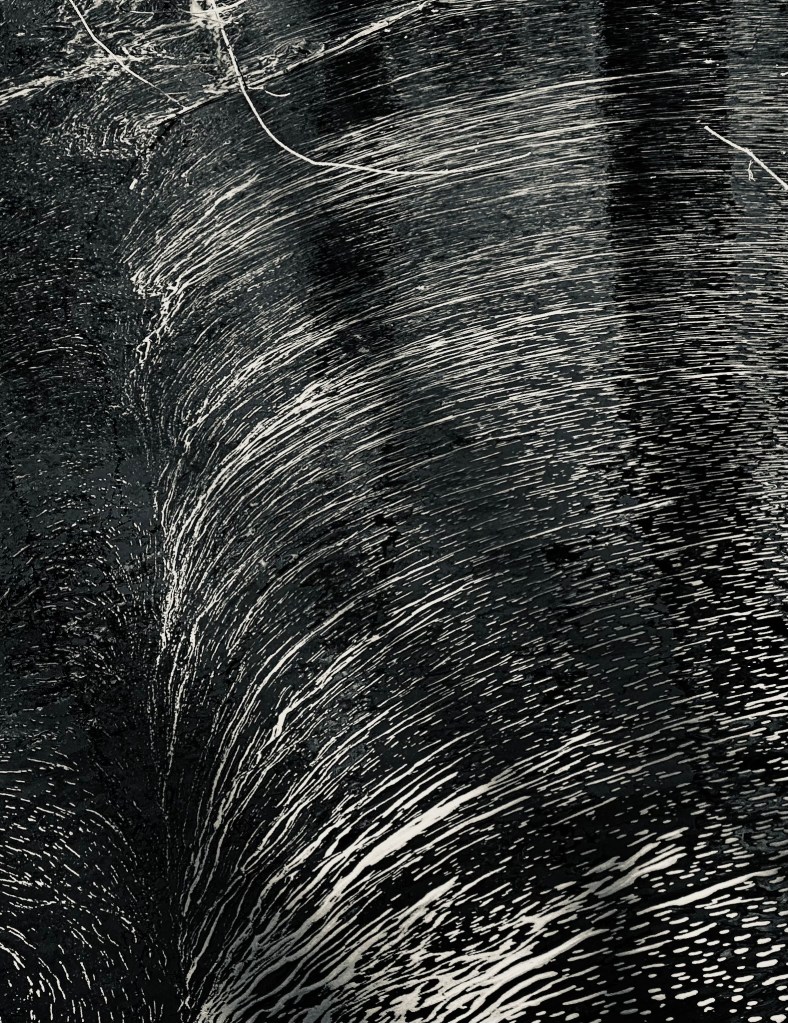
Although I don’t believe in the unified theory of creation, I do embrace the notion that patterns characterize our lives, giving them coherence. In fact, our brains are always making sense of our surroundings — not in ways that always render the truth — but having a working theory is better than the disorienting feeling that all is random and chaotic. 

Seeing this image reminds me of the Milky Way or a Ferris wheel at night or a vortex of particles swirling in a magical mixture. When in fact, what I captured is a tiny body of water near Asa Pond and off the bike path after a heavy rain, bringing soap suds into the stream and down a half-foot waterfall. The more you look, the more you see the connections and the deep surprise of everyday encouters. 

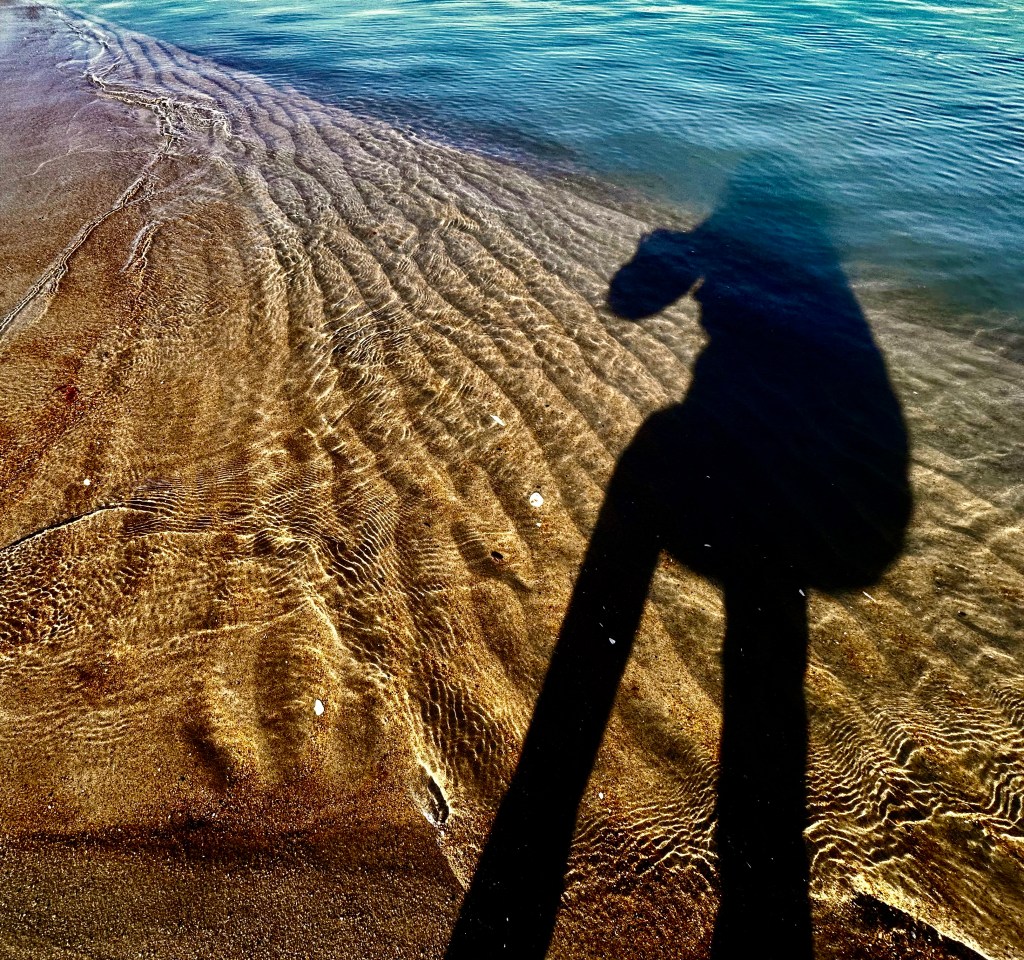
Underwater

Often enough, we can find ourselves in a place, both completely recognizable and profoundly strange. Sometimes, we don’t even know we’ve been there until we’ve see sand from the desert on our pants and fragments from the Rain Forest in our boots. Or we see what image emerges in our camera and wonder how something could have played out in front of our eyes while we were paying attention to something. It’s like playing that ‘“nobody saw the gorilla on the basketball court because we were watching the game” kind of phenomena. This doesn’t only happen in our material world. It happens in our social and political world, as well. We wake up in the middle of the night in anguish because we suffered an unaccounted for moral injury earlier in the day. 
We often take ourselves to task for living these privileged lives and those points are all well taken. The ways of the world are crazy. There is no arc of justice that bends fast enough toward justice as we’d like it to be. There is no denying that there are forces bending the arc the other way, perhaps towards a world they see as just. It should be noted that our complex interconnected world yields great fortunes for some of us but it comes at a great cost not only to others but ourselves, as well, in the alienation, the existential threats, the complex nature of matters around us. Perhaps, those are all diseases of modernity but it seems more than that recently. Like the photo above, I seem to be underwater, somewhat adrift, in a world less of my making and certain less to my liking. The world swirling and our struggle to gain footing. Perhaps, in our complex rapidly-changing world, the longer we are alive, the more alienated we feel. Unless, we take the long view — that we are members of a long lineage of creatures on the world, stumbling along and making the best of our limited and limiting view of what’s around us.

Sunday Drives

I remember only the vaguest of details about the episode. My older sister, Janet, who keeps threatening to write a memoir revealing our family secrets tells it at nearly every family occasion. My brother, Carl, the baby of our family, swears the whole thing never happened. None of it; not a minute. 

It is generally agreed that parents and their children recount their family time together as differently as those blind men pawing over that elephant in the child’s tale. The stories that siblings bring back from their childhoods may reflect more about who they are as adults than what happened in their childhoods. Sometimes, it feels like we didn’t share much of our childhood together at all. Instead, we were more like boarders in a house with little interest in the other occupants. 

This episode supposedly happened two years before our father died in a fatal car crash. Janet uses this undisputable fact to shore up her accounting of this day.  We were on our Sunday drive in a rundown twenty-year-old Studebaker which my father maintained with his minimal mechanical skills. Bald tires. Engine burning motor oil. Failed emergency brake. Body rot. Unsafe for him to drive, but dangerous especially for my mother, a new driver, usually with a carful of kids.

We children were in the back seat on our way home after a long summer day at a public beach. My father was driving, with one hand on the steering wheel and his other arm stretched across the back of the front seat. My father’s family organized these gatherings and with plenty of cousins and lots of food we were dazed from the sun and sand, eager to get home and out of our swimsuits. The adults were full of booze, especially my Dad and his brothers. Janet says they were feeling “no pain.”  

As she tells the story, Carl and I slouched over each other ready to fall asleep. It was getting dark and the traffic was crawling along the state highway.  She was sitting at the edge of the back seat, pretending to read her book but was really hoping to hear what my parents were talking about.  To her it sounded like they were having an argument. Mom was asking him if he was OK to drive. 

Daddy said, ‘Of course, I am.’” He smiled and reminded her that he was a great driver.  Janet says that that my father was in a very good mood on that drive home. And she added “because he’d been drinking.” 

This kind of thing drives my brother and me crazy.  His drinking infects all her stories about him, even the ones about a very happy Christmas morning when he was awake earlier than usual, making us special Santa-shaped pancakes.  He was even more excited than we were about opening presents. That lovely childhood enthusiasm about him made him a great playmate and sometimes an unreliable parent but not on this magical morning. He was completely ours to enjoy. She insists he was up early drinking. That is why he was so much fun; Carl and I tell she’s crazy. This story always makes my brother storm out of the room, no matter how often she tells it and how often he pleaded, Please, not again. 

According to her, on that Sunday afternoon, there was an accident just ahead and the rescue crews were arriving. My father grew impatient and as quickly as he could, he swerved the car over to a back road. She reminds us of how much he hated traffic. I remembered that he knew every major highway, side street, and gravel road in the state. His job as an appliance repair man required him to know how to navigate anywhere; he also seemed to have magical sense of direction, the way some people do. So, on these Sunday drives, we could find ourselves in places he’d discovered during the week — abandoned mines, old houses he could fix up, farms he wanted to buy – all adventures and dreams.  This backroad would likely be a shortcut that took us a longer time to get home but it didn’t matter, he just hated traffic. 

Janet says that once we turned down backroad, things got serious. My father started driving faster; my mother sat up straight in her seat. Janet says my mother tried to catch my father’s attention by staring at him, by throwing one of her “stop it now” looks but it didn’t work. My father was smiling, enjoying the drive, one hand on the steering wheel and the other now on the shift.  She put her hand on his to get his attention and he smiled. 

Our mother asked him to slow down because he was driving too fast.

Janet says, he just smiled and sped up a little. The back road was not well paved so the car was bumping along. I do seem to remember that part of the story, being jostled out of sleep for a minute.

Janet says, “She asked him to slow down again, ‘Please, John. You’re scaring me’.” 

Daddy said, “Nothing to worry about, honey. We need to get these kids home.” Smiling again. 

Janet says, “I must have gasped or something because Mommy and Daddy heard me and noticed I was listening in to their conversation. I felt like I was in the middle of one of their arguments but I didn’t want to be. So, I leaned back in my seat. I just wanted Daddy to stop driving so crazy.”

She says that she settled in between my brother and me. Soon, the car started weaving.  Janet says, “Daddy was jerking the wheel back and forth and the car is rocking, speeding down the road. He’s driving like he’s a stupid teenager.”

 “Mommy screamed and she said to Daddy, ‘John, you’re going to kill us all’.  And she looks back at me, and says, ‘You’re scaring Janet.’  Mom took her hand away from his and put them on the front of the glove compartment, bracing herself in the case the car crashed.

“Daddy looked in the rearview mirror and motioned me to come forward. I leaned into his side of the car and put my hands on the back seat. I was almost crying but I tried not to. I could smell the alcohol on his breath.” 

“Daddy asked me, ‘You’re not scared are you, Janet? We’re just having a little bit of fun. Mommy just don’t understand’. I looked at him and I could feel myself biting my lip, scared but maybe thinking he knew what he was doing. Maybe, we were all really OK. But then I looked at Mommy and knew that she was right. He was driving crazy. I was scared.”

Janet always slows down her story at this point to look hard at my brother.

“And I told Daddy, ‘I am scared. At least at little bit. I think you might be scaring Baby Carl, too. I think he’s crying.’  She adds, as if she is sharing inside information “That was a lie. I said you were crying because you were always his favorite, Carl. Maybe, that would make him stop but really were both fast asleep. I had to do something.”

“Daddy just nodded his head and slowed down and straightened out the car.  Mommy put her hand back on his and I sat back and tried to relax. Some Sunday drive! We could have died that day. I was so happy to finally get home. Daddy carried you both in the house and put you to bed. I grabbed a Coke and went to my room.” 

Soon after this event, Janet stopped coming on Sunday outings. She played the teenager card — too busy with friends, had homework, got a boyfriend, blah blah blah. So, our little family continued our Sunday drives, exploring the backroads and looking at houses we couldn’t afford, schools we couldn’t attend and visiting dangerous neighborhoods we had no business being in. Until he died. 

I have listen to Janet repeat this short story over and over again. I suppose I should thank her for saving our lives and maybe I would if I remembered more about that afternoon. But maybe not. I only remember being in that car on a hot summer afternoon asleep with Carl’s feel stretched over my lap. That is it.  In my mind, I don’t want these stories messing with the memory of my father. 

I wish Janet could gain some wisdom and grace in her retelling of her stories about him. There could be a space for our father not as a severely damaged man but instead as a someone with a serious problem caught up in a post-war culture that celebrated men’s drinking. He was a wonderful father I can’t excuse his drinking but I’ll never forgive her these stories. 
Not my kind of Saint

When I was a child growing up in the fifties, it seemed that everyone in my life – my parents, my teachers, my aunts and uncles, and grandparents – and everything in my life – from the movies I watched to the books I read to the things I dreamed about – were all aligned in a project to make me a very good person. I resisted these influences in my childish ways but overall, I bought in. I embraced their hopes and dreams for goodness for me, but that wasn’t enough; I wanted to be a Saint.

My little sister and I shared a tiny bedroom and, on those nights, when my mother had a late shift at work, I would read to her at bedtime. I had the upper bunk and with the streetlight falling brightly onto my pillow, I could read as late in the evening as I wanted without detection. Our favorite book was given to me by my aunt Gaby. Without her own children, she had plenty of time and energy to devote to my development and guidance. She gifted me The Children’s Book of the Saints for my First Communion.  Every day of the year, there was another story of a Catholic saint, a simple guide for us to inspire goodness and courage. It was perfect for my dreams of sainthood. We loved best the stories of the saints who were martyrs. Stories of Saint Ignatius who was a rich boy and a soldier who then repented and found the Society of Jesuits did nothing to excite us. Saints like him seemed to us good enough but not bold or inspiring. We need saints who had visions and who suffered. We loved stories of saints like St. Bartholomew who was skinned alive, St. Ignatius of Antioch who was fed to the lions, or St. Lawrence who was burned at the stake. Never denying their faith. We relished stories of saints, like St. Juthwara who’d been beheaded and walked away with her head in her arms, on her way to church to pray. Our favorite was St. Thecia. When they tried to burn her at the stake, it rained. When they fed her to the lions, they laid down and licked her toes. She kept trying to kill her with snakes and swords but protected by her faith, not torture not the work of man could kill her. She lived to her eighties. As a child, I hadn’t yet worked out just how I would get myself into situations where I be given a chance at martyrdom but my mind was firmly made up to do whatever I needed to do to become St. Sandra of Rhode Island. 


Recognizing the power of movies over our generation, the nuns gathered us together in the cafeteria every month to watch an inspirational film like Boy’s Town, Captain January, or The Miracle of Fatima. When I was in the second grade, we watched a film about the Maryknoll Brothers doing missionary work among the pagans in China. At the end of the movie, the Chinese marched a Maryknoll Brother up a hill and crucified him – “He refused to deny his faith”, the narrator intoned.  We were stunned; I was inspired. Our nun talked with us about the movie and about our faith and passed around the little metal box where we were supposed to drop our change to support the missions. Some of the kids had spent theirs on candy; not me. Then, she asked, “Children, how many of you are willing to die for your faith?” Almost all our hands went up. “Me, sister! Me, sister!” I was so proud of myself for offering my life for Jesus Christ.  I never told my Mom, although maybe she would have been proud of me, as well. She knew about my sainthood thing.

From that moment on, I have never doubted for a minute that children could be recruited into Brown Shirts or an army of child soldiers or into the Children’s Crusade. Children may be innocent but they are engineered to be socialized into groups well-intended or evil seeking. I gave up on sainthood when it seemed the pagans were disappearing from the planet and emerging as Buddhists, Muslims, Hindis, and people of other faiths. There were other diversions from sainthood, as well, but that is a much more common story.

COVID Lessons

Even though I keep a daily journal, my notes on the pandemic are sparse. I recall best those very early days when neither science nor faith could stem the tide and terror, fear, and dread of the virus. As an older person, I felt my age for the first time, as both a high-risk target for the disease and as a vulnerable elder requiring careful watch and extra protection. I’ve learned that children can be just as paternalistic as their parents in that caring but condescending way. 

I do have an entry in my daily notes for Sunday April 5th, a few weeks after the federal government declared a national emergency, just a week after the U.S. had more COVID cases than anywhere else in the world. We were in the early days of lockdowns, travel bans, shortages. Fear of the disease and of each other. Daily briefings. Panic. On that day, I spoke with my sister in Florida.  A few weeks prior, we had set up bi-weekly check ins. That Sunday, we talked about how these could be our final days. That sentence sounds melodramatic when I write it, but it rings true to my experience. On that day, we broached the subject of final plans. She had organized a box full of important documents with my name on it on the second shelf of her guest room closet. All her contacts– professional ones and personal ones – to be notified when she passed away. Emails, phone numbers, passwords, online accounts. She had thought of everything – so kind. I committed to doing the same thing as soon as possible, yet still to this day, four years later, I have left most of this undone.

She considered almost everything. I asked her about her eulogy. Had she thought about who would say those final words? As soon as the question left my lips, I knew what I wanted to hear. As her older sister, I prayer it would me. She confirmed that hope. I would deliver her eulogy and she mine. We wondered together whether we knew everything we should know about each other. I made these notes in my journal. Committed to writing Marcia’s eulogy. That sent me down a rabbit hole of wondering. Was I really the best person to write this? Did I really remember the important points in her life?  Did I underestimate how painful those early illnesses were for her? Did I comprehend how deeply she at age twelve felt my father’s early death? Did I know the whole story about her marriage? Did I appreciate how deeply others loved her? Did I know only my special sister-side of her? Did she know I’d nearly been hospitalized for depression? That I came close to suicide more than once? Those eulogies may reveal more than we have told each other so far. These can be reckonings. 

I delivered my first eulogy for my mother. I asked her parish priest if I could say a few words after Mass. He told me that this wasn’t the custom in his parish but since my mother was a parishioner, he’d allow it. I could have three minutes. Three minutes? For my mother? And then I thought of her, so hating attention in any of its forms. She would tell me to take no more than two minutes, more than enough to say what needed to be said. So, I delivered that eulogy from my heart as I knew my Mom to be, underestimated, full of broken strength. I learned during the reception in the church basement how much I didn’t know about her. How kind she was to a neighbor. How much attention she paid to a lonely resident in assisted living. How crazy funny she was. That she was a wonderful dancer in her twenties. How she was a complete person separate from me—a richer, deeper, more complex story than I knew. I wished I had done better for her. Reaching beyond what I know or think I know; I will do better for my sister. 

Are you lonesome tonight: Assignment #5

The Beatles burst onto the Ed Sullivan Show just three weeks after my father died. This set off secret operations in our so-called music room. This was the back half of our living room with the piano that nobody played and with our record player, a significant piece of furniture with the console on one side and storage racks for albums and 45s on the other. Until I was a teenager, the only music we had in our house were my parents’ records, music from the War that they used to dance to, and our mother’s records, which we were not to touch. Records and the record players were in the “No Children Allowed” zone in our house. 

We loved watching my parents dance to music from the forties. They would glide across the floor with great grace, I thought. My father was a smooth dancer and after practicing the foxtrot and waltz with him, he accompanied me to the Father Daughter dance at our high school, clearly the most handsome and charming man in the crowd. That evening, one of the happiest nights of my life, happened just two months before he passed away.

We processed grief privately in our house. My mother simply couldn’t bear to discuss the loss of our father with her children. Much later in her life, she said to me that she had no words of comfort or consolation for us. My father would have known what to say to us, she said. So, my mother dealt with the anguish of loss she couldn’t voice through her records, stacked up for play one after the other.  How Great Thou Art by Mahalia Jackson, Don’t You Know by Della Reese, Full Month and Empty ArmsMoonlight Sonata, and Elvis Presley’s Are You Lonesome Tonight?

We would watch her expression, see her tears, and sometimes sit with her on the couch when she probably would have appreciated some time alone. Elvis really tore her up. I hated Elvis. I hated how sad he made her, how he kept pointing to her loss, and how much she missed my father. He kept making her cry asking, “Are you lonesome tonight?” With the full force of my teenage sarcasm, I would reply under my breath, “Well what do you think, Elvis. Her husband just died!” “Do you gaze at your doorstep and picture me there?” And from me, “Would you please just stop it!” I really did hate him. 

The underground operation – the secrets — began when my favorite aunt bought me the first album, Meet the Beatles. It is hard to explain six decades later the sort of effect the Beatles had on me. Their music was full of hope and fun and hand-holding, of the sweet innocence of love and flirting and dancing. It was perfect early teenager music. It seemed like the world changed when they arrived. My friends and I couldn’t get enough. I wanted to play their music all the time. My mother worked a long shift during the day but there were a few hours between our coming home from school and her returning home from work that we could use the off-limits record player, playing our music, and being careful to keep everything in its place and just so, remembering every tiny detail that could set off an inquiry.  During those magic hours, we would sing and harmonize and dance around the house, feeling free and crazy. Always in the back of my mind was whether all of that youthful exuberance was somehow a betrayal of the grief I felt in the loss of my father.  We hid the Beatles from my mother as long as possible. We covered our tracks as best we could. 

When the Beatles made that first appearance in early February 1964 on the Ed Sullivan Show my little sister, my tiny brother, my Mom and I were seated in our usual spots in our living room watching TV. I was apprehensive. Could the Beatles cheer up my Mom? Would she tune them out? Would we have to dampen our enthusiasm to honor her grief? I wanted her to love them, as I did, to see them as love and joy.

My mother loved the Beatles, these British young men with long hair.  She loved other English bands, too. We surprised her with the Beatles album which she added to her playlist and every once in a while, she would join us in a crazy dance. We had broken through the no-permission zone and into sharing music with my mother. It was all quite surprising to us. That was a new Mom. Maybe, we gave her a respite from her loss.

When my first true love moved away to college, my mother put up with my playing the same broken-hearted Dionne Warwick ballad over and over and over again. She never once told me to get over it, or to stop playing that miserable music, or that there would be other boys. She let the music pull out my tears, to feel the loss as best and as deeply as I could, even though I couldn’t talk about why this boy meant so much to me. 

We played out our grief and our happy times in common prayer of music.

What’s Going On: A play in four acts before intermission 3 of 6 assignments

Setting: September 1971 to May 1972, rural Alabama

Characters: Twelve northern-born VISTA Volunteers sent to the South to fight poverty. After a week of training, they cut their hair, put away their bell-bottomed jeans and prepare for work as teacher’ aides, family planning specialists, construction supervisors and community organizers. They are full of idealism and brotherhood and the wonderful feeling that they are doing something important. However, their ideas about doing good, about being comfortable in the world are challenged in this culture that is confusing, frightening, and disorienting. They spent that year and the rest of their lives wondering what’s going on.

Soundtrack; Marvin Gaye’s What’s Going On

Act 1. Three days after arrival. The VISTAs are placed with host families while they look for housing. The third night one of the women is raped by a teenage boy. She tells her friends. They debate what to do. Reporting this to the police guarantees that the boy will be arrested and may pay with his life. It will also mean the VISTA site is shut down. Not reporting it means that the violation goes unpunished, that the other women may be targeted for other attacks. It is just three days and already they are in over their heads. They make up an excuse to the supervisor to move her to another host family. This event has repercussions all year. 

Act 2. End of September. A cell in the local jail. Sheriff Wilkins welcomes the VISTAs to Lee County. He tells them he can recognize a Yankee at a half mile away – the walk, the swagger, the clothes. He wonders why they would come all the way to Alabama when they have so much trouble with the “coloreds” up north, rioting and all of that. He knows that as outsiders, the VISTAs will be troublemakers and that he will be watching them carefully. Her reminds them that last year, the house that the VISTAs were living in in Beulah, a Black community, was firebombed. He sure hopes they doesn’t happen to them. 

Act 3.  Early October. Three women are renting an old farmhouse from the Belks, a prominent family in Lee County. Bubba Belk, the youngest of four brothers and like the VISTAs, a recent college graduate, visits and brings along the gift of a rifle so the women can have some protection. They refuse his generosity. He insists, reminding them that they have no phone, that the nearest police station is twenty-five miles away, and that everyone knows that three white girls are staying together alone in this house. He reminds them that they are living in Alabama, not where they come from.  He walks them to the backyard, shows them an old whipping post and has each of them learn to load and shoot the rifle. They each take a few shots. They thank him and promise each other to hide the gun away. 

Act 4. A warm May late afternoon, three VISTAs and six Black families gather together to work out the day’s schedule at the self-help housing site. A young man arrives in a pickup truck, yells at them to gather around, jumps into the back of his truck and says, “the Governor’s been shot. Governor Wallace has been shot!” One of the men leads the group in prayer and song. They are praying for the soul and deliverance of the Governor. The VISTA volunteers are quiet, wondering how these folks can be praying when their own hearts are so full of hate.  

Do You Believe in Magic? An Older Woman’s Brush with Beauty. 4 of 6 essays for writing prompts

I came from a family where wearing makeup and caring much about one’s appearance was frowned upon and considered vain. I knew that I was not a great beauty. I was one of those “she has such a nice personality” girls, encouraged by my mother to develop my brain and housekeeping skills because youthful good looks wouldn’t last forever. She failed to tell me that my brain and housekeeping skills would also fade with time. (Thank goodness for the latter.)

I successfully resisted makeup and even paying much attention to my appearance until much later in life. Then I relented in my early seventies. Maybe it was my very pretty dermatologist. We had tried lotions and cremes for aging spots, and nothing worked. One day, she suggested a chemical peel. The results sounded promising. Clear skin! My heart swelled with expectation. I remembered what Charles Revson, the founder of Revlon, said about the cosmetic industry. “We don’t sell lipsticks. We sell dreams.” Or “Perfume is made in the factory, ‘hope’ is sold in the store.” So, I bit the bullet, believing in magic. The promise, dream, and hope of a better me. 

Even after bottle after bottle and tube after tube fails to make us beautiful, we again and again put our faith in the magic of potions and creams and procedures, resting on a shaky foundation of that improbable fix.

I signed for the least intrusive chemical peel, as I called it, the baby peel. My lovely dermatologist and her aide prepped me with alcohol and brushed the peeling agent over my face, paying special attention to the darkest areas. The whole thing took less than thirty minutes. I went home with discharge instructions and suggestions to stay out of the sun and take it easy. I should be back to normal with some redness in just a few days. Imagine that!

The discharge instructions and the calm counsel from my dermatologist were completely inadequate for what followed, like the instructions that Marie Antoinette might have gotten before her beheading, “You feel a sharp pinch in your neck that will end quickly, and you will fall into a deep state of rest and relaxation.”  Follow-up instructions generally fail to describe what really happens in post-surgical recovery. Doctors are woefully inadequate in describing pain. Maybe, they figure no one would sign up for any surgery if they told the truth or maybe they resolve to leave the theatrics to the fiction writers of the world. If I wanted to really know the truth about a chemical peel, I could watch a Lifetime movie.

I resolved to catalog my agony and suffering. I took photographs and maintained a log. I have had several surgeries, some quite serious and nothing was as painful as this. I was actually crying in the anguish that I had gone through this suffering for vanity and nothing else – my punishment for believing in magic.

In the follow up visit to the pretty dermatologist, I am eager to share my misery. I have photographic evidence on my phone and paper documentation. However, before I can answer her question, “So, how was the recovery?”, she interrupts, looks kindly at me, and says “Horrible, right?” I nod in disbelief. All that was normal? I suggest to her that she needs to rewrite the discharge materials to more accurately describe the burning, the tightness in face, the frightening peeling of the skin.  

 Before she can disagree, I begin, “Here’s my version, Doctor.”

First, they pour acid on your face. 

Then your skin lifts off your face and dies right in your hands. 

Then your face burns no matter what you do. 

It will seem that the procedure has gone completely wrong but that is entirely normal.

And please don’t sneeze because we have no idea what will happen. 

Clinical results will vary.

We suggest that your loved ones take a short trip while you are recovering because some partners may suffer from nightmares from seeing the patient on days three and four.

Results will vary and are unrelated to your suffering.

The procedure may be repeated in six months because the spots are likely to reoccur.

Abracadabra.

Inspired by Do You Believe in Magic?

Where have all the flowers gone: Two of six

Her days were undistinguished except for the afternoon sun. As the seasons passed, she watched the shadows shorten and lengthen gliding across the floor in her tiny sitting room. At her side, a basket of knitting sat untouched. The last time she picked it up, she had no memory in her fingers of how she once made blankets and hats for every member of her family and many of the babies at the church.  

She felt the warm June sun and looked out to the garden. She struggled to recall the year when she. was strong enough to dig a two-foot trench for the asparagus bed. It thrived for years when the children were small and began to fail when she could no longer tend it lovingly. Where did that lovely asparagus go, she wondered. 

She surveyed the yard, once resplendent at this time of year — every bed a surprise of color and form, her peonies with the grace of ballerinas, those dahlias uncompromising in their bold colors and shapes. Where had all those flowers gone?  Or maybe, she didn’t recall this so clearly. A fleeting thought poked into her mind, perhaps this beautiful garden in her memory was actually someone else’s garden. Not hers at all, perhaps. 

The neighbor’s children, the age of her great grandkids, were screaming with delight, splashing into their backyard pool, celebrating the birthday of the youngest, Liam. She recalled such parties when she was young but not much about them. She couldn’t recall the name of her favorite cousin or remember when she had last seen him. Had he died? Maybe so. Could that be that I wouldn’t remember? She knew she had a happy childhood but the details, of it like so much else these days, escaped her. 

So much had passed by in her long life. Friends. Wars. Struggles. Great joy. Great books. Love. Being a mother. A productive career. Losing a husband. Losing all but one of her siblings. She tried not to dwell on the past, but her future seemed short to her. She did remember her high school friends. “We were such a gang of girls, full of energy and delight and not a little sassiness” she thought. “We were so lovely although we didn’t know it at the time.  Where did those girls go?” When she saw the few friends that remained, she saw old women, with their youth like phantoms beside them. 

She was willing to accept that life was full of loss; that fact she could accept with equanimity. More than anything, she missed her words, her clever mind, her intellectual power. Once, she could summon a rich vocabulary and choose words that delighted her, like a captain commanding his troops to attention, those words bold and perfectly fitted to her ideas. Now, those words were fewer, wandering, and remote and painfully slow to appear. That loss she felt deeply. 

But even as others saw her depleted and elderly, she felt something else. A favorite author of hers wrote at the end of her life, that she was herself, as never before, with fierce energy and intense feelings. Everything was profoundly beautiful to her. Even her own children weren’t as captivating as the children she saw these days. Last year’s Mother’s Day flowers drew her attention like never before. Music brought her to tears. She wanted to draw the world close, to live each minute with all the passion and light that was remained. 

What’s Tina Got to do with me? One of six assignments

Growing up in the fifties, I am given more freedom than I deserve. My distracted mother, a recent widow with three young children to raise, ignores my adolescence. I explore far and wide. I pal around with boys and the girls. I am athletic years before Title IX. I am crazy about music. I teach myself guitar. We write plays and perform musicals at my little high school. We sing and play music on our bus rides home, me playing bongos on my math and English textbooks. We know all the moves of those girl groups and can mimic and even embellish their dances. I can harmonize. It is magic for me. 

I don’t give this up at eighteen. In my twenties and thirties, I find another group of women friends who also love to do this. It was a heady time for the women’s movement. We want to be in and celebrate each other’s company. We sing and dance for our friends and perform at women’s conferences. We perform Aretha, the Shirelles, the Supremes, the Dixie Cups, Gladys Knight and the Pips. We never tried to do a Tina Turner song She was too far a reach for us. Which of us white working-class girls imagined dancing like Tina did? None of us. I had seen her on TV with Ike and the Ikettes. She was too sexy. Too crazy. Too beautiful. Unreachable as an icon with those long legs and warrior woman body. She was just too hot.

That all changed. She survives her abusive relationship with Ike Turner and returns to the music scene with ground-breaking album Private Dancer, with the hit What’s Love Got to do with it?  She rises strong, confident, strutting. A music critic writes that this album “reeks of attitude.” I can’t read that as adoration. George Bush awards her the Kennedy Center Honors and notes that she has the “most famous legs in show business”. They still don’t understand what Tina is all about. At 44, she becomes the oldest woman to receive a Grammy for Best Solo performer. That doesn’t sound that old to me. 

I see her anew. She is just ten years older than me. In my youthful eyes, I saw her a giant. I learn that she is a tiny 5’ 4” tall and weighs 120 pounds. That is exactly me. In her emergence, Tina gives me strength. I am finally ready to bust out of my good girl, Catholic obedient, uniform wearing, background singing self.  Tina creates the space for me to come out to my friends. To feel flirtation for the first time in my bones. I let myself be attracted and attractive. And maybe for the first time, I think, “That can’t be love. What’s going on? We just met!” But there is something powerful and worth paying attention. 

And not just me. Liberation is recognizing that is always time for re-birth and reinvention. My troupe is done with happy songs about “Going to the Chapel” and waiting for that boy to call. We’ve been burned and are ready to claim power and respect. Turner steps out and we follow. We sing Tina Turner in our comfortable shoes, with our short legs and choreographed moves until my group falls apart, with heart aches, broken marriages, wayward children, cracking voices, slower paces. One of us has cancer. Another, a husband certain to die with a brain tumor.  We are well prepared for the next transition.