This blog includes essays about life, aging, humor, inspiration and creativity. These things capture my attention and I hope are worthy of yours. Sandra Enos.
2021, the second summer of COVID. I was hungry for human contact that steeped beyond my tiny world. I must have been radiating that vibe because my early morning beach walks were filled with surprise encounters. The humans I met regularly during these walks seemed completely free and eager to share with me their grand claims about the universe and their profound theories about the ways of the world. They were all sharing a bit of themselves, revealed to a total stranger. There must have been something in me that drew them out without fear of contradiction or challenge. Some people I saw every day, others for one moment, not longer than that.
To be fair, in this second summer, I emerged shell shocked from confinement. Certainly, I connected with people on Zoom calls, but those meetings like I was watching a movie with some friends cast in unfamiliar roles. I was distracted watching myself watching everyone else. None of it felt real. As the months wore on, my colleagues turned off their screens. It was too much exposure and not enough real exchange. We all dove into a huddle with ourselves, it seemed.
Exchanges with strangers on the beach felt like the only true contact I had, and I relished these. I was open and eager for spontaneous conversation to lighten my day. Until that point, I was never that person to begin a conversation with a stranger. I would smile and nod but no more than that. However, based on the conversations I was having, I seemed to present myself as a 72-year-old naïf, like someone brand new to the world. People told me stories and I was enchanted.
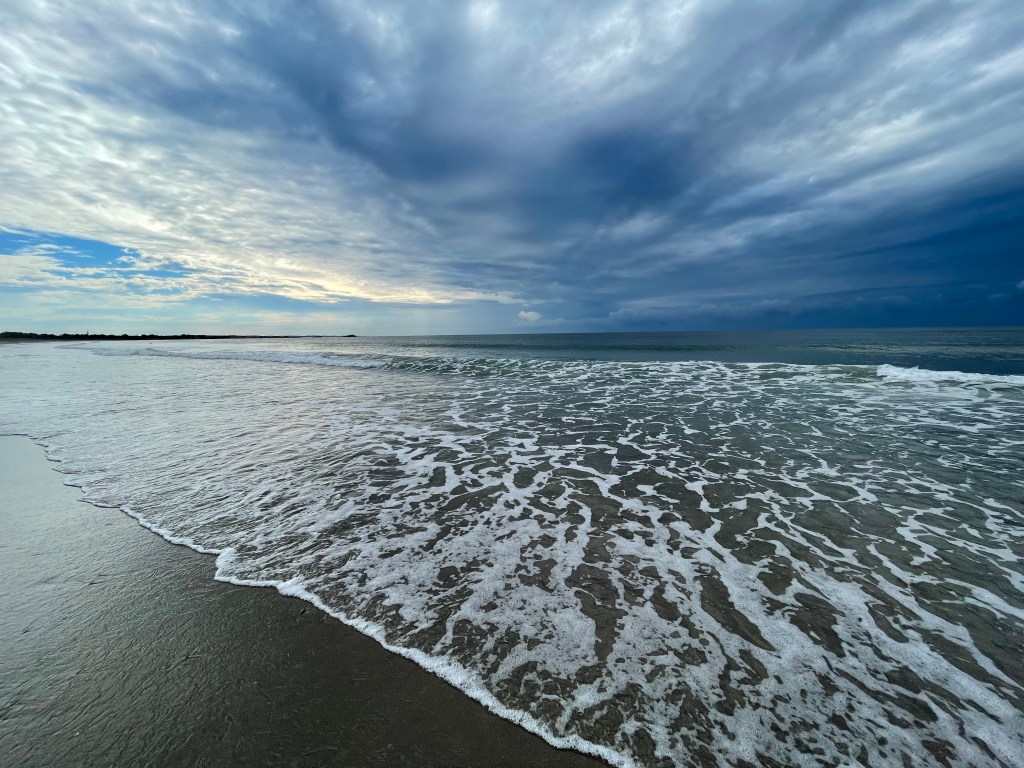
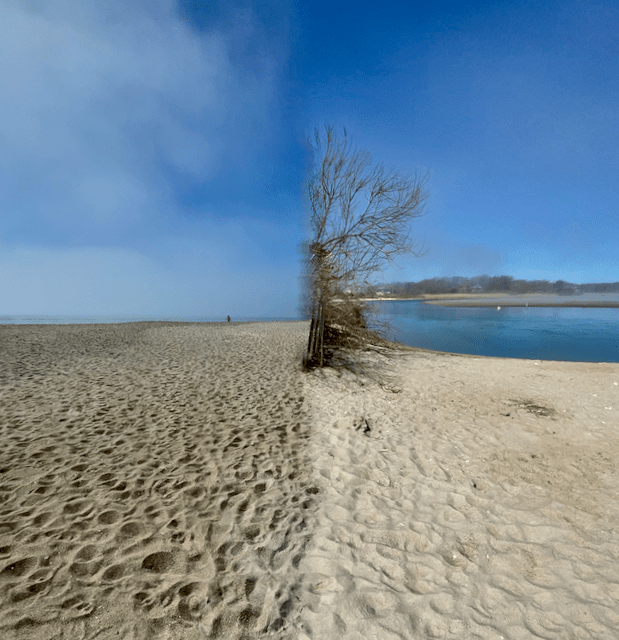
Narragansett beach between weather patterns
One woman, I will call her Hailey, was always splendidly adorned, as if she were attending a party with others similarly dressed. Her disappointment with dress code of the rest of us beach bums was obvious. She sported a giant gold necklace, evocative of a Roman gladiator, and wore well-fitting matching tops and tights. She had the excellent bearing of someone who was not only born into money but also married into it and likely earned some her own. She spoke of afternoons at the Club. She told me about her friend, Billie, her dyspeptic dog, and her former husband who met a fitting end at a hospital in the Philippines. Maybe, this was interesting to me because my father had served there in World War II, although she didn’t know that. Hailey kept asking me if I knew people from the Club, “Do you know Marsha Dawson?” “Have you seen the Clements since they came back from Florida?” Nope. Never. I didn’t even know there was a Club. She shared a story about an albino deer who was especially fond of her. Maybe, albinos are just that way, like some dogs are people dogs and some deer are people deer. This deer had so much regard for her that he never ate her hydrangeas. He also hid from the guests when she was entertaining, keeping him exclusively hers. He sounded like an ideal combination of a gardener and a younger boyfriend.
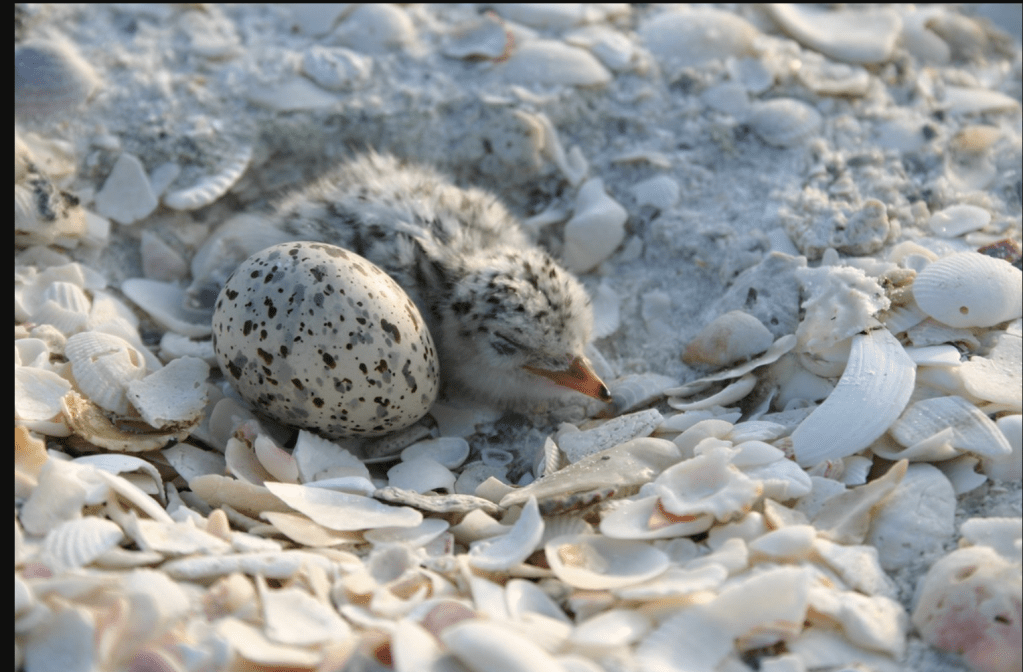
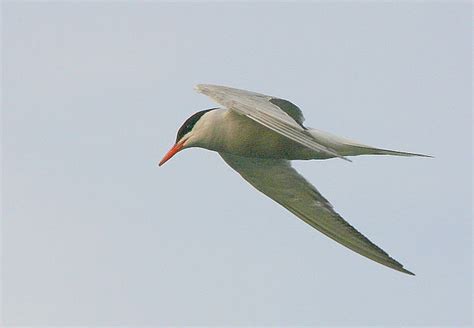
Tern egg with hatchling
As the summer wore on, we stopped on the beach to chat every day. No matter how early I arrived, she boasted that she was there well before sunrise. (At the of beginning of summer, that would be about 4:30 in the morning). No matter how far I had walked, she had walked farther and faster. No matter what I had discovered on the beach—sea glass, an egg from a lesser tern nest abandoned on the beach, fishing lures caught up in seaweed – she had discovered other better things just the day before. How did a beach walk get so competitive? I was tempted to wear a necklace myself made of shark teeth and shrunken heads, just to show her that I was interesting, as well.
Another morning a woman paced one stretch of the beach over and over again, head down and picking at the sand, like an egret looking for food. I learned that she collected sea glass. These people are easy to spot once you know what they are looking at and looking for. I do a lot of beach exploring on my own and will pick up anything of interest. We chatted about sea glass and the perfection of those mornings. I remarked to her about a lovely violet piece of sea glass I had just found, and she replied, “Well, of course, you did. The universe offers these pieces to you, and only you, when the glass is ready to be found, not a minute sooner.” I could have countered with my own analysis, but some minutes in our lives are best spent letting go and listening to how others see the world. She then passed on a chant to me (and only me) and told me how much her dog loved my vibe. I liked his vibe, as well, I suppose. I think he really appreciated that I knew how to scratch his ears but that is part of our vibe together, I suppose, for some of God’s creatures, anyway.
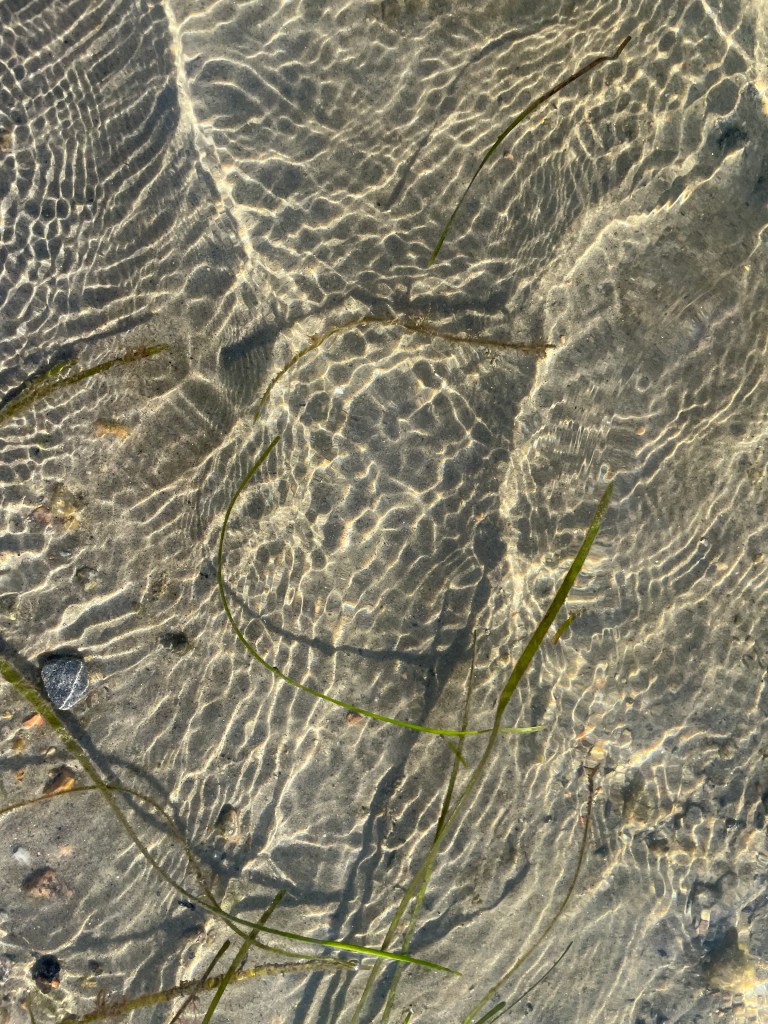
Another woman with a scarf wrapped around her neck and I smiled at each other. We were down at the far end of the beach, dazzled by the light on the water, where the river empties into the bay. The currents and the tides flowing in the opposite direction make for exquisite patterns with light and water and sand. After a few minutes of shared bliss, we acknowledged that we were sharing a beautiful moment. I broke the silence. I said I had seen her yesterday for the first time and she told me in a low voice that she was living out of a van, just like the movie, Nomadland.[1] She was just recovering from melanoma surgery on her neck and chest, aiming to enjoy the day’s light without further damaging her skin. She lived in New Mexico and was visiting her sister who was dying of cancer. This woman was convinced that the cancer was self-inflicted, the result of unresolved childhood trauma. She observed that we can be both victims of trauma and perpetrators, as well. She couldn’t bring herself to care for her sister like she wanted to. Leslie felt she was battling for her own life in the company of her sister. She was bristly about human company although she commented on my gentleness and openness. She also liked my energy.
On the same day, I ran into Tim who practices meditation on the beach. He has a lovely beard and a kind smile. He invites me to join him. I pass and claim that I do a walking meditation. He salutes that intention with a small bow of his head. My next encounter was with an older couple I had been seeing for a few years now. They have a European accent which despite lots of conversations, I have yet to identify. She is wearing a pair of short orange overalls which I recommended to her last year after she complemented me on mine. She said just a few years ago she would have never worn something so comfortable and utilitarian. I congratulated her, nearly hugged her actually. We are always growing together as humans; there is no other way.
For two years now, I’ve seen a lovely couple who are here on summer weekends. They swim at the end of Narrow River floating with the current, into the ocean where the waves guide them to safety. We comment on the wonder of this perfect day, just as beautiful as the day before and the day to come. “How can this be?” I ask. “How can things be so good?” Greg answers, “Gosh, I am so good, there should be two of me.” Exactly. Me, too.
My daily rounds were topped off by speaking with David, a patent attorney whose wife has multiple sclerosis. He so wishes she could join him on his walks. When she does, she is completely exhausted, but maybe in a good way, he thinks. We talk about sea glass which he also collects. “How do you know when you have collected enough?” I ask. “Do you have a plan for it when you die”? He has asked his children to mix the glass with his ashes and to dump both in the bay. That idea really appealed to me. This may be illegal, he fears, not the glass, but certainly the ashes. Legal training sometimes makes you too aware, I think. That sort of thinking can stifle your dreams.[2]
I can say that this daily practice of encountering strangers has added immeasurably to my life in surprising ways. We encounter so many people in so many ways that they can blend into an undistinguished crowd of “people I don’t know.” But each of them has a story and a perspective. Those minutes together are improvised stories, an exchange that brings us both to the present and keeps us here long enough for a true encounter. These are blessings in each morning.
And, of course, there is the simple beauty of the beach, where a careful eye and ear and an open heart with reveal something new every walk, like shimmering light on the water.
Sandra Enos
[1] Nomadland is a wonderful film with a perfectly scored soundtrack.
[2] The EPA has a policy about burial at sea. Cremated remains must be disposed three miles off the coast and reported to the EPA. You cannot simply toss remains off the side of a fishing pier or take them along with your lunch on a nice kayak paddle. I think the Mafia must have scared the EPA into regulating these burials at sea, even cremated remains. They are silent on sea glass.
In my mid-forties, I had a career crisis. I was bored to death at my state job reviewing applications for asbestos abatement assistance. The paperwork to get a grant for abatement was so onerous that we disbursed much more aggravation than we did money. I am not proud of that fact, but I could do could little about it. My supervisor was the sort of man who divided the world into two groups — the criminal and the pre-criminal. No one was above suspicion. He put rules and procedures in place to assure that no sneaky citizen would ever ever pull off a scam under his watch. I was his unwilling lieutenant repeating to applicants stupidly bureaucratic excuses for why their applications were turned down. I took a lot of appropriate abuse from perfectly eligible grantees. It was soul- and mind-deadening. I imagined myself, retiring at 90 or so, never having approved a single grant, and receiving an outstanding public service award from him for The Exercise of Frugal Excellence. He would be 110, still railing against incompetence and corruption, everywhere, everyplace, all the time.
I was located in a brand-new state of the art building laid out in a chessboard of cubicles. Our manager was very excited about this new office design, promising us that we would be more creative, and team-like. In truth, we felt like rats in a maze. With so little privacy and so much overcrowding, our union steward warned our overlords that we would most likely get aggressive and first turn on our supervisors, and then on each other. The workers wouldn’t be responsible. Instead, our bosses would have blood on their hands and it could be theirs, literally.
My little four cubicle pod penned up me and three other low-level bureaucrats. On one side was a young man divorcing from his wife and spending much of the day heaping abuse on her on the phone. On another, a woman constantly snapped gum and by the smell of nail polish and the sound of fingernails being filed, she was clearly running a manicure salon while pretending to meet with other employees. She was the busiest of us. In cubicle #3 was another man who played talk radio all day, muttered all day to himself and was full of bad ideas and half-baked theories. I saw myself as an abandoned soul in the land of troubled and troubling souls.
This new office landscape did not lead to our being more innovative and community spirited at work. It did the opposite. I hadn’t realized until I was trapped with them, how much I disliked each of them. I would sit at my desk with earphones, a face mask, and sunglasses, hoping not to be recognized. It was a perfect place to be a member of a witness protection program. Not one person ever came to look for me. It felt like Kafka may have been the genius behind all of this, like a revenge architect.
I came home each night wondering how much longer I could last. The good news was that this mind-numbing job gave me plenty of energy to dream about other possibilities. I settled on two. The first was to pursue a doctorate in Sociology so I could teach at the college level. I had been doing this for nearly a decade as an adjunct professor. Students liked the way I taught, and I loved the excitement of teaching challenging material in creative ways. This part-time job was like a lifeline to more engaging and stimulating world.
My second option was to become a standup comic. A friend and I ran “How to Be Funny” workshops at women’s conferences and those were really well received. I got several humorous pieces published in magazines. People thought I was funny; I could tell a good story. However, I was nearly fifty years old. Comedy hadn’t really hit the big time in the early 90s and there were few women comics that I really liked and admired. But undeterred by any facts at hand, I decided to explore being a stand-up comic. I connected with a middle-aged man who was a social worker during the day and an aspiring standup comic at night. I went with him to some of his shows. These were located in dismal, smoky bars, late at night, perilous to any woman in these places without a male attached to her arm. I got plenty of offers but none that would advance my career in comedy, except maybe to share truly clumsy pickup lines.
After visits to the clubs watching this guy suffer, I opted to pursue the more conventional route – pursing a PhD in sociology in my late forties, hoping to graduate when I was fifty. A colleague cautioned me that there were already 10,000 unemployed PhDs in sociology and that dreaming that I would land a teaching job was a fool’s errand. Having been on many fool’s errands and enjoyed them, I hopped on board and went to graduate school. I earned a PhD at fifty – the best learning experience of my life – and enjoyed teaching for a few decades before I retired. I was never properly a sociology professor, not a great fit for an academic role, but I did my best to carve out my own special practice as a uniquely weird professor.
Fast forward, twenty-five years after that PhD. and I was a retired sociology professor, ready to explore some new interests and revive others that I had ignored for way too long. During the second year of the pandemic, I decided to try out some new activities — to engage in some classes or activities I had sworn off, telling myself that I didn’t do these sorts of things. I wanted to step out of my comfort and competence zone. I was provoked by Emerson’s quote, “The mind, once stretched by a new idea, never returns to its original dimensions.” I loved that idea because I was sorely feeling that I needed new dimensions. I wanted my older years to be about expanding, not narrowing, my interests, activities, and friendships. I wanted to move down some new avenues while my health was still good and my energy abundant. I was looking forward to changing some things, to exploring what could happen.
Dan Gilbert, the Harvard psychologist, has done research about the end of history illusion. It refers to the ways in which we discount how much we will change in the future. We imagine that we have changed a great deal over the past ten years, let’s say, but assume that we will not change much in the future. What is even more interesting is that this illusion happens in the same way for people from all age groups. Neither the young nor the old nor the middle-age are any better at understanding how much change is ahead of us.
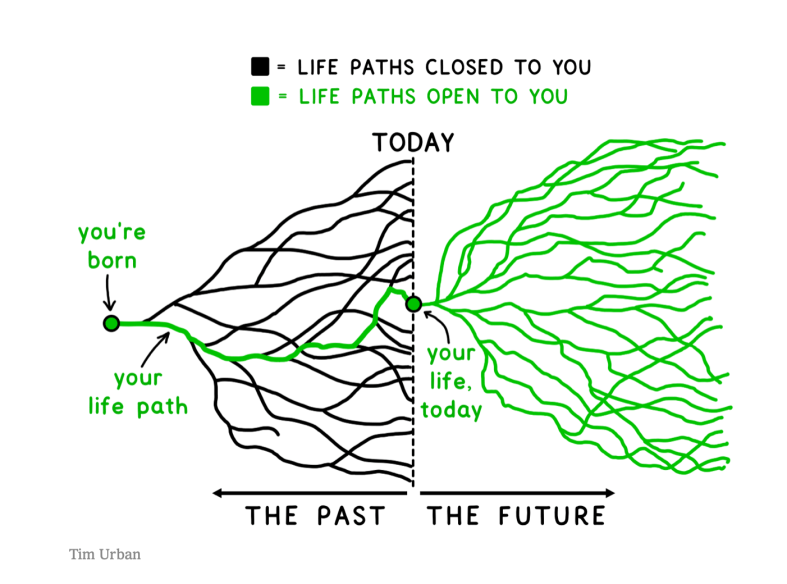
I was intrigued by this image is from a 2022 article in the New York Times[1]where author Tim Urban discusses how we use time and how we might consider our futures. At any point in our lives, we have arrived a place which is the result of multiple narrowing paths. We went to art school, instead of medical school. Or we didn’t apply for that promotion and instead changed jobs. Or we chose one partner over the other. On and on it goes. Each of these decisions leads to other opportunities; you foreclose on some possible opportunities at every turn. We can’t all the lives we might have lived. The only paths closed to us are the ones in the past.
However, ahead of us are many possibilities. We can be easily overwhelmed if we really take this to heart but if we really consider the many paths ahead, it is life-affirming, even in our later life. This is not to say that all of us are blessed with resources, time, and talent to move ahead and follow any dream that we can conjure. That is certainly not the case, especially in mid-life and later years when caretaking our elders, our partners, our grandchildren, and ourselves makes many demands on us. But there was enough truth here to make an impression on me. No matter what the constraints are, there are still plenty of possibilities and choices.
Over the course of my lifetime, I have put many obstacles in the path of exploring possibilities. Before I start anything new, I had to plow through a heavy thicket of objections. Why do this? Why now? What would I learn? Why didn’t I pursue music or language lessons when I was young? Am I too old? Can I really do it? Suppose I fail. Who would I meet? Would I like them? Suppose they don’t like me? What makes me think this is interesting? Am I having a late-life crisis? Is there such a thing? I would entertain doubts for so long that they got comfortable.
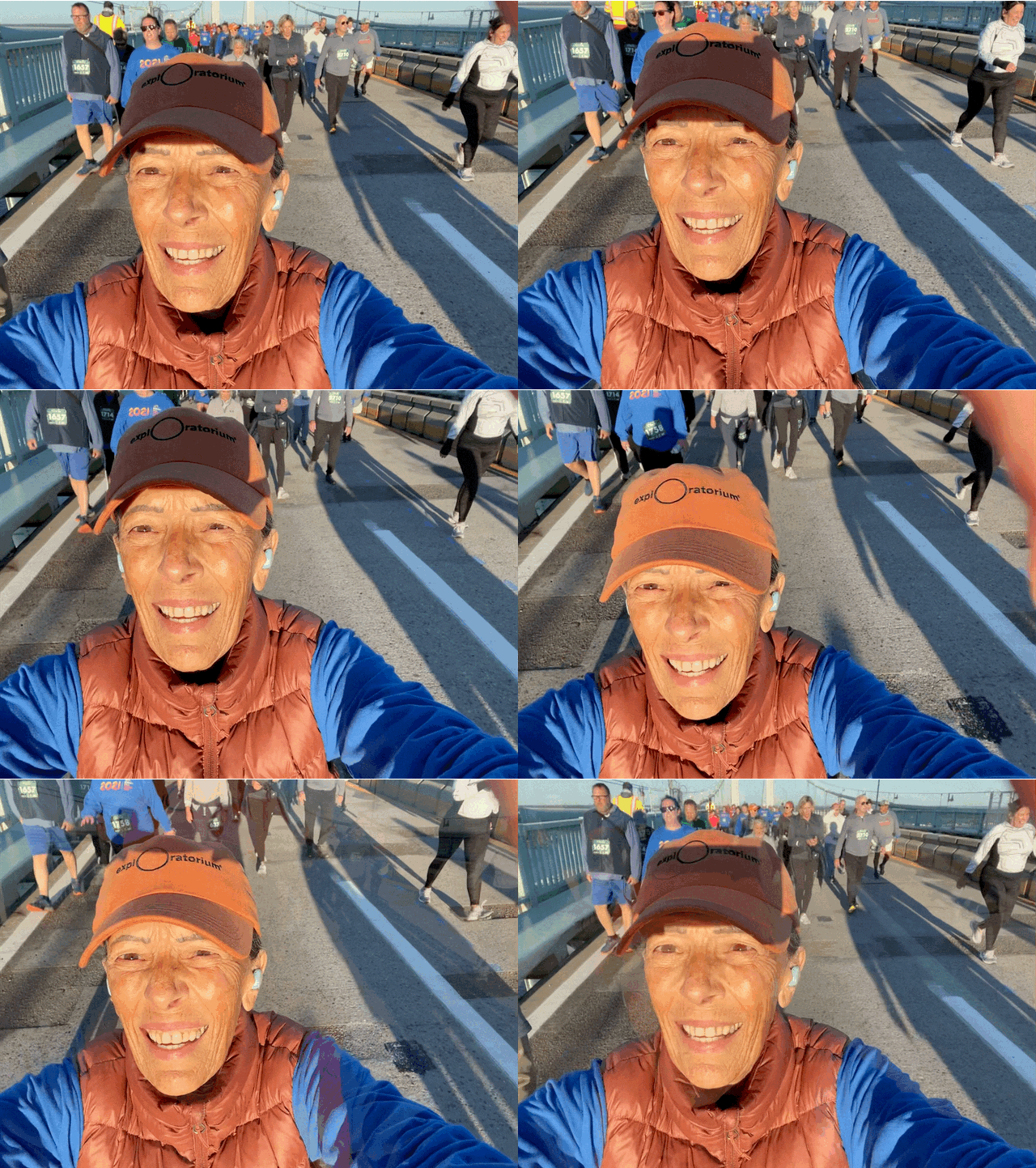
These were exhausting enough but not completely discouraging. So, gathering up my courage, I signed up for my very first 5K run. The race was a 5K over the Pell Bridge which spans Narragansett Bay in Rhode Island. The race started just before sunrise with three thousand participants on a beautiful October day At the peak of span, you can see Newport to the east, with a magnificent view of teh East and West Bays. I did very well in that race, finishing in the top quarter of my age class. I felt completely alive, like I did before the pandemic, with the world full of possibilities. And full of people enjoying their lives with each other, embracing the gifts we bring each other. A man proposed to his fiancé at the top of the bridge. Love (of life) was in the air.
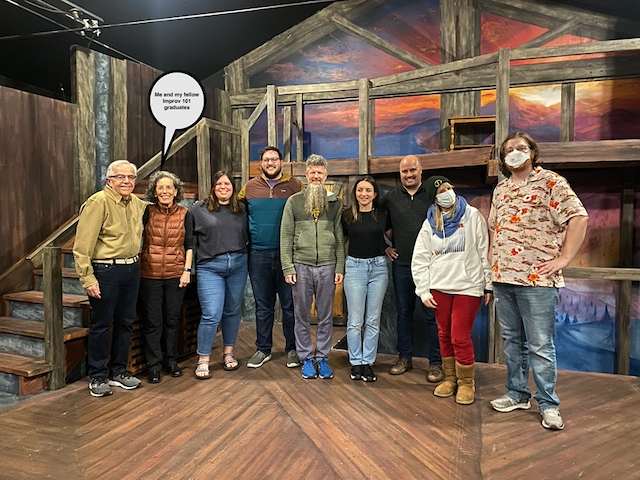
That summer, I also signed up for an Improv course, at OLLI,[2] hosted at the local university. The Improv class was a wonderful entry into the world of improvisational theatre. It re-awakened my interest in comedy. The students were at least 65 years old, drawn by an interest in Improv but with no big dreams or pretenses of appearing someday on the Comedy Channel. We were all simply curious and willing to be silly in the company of complete strangers. After years of pandemic isolation, we met in person in class, and it was delightful to be in the company of people I’d never met before; that felt like a completely new experience. I made two wonderful friends in that class. That course led me to another one at our local community theatre where the students were much younger, faster, and sharper[3]. That eight-week course was an engaging and challenging experience. I would leave these classes completely spent and energized. Soon I took another course in Musical Improv which tapped into another of my lifelong interests, singing and dancing and harmonizing—all of these re-ignited my sense of joy in playing with others. This led me to join the chorus catchers at my local theatre, where I am still learning the magic and structure of improv.
The Improv courses have been among the best learning experiences of my life. I say that in light of the fact that I was a very good student and a pretty good professor. I can perform pretty well in the structure, hierarchy, and predictability of traditional education but I really came alive as a learner in the improv environment and believe that almost anyone would benefit from a similar experience. What follows are my observations from improv classes. So, with less than one year of improv under my belt, I am ready to offer some summary observations and reflections. I call this LifeLessons from Improv or Everything I Learned for Real I Learned in Improv.
What happens in improv doesn’t stay in improv.
In improv, there are no set scripts. Improv classes are a series of games and exercises that teach some of the skills and orientations you would need in improv theatre. These exercises are fast. You are obliged to think on your feet. Not to overthink. Not to try to be funny or clever. To tell a story in improv, you rely on the other actors to create that story together. No one is really in charge. You are simply connected to each other in a contrived space and social situation. No experience is necessary. No basis of knowledge will help you more than another. In fact, it seems to me that the great variety of stories we all carry is the great fuel for improv. These serve as a great reserve for plots and characters and the flow of the stories told.
The key to improv is being in tune with your fellow actors and learning how to be in tune with a great variety of people and personalities in a short time. In music improv, you are not only telling a story, but you are also creating songs and choruses and dances sometimes. It calls on different skills, but you are still co-creating a story right on the spot.
For example, a typical improv musical runs in two acts about ninety minutes long. There may be four or five actors in the cast. The host of the show will ask the audience for the name of a musical that has never been done before. The audience may suggest, such as, Floating Down the River, A Town Called Fortune, or Dancing with the Cows. The actors choose one of these and then are challenged to pitch their idea of what the story will be. The audience claps to indicate their favorite among the options and the show begins. The actors will take their places on stage and the director sets the scene with a time and place. A conversation will ensue among the actors who begin to introduce their characters. Soon, someone says something, like “the trees look so big in this forest” or “I just had a crazy dream” and motion to the pianist that this phrase will form the first song. Music begins to play, and the actor begins to sing the words to the chorus. This is repeated until it seems set. The rest of the actors join and add verses that begin to develop a plot, the characters, the scene, and some interesting possible developments. The director may add challenges (“Ask her to marry you, Gary.”) or ask an actor to change her mood (“You are really really angry about this, Alice.”). The story line and characters develop, and chaos ensues. The magic of all this is how each show unfolds. It is very often a complete surprise to everyone who is on stage. The skills to do this work (or play) depending on your perspective are considerable. I will argue below that these are not just critical for improv, but that they instead broad lessons that could benefit all of us.
Since I have been taking improv classes, my friends have been asking me, if it is improv, why do you need to take a class? Or why does the cast need to go to a rehearsal for an improv show? Very simply, there is lots of learn. Acting is one thing. Bringing life to the written word, putting your voice to words a character may say is hard enough. That takes years of training. However, telling a compelling, maybe hilarious, maybe poignant story from scratch, a story that has never existed and will never exist again is another thing entirely. There has to be some sort of structure or protocols or rules of the stage in place for anything of value to happen.
Your fellow actors are at least as interesting, amazing, curious, and complicated as you.
Because you are a member of a troupe, there is great relief to know the success of the enterprise doesn’t rely completely on you. The success of the performance depends on everyone. You bring what you have and what you are to the stage, as do the other actors, and some magic may happen. Just the discovery of what may be cooked up is interesting in and of itself. Things happen. Personalities are revealed. Stories are shared. Connections are made. You can rely on each other’s passion, curiosity, sense of humor and connection to create the story and move it ahead. No matter how old or young we are and independent of what we do for work or play, we have plenty of share. Recognizing that depth and breadth in others is a real blessing in improv.
All of us has a superpower weirdness.
I have taken improv classes in two settings, at a university and at the local theater. All those classes brought together people who were strangers to me. With COVID, retirement and a busy professional life before retirement, I hardly ever found myself in a room full of strangers who were so diverse in terms of age, occupations, race and ethnicity and experience in the theater. Yet, after just a few exercises, people’s personalities would begin to surface. They would say something that was completely off the wall, surprising themselves and all of us. We would regularly crack each other up, based not on our native wit, but instead on the structure of the exercises, which pushed us to free association and creative expression. That occasion for weirdness opens an opportunity to pull something from your mind quickly and in some instances, crazily. That superpower can lie dormant your whole life. We actively suppress it in most settings, unless we have a reputation as a good storyteller among our friends. But that superpower is our very good friend in improv because it presents premises and oddball ideas and characters to work with and around.
Anything can happen.
Improv creates and rests on the premise that anything can happen. This hearkens back to chart we looked at above, where the paths ahead are multiple and unknown. An improv performance takes one of those paths and plays with it, exercising imagination and flexibility as the scenes develop, step by step. In an improv scene, you may be a Scottish farmer, a collector of goldfish, a mad pharmacist, or a grower of artisanal marijuana. You can sing a soulful ballad or belt out the blues. Anything can happen. You simply need to commit to it, to understand the context, and to incorporate both the development of the story and your relationship with the other actors on stage.
All the world’s a stage: All the stages are little worlds.
Improv is great stage for understanding human behavior, misunderstandings, status, culture and more. Real life provides the fodder for improv. In an improv performance what shines through is the character of human beings in social situations as they try to figure out what is going in the world. We can watch as individuals learn about each other, violate social norms, try to vanquish an opponent, fall in and out of love and much more. As much as we may feel on occasions that we are just cogs in some big wheel, we see the actors on an improv stage, learning from each other, as vulnerable, powerful, and very human beings.
The best plans are made by other people.
Improv pushes you to show up, to be fully present, but not to be in charge. As the story evolves, the actors are giving each other room and openings to develop ideas together. Possibilities surface in what are called, offers. An actor suggests an idea, “Hey, Bob. I know your wife has just left you. Why don’t go down to our favorite soak our sorrows in some gin. Who knows maybe you’ll meet a new girl?” Bob has some choices here. He can say, “Hell, no. What are you thinking?” or he can agree, “Hell, yes! And maybe, we will finally find a girl too after all these years?” or go a completely other way. These offers can pivot a story, adding complications, and filling in the characters.
You can stretch a lot and not break.
As I wrote earlier, I am new to improv, less than one year into the practice. I like to study things I get involved with and like to jump in with both feet. Every improv class I have taken has challenged me in some way to move out of my comfort zone.
You realize talents that you have kept under wraps, undeveloped and untested. I can now sing loud enough to offer my sense of harmony and timing. I can initiate a dance line. I can offer plot lines. I can move ahead with ideas. There have been several instances where I thought of opting out of performances until I was legitimately ready and prepared. I held some unproductive rule about readiness in my mind which held me back more than my lack of ability. Because I learned, you can’t feel the talent until you try to employ it and then it may appear or not. The truth of this is that no matter what we do, we are never fully prepared for what happens. We just need to trust ourselves a bit more but that takes practice and self-compassion. We need to defeat self-defeating ideas.
This story will never happen again.
Some periods of your life are packed with stuff; so much happens. In one month on the improv stage, I was a fortune teller in a wild west town in cowboy times, and was a little kid caught adrift on a pirate ship in an awful storm. Later in the month, as an inebriated sheriff, I welcomed two sisters who were prospecting for gold to California in the 1840’s. As a hungry wolf, I terrorized two little girls lost in a forest at night. The girls put a magic leash on me, turning me into Steve the Dog, their friend and protector. Most recently, I joined a chorus line of cows and a crew of French mice and their sexy tormenting cats. All of this happened while our cast was singing and dancing and acting out our destinies which we had just made up. These adventures prime you for more because they engage the best and brightest parts of you, selves you may never be in context but in spirit and emotion, this is you. Not only do you walk in someone else’s shoes, you walk into someone else’s world. And like so many of our encounters in real life, we are not just playing a role, we are creating the story of our lives.
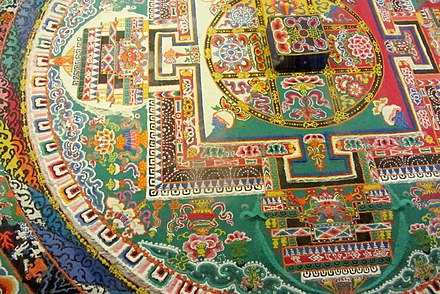
And wonderfully, what happens on stage, whatever song you create on the spot, however brilliant the dialogue, will never happen again. Improv is like a Tibetan sand painting, beautiful and ephemeral. The doing is the essence. And, once again, it is like life. We have one pass through it; today can be practice for the future, we are wiser, less judgmental, more fun to be with, a better listener, someone who is completely present, especially for the people who depend upon us and for the ones that don’t as well.
What skills are needed to succeed in life (and improv)
You can study improv for many years and take lots of improv courses before you will really get it, I believe. Well-done, improv classes are a wonderful way to learn about communication. So much is about connecting with the other actors in the exercise, maintaining eye contact, fully listening to what they are saying, appreciating the emotional feeling of scenes, bringing yourself there, and both being present and in the moment. It is wonderful to see improv shows as they are put together, to fully appreciate how much is left to the actors. Based on my one year of experience, I believe that among the skills you need to succeed at improv is confidence, believing in your bones that you can be on stage as a problem solver. You have something to offer that is creative or possible, something that will either develop the story or fill out a character. To me to be good at improv means that the other actors can rely on you to stand up and stand down, to be there for them, just like being a good member of any community. To this well in improv, you need practice that develops your improv muscle memory.
Important in Improv is the understanding that not every moment will be a brilliant one. You are never always at your best. Your attempts at humor or pathos may fail. You can die on stage, but others will have your back.They have energy at the moment when yours fail. Your obligation here is to be aware and open and ready and prepared to help others when they are lost for a moment.
We are always both living and creating our life stories
There are plenty of challenges to capturing the essence of improv. I think of it as “brain to fable.” In some ways, it is like writing a novel or play, laying out the plot, developing the characters, creating and resolving tension, and making it worth the reader’s time to turn the next page or stay in their seat. That takes lots of drafts and reworking. Many authors can write a novel in about a year but there’s lot of variation here. William Faulkner wrote As I Lay Dying in six months, but it took Tolkien sixteen years to write The Lord of Rings. At one end of the writing process continuum, Mary Shelley wrote Frankenstein in about a year, JK Rowling spent six years writing Harry Potters and the Sorcerer’s Stone. In improv all of this happens in a very compressed time period. It happens almost at once. On stage, the actors are deeply present, aware of the recent past, and looking forward to the future, but not too much because that future is so tied up with the future of other actors.
There is also the great blessing of having a brain and heart full of stories, yours, and others, that can be called upon as goofy, exquisite, and captivating slices and tidbits of live to offer to the actors and audience.
Balancing comfort and commitment
As my friend, Elisabetta says, we all need to be comfortable with being uncomfortable. Improv certainly affords that opportunity. The more improv I do, the more I discover the talent, skills, awareness, and emotional openness on the parts of the actors that makes a performance great for the audience. There is a palpable discomfort to making up an entire story on the spot but like life itself, it evolves in every sentence said, every gesture expressed, every choice made, and every breath taken. There is a sweet spot between that discomfort and being completely in the experience. Giving it all you’ve got. Showing up. Raising your voice and pushing to be heard.
In improv, there is a practice that pushes you to be committed – to your character, to the story, to the other actors, to the belief in the magic of pretending – in the moment and comfortable with the unknown and along for the adventure of whatever comes next.
Summary
Running a road race and being so engaged with improv were never on my bucket list; neither were they on my F(explitive)-it list. They were simply off my radar, out of my orbit. It wasn’t until I was searching for something new that I discover what have been some of the most enjoyable experiences of my life. Is this some late-in-life epiphany of what could-have-been? Career paths untaken? I don’t think so. What I am convinced of is that we all need to do things we’d never imagine ourselves doing, things that our of character. Who knows? We may find that we are many more characters that we would have imagined in our small worlds (like Parisian mice, and wolves, and sheriffs).
[1] Here’s a link to the article How Covid Stole Our Time and How We Can Get it Back by Tim Urban. He is the author and illustrator of the Wait but Why blog (@waitbutwhy) where he explores topics ranging from aliens to marriage to A.I., and its accompanying newsletter.
[2] OLLI stands for OSHER Lifelong Learning Institute. This is a network of over 120 programs located at colleges and universities in the U.S. that offer courses for older adults, taught by community members.
[3] The Contemporary Theatre Company (CTC) in located in Wakefield RI, the downtown area of the small town of South Kingstown, RI with a population of 30,000. The CTC offers scripted shows as well as improv theatre, live music, classes, campus for children. It has been located in a newly renovated space for about 10 years. It is a wonderful and welcoming community organization, vital to our lively downtown.
I get my heart broken most of these days. This is not due to the loss of a love. The source of this is not unprocessed trauma. It is the end of the semester. I am reading essays from students about giving and the nature of the world and their change of heart. The best essays are from students from whom I expected less. Their description of how their hearts have softened, how they have grown more compassionate, how they can never again shoot a poor beggar a dirty look—these all break my heart. There is a place in my imagination where I apologize to them for concluding that they didn’t have that sentiment in them.
However, in the real world, I see myself at the front of the classroom right at the edge of sarcasm. I am fatigued and cannot get a conversation going about the assigned reading. Internally, the attention is on me. What can I do? What have I failed to do to make this dialogue happen? The topic of the day is about the unanticipated consequences of charity. Certainly, a good enough subject for young people to address. But, then I move very quickly to attacking the students, their lifestyle, their attitude, the way in which they have been indulged and don’t know it — this all in my internal deliberations. So, it is these sins of judgment for which I am atoning with my tears. And, beyond that, there is the sweet heartbreak of a work well done, to know that I know these students a bit, that we have spoken to each other across the generational and authority divides and there is a relief in that. Some of my peers have gone over to the other side. They cannot talk with anyone other than people just like themselves, so the faculty cafeteria is full of stories of the lack of fitness of this generation for the education we have crafted for them.
My heart also breaks during my strolls through my neighborhood, tethered to my dog with his leash (actually, our leash) and to some Philip Glass on my iPod. These two tools are my auxiliary sensors. The pace of the dog works against aerobic effect. He is a naturalist in a way that I cannot match, his nose attuned to the great variety of life, unavailable to me. With Glass as background, my thoughts move into a narrative. A story emerges with Glass as the soundtrack. Again, my heart is broken. The landscape along our daily journey is remarkable, as are all places, given enough love.
Walking with the soundtrack from the Hours by Phillip Glass. I was so present at that film that I could link images on the screen to passages in the music. Buying this music was a dangerous move. Two characters commit suicide in this film and others are not far from that act in both the sense of their emotional involvement with the actors but also from their own consideration of suicide as a choice. This morning, I thought, “I could so easily drift away from the life I have made.” I have thought this before but this morning, I felt particularly apart and away from the business of my life. What I had characterized as a lack of roots that enabled me to move from one job to the next, to reinvent myself has to do with this same sense. The feeling that I could be anywhere. It would matter but not deeply. I could move along again. So, when I bought the Hours, I knew that it would take me away. I would be swept off, teetering close to some depressive edge as I do every Christmas holiday. I could take precautions, but I never do. It may be my penance.
Along the way today, I saw a cross with the words “Christ is risen” fallen over in front of a shed, just a day after Easter. I saw a man, aged in the way someone would be in Appalachia, wearing a railroad engineer’s cap. I saw a young man with a Bluetooth device curved around his ear. He was talking in a cadence of black minister about the wrath of God who sends us this mild weather to warn us of eternal fire. Yesterday, I smiled at man who was waving hello a few streets away. Then, he blew me a kiss and whistled.
I think it is all this nonsense that detaches me, that reminds that my attempts to impose order are futile. I walk a tightrope between the rational and the absurd.
I have hit that time in my life when I less production-focused and more aligned with delivering the summary report. I have fewer things to do that are connected to larger purpose and complex organizations more to do with observing that the spit at the beach extends a little farther to the north today because of yesterday’s storm and rip currents. I do the later as part of my daily walk at the edge of the Atlantic Ocean on Narragansett Bay, which reminds me of a story. That is another artifact of this life as an elder. Much of what happens reminds you of another thing that happened a while ago. I don’t think I have ever heard a twelve-year old say, “Oh, yes. That reminds me of a story? Have I told you about walking home from school in a blizzard and nearly dying of frostbite?”
Back to that story. A few ago, I served on the board of an organization whose mission was to provide job training and employment for refugees. I was speaking to a middle-aged woman called Maria whose husband was killed in during the Iraqi war. She was left to care for her four children and because of her dead husband’s work, she needed to leave Iraq as soon as possible. She spent years in a refugee camp in Jordan with her extended family. Many of them were eventually sent to Germany but for some unknowable reason, she and her children were to be sent to Rhode Island. She asked a fellow passenger on the flight to New York City about this place called Rhode Island. He asked her if she ever saw the movie Titanic. She replied that she had. He then said, “Well, if you remember, the Titanic sank when an iceberg hit it. That was the Atlantic Ocean. Rhode Island is at the edge of the Atlantic Ocean where the Titanic sank. Right at the edge.” Marie would refer to that orientation point for years when as she told people of the Iraqi diaspora where she lived – here on the edge of the Atlantic Ocean where the Titanic sank. As I look out from the water, I imagine the Titanic and Marie and much more. I can hardly see the horizon without a memory, allusion or poem flooding to the surface. That amazing neural networked, hyperlinked three-pound brain, sitting at the top of seventy-two years of lived experience.
On a recent holiday, I brought my iPad along so that I could do some writing. I have been writing all my life without much synthesis. It is a good thing there is no editor in our Word programs that would remark in a little bubble “You are repeating yourself. Please don’t write this again!” And then it would refer you to a document or many documents from decades ago where you surfaced the same complaint or delivered the same brilliant insight. I suppose we cannot help but echo the same themes that pass through our lives; they are defining. Mary Catherine Bateson writes that our lives are not so much linear progressions as the re-circling and development of themes we live out and through. However, in this encounter with my iPad, I decided to do some digging and exploring. Instead of writing something new (Ha!), I thought to explore files I hadn’t looked at in a while — essays, poetry, observations, drawings from years ago. I found ideas I had abandoned, essays I really loved to read, stories I swear I have no recollection of and more. It was better writing than I remembered creating. I found a beautiful memoir from a painful time in Chicago. I found humorous essays that made me laugh out loud. I was gathering bits and pieces of who I was decades ago and what remained just now. I was trying to reassemble myself the way an archeologist might put together artifacts of a vanished species. I wanted to get a clearer view of who I was with less of a reconstructed pre-formed narrative story. As researchers have established, none of our memories are pure. All are constructed in the way we would write a movie script. We edit out the parts that don’t fit the story we wish to tell. I wanted to confront these former lives in another way.
And there is so much of this writing. Some are like the ones I find on my computer files. Others rest in repose in my large rattan chest of journals. Others in scraps of paper here and there. I have to remind myself that is somewhat unusual. I don’t know anyone else except maybe a friend who was a high school English teacher who has kept a journal for so long. And what would one do with all of this, this enormous collection of a lifetime? It is an amazing record, I imagine of something, of a single surprising and completely average life. If I were a researcher writing my biography, (let’s put aside the question of why anyone would), what would I find? Would my writings be an accurate and telling account of what was on my mind? Would I be disturbed by this telling by another’s hand? Just writing that sentence taps into my defensive nature. I am already primed to argue. Or maybe, that blessed biographer would be gentle and put things in warm perspective.
At the same time that I am collecting these writings wherever they lay and hide, I am reading The Practice by Seth Godin about sharing your work with an audience that will or may care, comforting myself in the knowledge that my writing is not for everyone but that doesn’t matter much. I just need to find a following that is large enough to feel worthwhile for me and them. So, reacquainting myself with all of this work has put some wind under my sails. I just need to get into a completion habit. I can’t really just put things in a TO DO file and imagine they will get done by themselves. That is probably my first and deepest resolution, the result of a life-long bad habit. I see it all over my office and in cabinets. And it weighs on me more than I think.
So returning to the archeology idea, one finds at the end stage of a life, having evolved good and bad habits. If we had archeologists of our personalities, they could assay your long life and conclude, “Well, that lifelong optimism worked for the first five decades but after that, this was a failure.” Or “On balance, the making of new friends all your life made sense, but you lost more than you made. You were careless there.” And then maybe a medical archeologist as well, to say, “Well your chronological age is 72 but you have a 62-year-old heart, 86-year-old hair, 90-year-old hearing and a liver that is over 100. This will all get complicated very soon.”
The rest of his made world must have had a vexing week
Waiting for things to begin
When he crafted a vast universe
Then cast upon the world
An uncountable galaxy of time.
But to dream and imagine
If I had all the time in the world at my dispensation
(Had God taken the day off and I stepped in his stead)
I would have a busy day
Spending my time in an inspired frenzy.
Taking time from here and placing it there
Until the world was set on a schedule that seemed to me
Better.
Some harsh judgments
Some kind gestures
And like God’s version of the universe
Neither fair not just
Perhaps, not for the best.
But in my mind, better enough.
I would take eons from the years in takes to decay nuclear material and
Add them to the years of dogs’ lives so we would have them as life long companions.
I would tack on years to the lives of poor children who needlessly die from diseases a rich child knows how to cure and
Deduct the years spent on our planet by over-privileged individuals who have taken more than their share of the planet’s riches.
I would delay on the arrival of homo sapiens on our planet another 100,000 years hoping that the other animals can develop better defenses to our domination.
I would extend the lives of butterflies and dragonflies and
Bring to an early end the mountains of disposables
Whose use is momentary and whose legacy is centuries long.
I would add time to the lives of species going extinct and
Send to its death that most dangerous of all ideas
That because we pass by this way once
We can be ignorant of what comes next.
That our obligations don’t exceed our vision.
In my own tiny life, I would underline with arias and symphonic movements
All those moments when others had been deeply generous and kind to me and
I much less so.
The rapture of the cello and the high soprano slowing moments down
So I can take full measure of those gifts.
Fully alive in mind that our lives that are short.
We need to do what’s right when the occasion presents itself.
I would bless myself with the magic feeling of the summer’s start
Ten years old
The season stretched out
Time without end
Of untimed swims and bike rides
And discovery and play
And stories in books
With late nights, capturing lightning bugs in jars
Releasing them just before a deep child’s sleep
When time disappears into another world.
I would add moments to the lives of people who have passed away so I could tell them the story of how much of themselves they have left behind
Ripples of being echoing forward.
I would interrupt time so that I could ask questions of those who have passed resolving for me great mysteries in my own life.
And I would step back almost finished with my work and
Imagine a trial run where I see an evolving planet
The world made manifest in orchestral form.
Our beautiful tumultuous planet
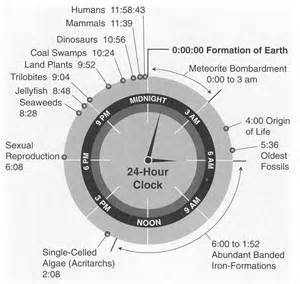
Four billion years
Laid forth in a grand four movement symphonic gesture.
All wonderfully paced
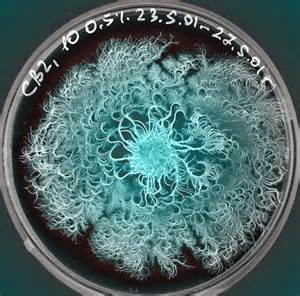
First a single microbe
Alone here for three billion years
In our symphony
This accounts for three quiet one note one beat movements.
Now in our final movement, the algae emerge
Followed by multicellular organisms
This, the Cambrian period, explodes into millions of species
Swimming in our seas
(Sound the cymbals: rouse the entire orchestra)
Then a mass extinction
(Quiet the horns and woodwinds: a solo for the cello.)
Plants emerge on land
Amphibians follow.
Great diversity in plants emerge
Another extinction.
We are half-way through our last movement
245 million to 65 millions years ago
The parade of reptiles
Mammals
Dinosaurs
Birds
Primates
Speed up to seven million years ago
The apes are walking upright
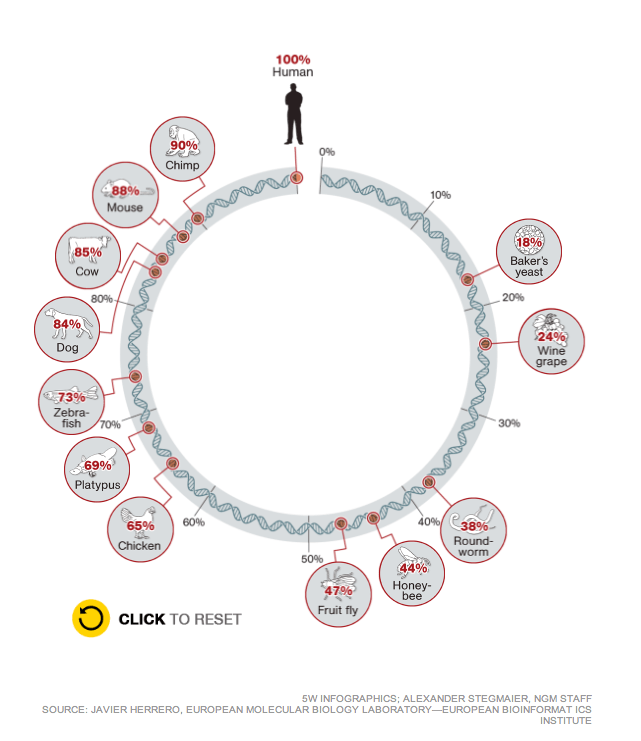
Our complex family tree includes all life
The last stanza occurs in our last 15-minute movement in a matter of seconds
We will have the orchestra play this as fast as their talents allow them.
And the music in its final movement
Gliding to the end, when the universe work is about to finish
With just seconds left
A recent 13,000 years ago, the humans arrive
Civilizations arise.
Political organization
Religions.
The printing press.
Science.
The Industrial Revolution.
The great Wars.
Globalization of the world economy.
I enter–a millisecond of a note
One of five billion at the time of my birth
106 billion of us once occupying the planet.
All this perfectly played in time.
All the time in the world to reconsider another plan.
I started my life as a Baby Boomer member of a working-class family in a mixed class neighborhood in a factory town in New England. Through fortuitous circumstances, few of my own doing, I entered the white-collar class soon after graduating from college. I was the first in my family to graduate from high school and college. With that degree, I no longer worked factory and waitressing jobs that I held in high school and during college summers. I moved into low-level jobs in organizations where my brain was occasionally put to use. Through a series of positions in nonprofits, public service and the tech world, I was able to buy a house, a car and save for retirement. A late in life PhD. allowed me to earn a better salary as I neared retirement.
Somewhere along the way, I had accumulated stocks and bonds into a portfolio, where my savings were invested by my financial advisor. I am putting these words in italics because they still seem so foreign to me. When I was in the seventh grade, my father advised me to start saving for a house as soon as I could and to never ever put any money into the stock market. “The stock market is a rich man’s game”, he argued. “It is no place for people like us.” He also warned me against getting rich or wanting to. “Nothing good can come from that,” he cautioned. I still think my father was right about the stock market and the desire for wealth but with an economic system that simply doesn’t reward savings in a bank account any longer, I opted for the tools available to me. Thankfully, every job I had that came with a retirement plan; there was no way to escape investing in the markets.
So now, over seventy years old, I am faced with figuring out what happens to my portfolio should I die before my modest fortune disappears. I have the chance to bequeath money to my heirs (I don’t have children of my own, but I do have relatives and beloved friends that could benefit from these funds, I am sure). If I pass along wealth to my family, those assets join whatever wealth they already have. Although neither of my siblings is wealthy, we are all comfortable. So maybe some of my fortune could go to nieces and nephews who in their thirties and forties could use an infusion of cash for a house or a car or their own retirement and college planning.
Alternatively, I could donate money to worthwhile charities or create some fund to distribute those dollars after I pass away. If I donate them carefully, maybe I could share the wealth with others who didn’t have the advantages I and my family enjoyed during our careers. As I have been thinking about all of this, I recognize that I am not the only one with this challenge. To understand just how important these decisions are we can look at some larger trends.
Research shows that the passing of the Baby Boomers will lead to the greatest intergenerational transfer of wealth we have ever seen. No generation has been wealthier than the Boomers. Between 2018 and 2042, members of this generation will transfer $70 trillion dollars of their wealth, approximately $61 trillion to their children and grandchildren and the rest to charity. That passing on this great wealth can’t help but contribute to growing inequality. We have never before seen more wealth concentration in this country than the present moment. Estate taxes are virtually zero for most Americans and those with sizable assets are usually armed with accountants and financial planners that work to preserve assets. Perhaps, this transfer of wealth will generate great innovation and entrepreneurship. However, we do have some data that shows that giving wealthy folks more money, like we do with tax cuts, doesn’t necessarily lead to creation of new jobs or social betterment. In fact, it may encourage more second homes, exclusive educations, cooler cars, expensive hobbies, moon shots, along with increased concentration of political and economic power, and other mischief.
As I consider this intergenerational passing on of wealth to our children, I am also thinking about the impact all of this wealth creation has had on the planet. I believe the term externality as used by economists can be helpful here. Externalities are impacts created by producing energy, for example, that is not reflected in price charged for that good. Externalities are also borne by third parties. In this case, it could be environmental degradation. Neither the producer nor the consumer pays the price of this instead it is passed along to the local community, or maybe to the larger society in terms of unhealthy air and water. What externalities have been created by virtue of our accumulating wealth?
If accumulated wealth is what we have earned while on the planet, what unpaid debts can we incurred? What sorts of impact have we had living on the earth, making our living, enjoying ourselves, and raising our children? We can assume that this impact is great if we live in an advanced economy. Research shows the big economies, like the U.S, Europe, and Japan have contributed by far the greatest amount of greenhouses gases to degrading the environment, but those other economies, like India, China and Brazil are catching up. And while these nations are the chief contributors to climate change, it is highly likely that the poorest nations will bear the great burden from these changes. On a more personal level, we can also assume that if we are middle- to upper-income that our impact on the planet is greater than if we were lower income, because we are able to travel more, consume more, have larger houses, demand more products and services, and more.
Oxfam estimates that the world’s richest 10 percent of people have carbon footprints that are 60 times higher as the poorest 10 percent. Any estimation that generalizes large populations is difficult to make, but researchers at Oxfam also estimate that the emissions of the world’s richest 1 percent create an even larger emissions gap: the 1 percent could emit 30 times more than the poorest 50 percent and 175 times more than the poorest 10 percent.
So, imagine as we near the end of our lives, we could calculate the debt we owe to the planet. Suppose when we died, a report issued that measured our environmental impact over the course of our lives. That would include our lives as individuals on the planet, in our households, at our jobs, as we traveled and consumed. It would also take account of the waste we have generated and left behind in landfills, as well as the impact of our investments, and more. Imagine if we can all the water, gasoline, plastic, minerals, food, and other resources that we have consumed or that have been consumed on our behalf.
What if there was a reckoning at the end of our lives based on a valid and reliable calculation of our environmental footprint? Smart economists could determine a monetary value for this. This could be presented at the reading of your will by your executor. First, there would be a statement of your wealth at your death, a total count of your assets and obligations, all set forth and ready for distribution to your lucky heirs and a few selected charities. Second, there will be a fair accounting of your environmental footprint which your children will be obligated to pay off in terms of taxes and other assessments. If they don’t pay it off, it gets passed down to the next generation, just like accumulated wealth. Perhaps knowing that own descendants will be responsible for own environmental impact would lead some of us to care more about the environment than we do now. We would be incentivized to avoid passing down what would be onerous burdens to our children. Those families with parents who had the greatest impact on the environment would pass on their children the greatest burden of accounting for their parents’ impact. It would be likely that those with the largest inheritances would also be those with the largest environmental burdens.
On the other hand, those who trod softly on the earth, who used less than their share, who lived in less resource-intensive economies would pass on credits to their children. Similarly, those who were the victims of environmental harms caused by others, would also receive credits. Those with debits and credits could settle up in some marketplace yet to be devised.
This proposal is way too radical to work, I imagine, but it is a good exercise to begin to take account of the fact that those of us with “portfolios” haven’t earned them out of thin air. We do have an obligation to leave the world a better place than we found it. For the Baby Boomers, I think our time is running out.
Early on the day after Christmas, I went to Narragansett Beach, at the peak of low tide. The walking is always best for me at low tide, especially during the six months out of the year when I am barefooted. I start this ritual on the first day of April and end it just after Thanksgiving. My aim is to sense through my feet the warming water and the coming of summer as well as the water cooling and the settling in of winter. Once in a while, there is a day out of order when a December afternoon feels more like September, and I take my shoes off and enjoy the cold water until my feet go red and numb.
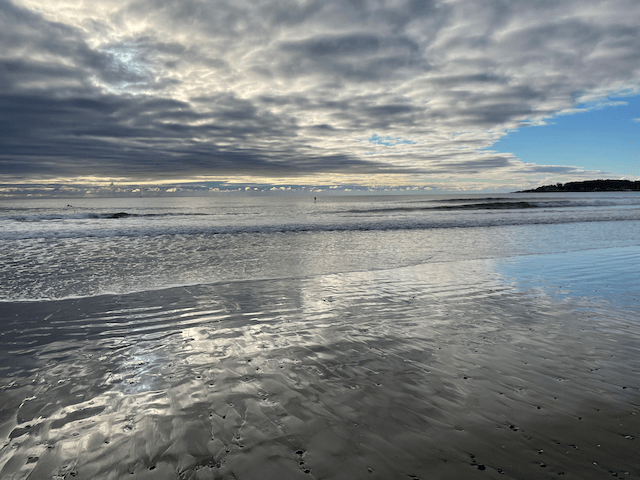
But on this morning, the sky gathered a full palette of clouds. The sun was just rising above the horizon so that objects in the distance — gulls flying over the water or a surfer catching a small wave – were backlit, like a silhouette. The beach was empty except for one other walker, and I felt in solidarity with the figure on the paddleboard here in the photo. He was so small set in the landscape of the water and the sky. I wanted to welcome him to the New Land, just a traveler, finally arriving in the beginning of winter, looking for a port before he set sail again.
I felt very small myself, dazzled by the light.
The metallic shine of the sand and the water.
The bands of light through the patches of the clouds.
The mesmerizing shuffle of the waves.
My own breath in concert with the beat of the universe.
Even for just one moment.
That is just enough sometimes.
There is great comfort in recognizing your insignificance, in taking full measure of your size and weight in the universe, not as false humility but as a path to giving proper due to all that came before and that will come again, of all we will never know or understand, of all the possibilities not lived and of all the hearts we will never touch or be touched by.
I finished that walk on the beach with a little prayer for my tiny soul and for all the foolishness of my young life where after a little study I renounced the works of on faith and went to embrace ideas that were more easily forgotten, readily replaced with others. Until coming full circle, I may arrive where I started, as a babe, just baptized.


 What if there was a reckoning at the end of our lives based on a valid and reliable calculation of our environmental footprint? Smart economists could determine a monetary value for this. This could be presented at the reading of your will by your executor. First, there would be a statement of your wealth at your death, a total count of your assets and obligations, all set forth and ready for distribution to your lucky heirs and a few selected charities. Second, there will be a fair accounting of your environmental footprint which your children will be obligated to pay off in terms of taxes and other assessments. If they don’t pay it off, it gets passed down to the next generation, just like accumulated wealth. Perhaps knowing that own descendants will be responsible for own environmental impact would lead some of us to care more about the environment than we do now. We would be incentivized to avoid passing down what would be onerous burdens to our children. Those families with parents who had the greatest impact on the environment would pass on their children the greatest burden of accounting for their parents’ impact. It would be likely that those with the largest inheritances would also be those with the largest environmental burdens.

 Delight/ Awe and other things