Across a crowded Zoom

I posted this on Instagram and received several comments about the poem being “touching” and “lovely” and “heartwarming.” This little poem is meant to be funny and goofy. Could I have missed the mark? Maybe, no one really reads a poem on Instagram. In any case, this poem is best read aloud.

Across a crowded Zoom                                 

I’ve been looking for love in all the wrong places 

Because now that I’m older, I can’t remember faces 

Which causes a problem in communication and connection.

I’m just looking for nice. I don’t need perfection.

I’ve tried going to church and meeting the congregation

I tried traveling the world on expensive vacations

I even ventured into learning ballroom dances

Maybe, I’ll meet someone, what are the chances?

Desperately, I tipped my toes into internet dating

But that feels like shopping, not at all like mating

So, I took an online course in romantic poetry

Thinking that certainly my love would there be. 

I signed into the class, with twenty other students

Many speaking loudly, others simply muted

And I saw you in your square, your grace filling the room

And, all of a sudden, I fell in love on Zoom. 

You looked so happy and pleased to be there

You sent us a chat message just to show how much you care

I was smitten and enchanted, just by your smile

And wondered how long I’ve waited to be so beguiled. 

The class began with hellos and intros of all

You were a poet (I knew it) living in Sioux Falls.

With me here in Boston, our romance may be doomed

But if we really fell in love, we could zoom and zoom and zoom.

You were brilliant and insightful but when I tried to speak

I kept muting myself, like a clumsy teenage Geek

I scanned your screen background to learn a little more

And on your bookshelf, what do I see? Is that Mary Olivore?

Please, please don’t turn off your screen, we’ve only just met

Would I be too forward, to call you, My Pet?

I could send you a zoom invite for just we two

Gosh, I’d upgrade to premium just to spend more time with you. 

Or should I go on looking for somebody special for me

Surely there’s someone perfect, maybe algorithmically.

Are you lonesome tonight: Assignment #5

The Beatles burst onto the Ed Sullivan Show just three weeks after my father died. This set off secret operations in our so-called music room. This was the back half of our living room with the piano that nobody played and with our record player, a significant piece of furniture with the console on one side and storage racks for albums and 45s on the other. Until I was a teenager, the only music we had in our house were my parents’ records, music from the War that they used to dance to, and our mother’s records, which we were not to touch. Records and the record players were in the “No Children Allowed” zone in our house. 

We loved watching my parents dance to music from the forties. They would glide across the floor with great grace, I thought. My father was a smooth dancer and after practicing the foxtrot and waltz with him, he accompanied me to the Father Daughter dance at our high school, clearly the most handsome and charming man in the crowd. That evening, one of the happiest nights of my life, happened just two months before he passed away.

We processed grief privately in our house. My mother simply couldn’t bear to discuss the loss of our father with her children. Much later in her life, she said to me that she had no words of comfort or consolation for us. My father would have known what to say to us, she said. So, my mother dealt with the anguish of loss she couldn’t voice through her records, stacked up for play one after the other.  How Great Thou Art by Mahalia Jackson, Don’t You Know by Della Reese, Full Month and Empty ArmsMoonlight Sonata, and Elvis Presley’s Are You Lonesome Tonight?

We would watch her expression, see her tears, and sometimes sit with her on the couch when she probably would have appreciated some time alone. Elvis really tore her up. I hated Elvis. I hated how sad he made her, how he kept pointing to her loss, and how much she missed my father. He kept making her cry asking, “Are you lonesome tonight?” With the full force of my teenage sarcasm, I would reply under my breath, “Well what do you think, Elvis. Her husband just died!” “Do you gaze at your doorstep and picture me there?” And from me, “Would you please just stop it!” I really did hate him. 

The underground operation – the secrets — began when my favorite aunt bought me the first album, Meet the Beatles. It is hard to explain six decades later the sort of effect the Beatles had on me. Their music was full of hope and fun and hand-holding, of the sweet innocence of love and flirting and dancing. It was perfect early teenager music. It seemed like the world changed when they arrived. My friends and I couldn’t get enough. I wanted to play their music all the time. My mother worked a long shift during the day but there were a few hours between our coming home from school and her returning home from work that we could use the off-limits record player, playing our music, and being careful to keep everything in its place and just so, remembering every tiny detail that could set off an inquiry.  During those magic hours, we would sing and harmonize and dance around the house, feeling free and crazy. Always in the back of my mind was whether all of that youthful exuberance was somehow a betrayal of the grief I felt in the loss of my father.  We hid the Beatles from my mother as long as possible. We covered our tracks as best we could. 

When the Beatles made that first appearance in early February 1964 on the Ed Sullivan Show my little sister, my tiny brother, my Mom and I were seated in our usual spots in our living room watching TV. I was apprehensive. Could the Beatles cheer up my Mom? Would she tune them out? Would we have to dampen our enthusiasm to honor her grief? I wanted her to love them, as I did, to see them as love and joy.

My mother loved the Beatles, these British young men with long hair.  She loved other English bands, too. We surprised her with the Beatles album which she added to her playlist and every once in a while, she would join us in a crazy dance. We had broken through the no-permission zone and into sharing music with my mother. It was all quite surprising to us. That was a new Mom. Maybe, we gave her a respite from her loss.

When my first true love moved away to college, my mother put up with my playing the same broken-hearted Dionne Warwick ballad over and over and over again. She never once told me to get over it, or to stop playing that miserable music, or that there would be other boys. She let the music pull out my tears, to feel the loss as best and as deeply as I could, even though I couldn’t talk about why this boy meant so much to me. 

We played out our grief and our happy times in common prayer of music.

Announcement New of Policies from British Airways: The Regulation of Seat Behavior


It has come to our attention that as the size of passenger seats has declined that the number of complaints about passenger behavior in those seats has increased. While not rising to the level of a terrorist threat, these complaints have been the subject of an inquiry by Her Majesty’s Commission on Good Order in Seats under the Dominion of the Empire.  Accordingly, today, we are issuing draft regulations that we hope do make our expectations clear about the right order and decorum in the passenger seats. Such regulations only apply to the leisure traveler and neither to those in business nor first class where order appears to be maintained by a more genteel breeding. The timing of these regulations is a matter of urgency as increasing numbers of people all over the globe are turning to the British for guidance in these troubled times on matters of decorum and manners. How else to explain the popularity of Downton Abbey?  We British simply have the market concerned on civility and good manners, despite some recent high jinks in the royal family. These simple rules can surely return to the plane cabin some of the glamour of jet travel that existed before too many people could afford to fly.

Rule #1

The arm rest

In a typical seating arrangement on a flight, there are fewer armrests that there are arms. For example, for a three-seat wing accommodating three passengers with two arms each, we would expect six armrests. However, to save money, the airlines install only four armrests, leaving an undercount of two. This is not our fault; register a complaint with Boeing and Airbus. This shortage requires that EVERYONE share. The occupant of the middle seat bears this especial burden since that individual has no armrest of his own. Despite a common belief, the first person to arrive in the seats has no right, under national law or Geneva Convention, to claim the armrest as his. Neither does membership within a racial group or religious organization constitute such a claim. Similarly, the larger arms found on most men does not bestow upon them any endowed right to the armrest. It is our policy that all the arms of our travelers have equal call and claim to armrests.  Accordingly, a timing device has been installed. A small really negligible electric shock will be administered every ten minutes to assure proper sharing of the armrest. In the event that this fails to move the recalcitrant resistant arm, the cabin attendant can adjust the current. Technology has evolved to allow this system to work efficiently and effectively.

Rule #2

The rightful allotment of seat space and its environs

Contrary to U.S. law on this issue, British law and custom argue for a circumscribed space that is purchased with a standard airline ticket. In other words, under the British system, one buys his seat but that does not allow one to claim the penumbra around the seat. This stands in opposition to American jurisprudence and practice which suggests that it is not only one’s seat that one is purchasing but the area around and into the other’s seat if one is big and pushy enough. Clearly, we see the American doctrine of Manifest Destiny still rules the American traveler. Our seats are NOT selected to accommodate your specific height and weight. For that, you buy a wet suit. Our seats perfectly fit the average male in Great Britain (determined by the British census of 1920) and so should fit women as well. 

Overwhelmed by complaints from passengers that other passengers were taking up more than their fair share of breathable air and seat real estate, we are hereby providing enhanced procedures. A passenger may request from the cabin attendant a PROOD, a passenger-restrain-of-other-device. This instrument fits in between seats in accordance with British law on property and boundary rights on an aircraft.  A full-body version can also be requested to guard against passengers whose body frame leaks into another’s as well as those passengers who fall asleep with their heads on the shoulders of strangers.  Such activity is seriously disapproved by this airline. 

Rule #3

General communication protocols

It should be noted early in this paragraph that we were one of the earliest airlines to accommodate digital devices in our cabins. This is despite our deepest reservations that this move would lead to a further diminution of civility and correct behavior. We had expected nothing better than the worst that has emerged.  We have waited as long as we could before issuing guidelines.       

  • To game players. Despite the fact that you have your earphones on, the rest of us can hear the guns, the shouts, the senseless music, the crashing cars. Please lower the volume or risk having your gaming device tased on our armed staff. 
  • To the viewers of pornography, this should be done in your home, in your bedroom, if at all. Our cabins are full of children and people of good taste who really have no need to see what turns you on.  
  • To traveling salesmen. Do not coyly bring up your latest website so you can cleverly poke your neighbor in the ribs, saying “Oh, man. Look what the IT guys have done. Our next Turbo Filter looks awesome. It replaces the older mode.” Blah. Blah. No one cares.
  • To grandparents. Only one person on the plane wants to see hundreds of pictures of your grandchild and that person has just locked himself in the restroom after seeing hundreds of pictures of someone else’s grandkids.

Our overall advice: keep to yourself. Pretend you are carrying state secrets and imagine that this is the case for your seatmate, as well. Imagine that he will have to kill you if he reveals anything at all to you. Who knows? It may be true.  

Enjoy the flight. The cabin attendants will be serving refreshments if they think you deserve them. Thanks for flying British Air.

What’s Going On: A play in four acts before intermission 3 of 6 assignments

Setting: September 1971 to May 1972, rural Alabama

Characters: Twelve northern-born VISTA Volunteers sent to the South to fight poverty. After a week of training, they cut their hair, put away their bell-bottomed jeans and prepare for work as teacher’ aides, family planning specialists, construction supervisors and community organizers. They are full of idealism and brotherhood and the wonderful feeling that they are doing something important. However, their ideas about doing good, about being comfortable in the world are challenged in this culture that is confusing, frightening, and disorienting. They spent that year and the rest of their lives wondering what’s going on.

Soundtrack; Marvin Gaye’s What’s Going On

Act 1. Three days after arrival. The VISTAs are placed with host families while they look for housing. The third night one of the women is raped by a teenage boy. She tells her friends. They debate what to do. Reporting this to the police guarantees that the boy will be arrested and may pay with his life. It will also mean the VISTA site is shut down. Not reporting it means that the violation goes unpunished, that the other women may be targeted for other attacks. It is just three days and already they are in over their heads. They make up an excuse to the supervisor to move her to another host family. This event has repercussions all year. 

Act 2. End of September. A cell in the local jail. Sheriff Wilkins welcomes the VISTAs to Lee County. He tells them he can recognize a Yankee at a half mile away – the walk, the swagger, the clothes. He wonders why they would come all the way to Alabama when they have so much trouble with the “coloreds” up north, rioting and all of that. He knows that as outsiders, the VISTAs will be troublemakers and that he will be watching them carefully. Her reminds them that last year, the house that the VISTAs were living in in Beulah, a Black community, was firebombed. He sure hopes they doesn’t happen to them. 

Act 3.  Early October. Three women are renting an old farmhouse from the Belks, a prominent family in Lee County. Bubba Belk, the youngest of four brothers and like the VISTAs, a recent college graduate, visits and brings along the gift of a rifle so the women can have some protection. They refuse his generosity. He insists, reminding them that they have no phone, that the nearest police station is twenty-five miles away, and that everyone knows that three white girls are staying together alone in this house. He reminds them that they are living in Alabama, not where they come from.  He walks them to the backyard, shows them an old whipping post and has each of them learn to load and shoot the rifle. They each take a few shots. They thank him and promise each other to hide the gun away. 

Act 4. A warm May late afternoon, three VISTAs and six Black families gather together to work out the day’s schedule at the self-help housing site. A young man arrives in a pickup truck, yells at them to gather around, jumps into the back of his truck and says, “the Governor’s been shot. Governor Wallace has been shot!” One of the men leads the group in prayer and song. They are praying for the soul and deliverance of the Governor. The VISTA volunteers are quiet, wondering how these folks can be praying when their own hearts are so full of hate.  

Do You Believe in Magic? An Older Woman’s Brush with Beauty. 4 of 6 essays for writing prompts

I came from a family where wearing makeup and caring much about one’s appearance was frowned upon and considered vain. I knew that I was not a great beauty. I was one of those “she has such a nice personality” girls, encouraged by my mother to develop my brain and housekeeping skills because youthful good looks wouldn’t last forever. She failed to tell me that my brain and housekeeping skills would also fade with time. (Thank goodness for the latter.)

I successfully resisted makeup and even paying much attention to my appearance until much later in life. Then I relented in my early seventies. Maybe it was my very pretty dermatologist. We had tried lotions and cremes for aging spots, and nothing worked. One day, she suggested a chemical peel. The results sounded promising. Clear skin! My heart swelled with expectation. I remembered what Charles Revson, the founder of Revlon, said about the cosmetic industry. “We don’t sell lipsticks. We sell dreams.” Or “Perfume is made in the factory, ‘hope’ is sold in the store.” So, I bit the bullet, believing in magic. The promise, dream, and hope of a better me. 

Even after bottle after bottle and tube after tube fails to make us beautiful, we again and again put our faith in the magic of potions and creams and procedures, resting on a shaky foundation of that improbable fix.

I signed for the least intrusive chemical peel, as I called it, the baby peel. My lovely dermatologist and her aide prepped me with alcohol and brushed the peeling agent over my face, paying special attention to the darkest areas. The whole thing took less than thirty minutes. I went home with discharge instructions and suggestions to stay out of the sun and take it easy. I should be back to normal with some redness in just a few days. Imagine that!

The discharge instructions and the calm counsel from my dermatologist were completely inadequate for what followed, like the instructions that Marie Antoinette might have gotten before her beheading, “You feel a sharp pinch in your neck that will end quickly, and you will fall into a deep state of rest and relaxation.”  Follow-up instructions generally fail to describe what really happens in post-surgical recovery. Doctors are woefully inadequate in describing pain. Maybe, they figure no one would sign up for any surgery if they told the truth or maybe they resolve to leave the theatrics to the fiction writers of the world. If I wanted to really know the truth about a chemical peel, I could watch a Lifetime movie.

I resolved to catalog my agony and suffering. I took photographs and maintained a log. I have had several surgeries, some quite serious and nothing was as painful as this. I was actually crying in the anguish that I had gone through this suffering for vanity and nothing else – my punishment for believing in magic.

In the follow up visit to the pretty dermatologist, I am eager to share my misery. I have photographic evidence on my phone and paper documentation. However, before I can answer her question, “So, how was the recovery?”, she interrupts, looks kindly at me, and says “Horrible, right?” I nod in disbelief. All that was normal? I suggest to her that she needs to rewrite the discharge materials to more accurately describe the burning, the tightness in face, the frightening peeling of the skin.  

 Before she can disagree, I begin, “Here’s my version, Doctor.”

First, they pour acid on your face. 

Then your skin lifts off your face and dies right in your hands. 

Then your face burns no matter what you do. 

It will seem that the procedure has gone completely wrong but that is entirely normal.

And please don’t sneeze because we have no idea what will happen. 

Clinical results will vary.

We suggest that your loved ones take a short trip while you are recovering because some partners may suffer from nightmares from seeing the patient on days three and four.

Results will vary and are unrelated to your suffering.

The procedure may be repeated in six months because the spots are likely to reoccur.

Abracadabra.

Inspired by Do You Believe in Magic?

Where have all the flowers gone: Two of six

Her days were undistinguished except for the afternoon sun. As the seasons passed, she watched the shadows shorten and lengthen gliding across the floor in her tiny sitting room. At her side, a basket of knitting sat untouched. The last time she picked it up, she had no memory in her fingers of how she once made blankets and hats for every member of her family and many of the babies at the church.  

She felt the warm June sun and looked out to the garden. She struggled to recall the year when she. was strong enough to dig a two-foot trench for the asparagus bed. It thrived for years when the children were small and began to fail when she could no longer tend it lovingly. Where did that lovely asparagus go, she wondered. 

She surveyed the yard, once resplendent at this time of year — every bed a surprise of color and form, her peonies with the grace of ballerinas, those dahlias uncompromising in their bold colors and shapes. Where had all those flowers gone?  Or maybe, she didn’t recall this so clearly. A fleeting thought poked into her mind, perhaps this beautiful garden in her memory was actually someone else’s garden. Not hers at all, perhaps. 

The neighbor’s children, the age of her great grandkids, were screaming with delight, splashing into their backyard pool, celebrating the birthday of the youngest, Liam. She recalled such parties when she was young but not much about them. She couldn’t recall the name of her favorite cousin or remember when she had last seen him. Had he died? Maybe so. Could that be that I wouldn’t remember? She knew she had a happy childhood but the details, of it like so much else these days, escaped her. 

So much had passed by in her long life. Friends. Wars. Struggles. Great joy. Great books. Love. Being a mother. A productive career. Losing a husband. Losing all but one of her siblings. She tried not to dwell on the past, but her future seemed short to her. She did remember her high school friends. “We were such a gang of girls, full of energy and delight and not a little sassiness” she thought. “We were so lovely although we didn’t know it at the time.  Where did those girls go?” When she saw the few friends that remained, she saw old women, with their youth like phantoms beside them. 

She was willing to accept that life was full of loss; that fact she could accept with equanimity. More than anything, she missed her words, her clever mind, her intellectual power. Once, she could summon a rich vocabulary and choose words that delighted her, like a captain commanding his troops to attention, those words bold and perfectly fitted to her ideas. Now, those words were fewer, wandering, and remote and painfully slow to appear. That loss she felt deeply. 

But even as others saw her depleted and elderly, she felt something else. A favorite author of hers wrote at the end of her life, that she was herself, as never before, with fierce energy and intense feelings. Everything was profoundly beautiful to her. Even her own children weren’t as captivating as the children she saw these days. Last year’s Mother’s Day flowers drew her attention like never before. Music brought her to tears. She wanted to draw the world close, to live each minute with all the passion and light that was remained. 

Stumbling into beauty

Have you ever been so dazzled by the wind in the trees

That the voice of your friend chatting about last night’s dinner

Seems muffled and small

Remote and distant.

Is she really there at all?

Or so enchanted by the birds at the feeder 

That the whine of that leaf blower next door

Evaporates into the air

As sparrows and finches arrive, you consider each one

Wondering where they have spent the winter

You waiting just here for their sunrise chorus.

Or so awe-struck by the sweep of afternoon’s clouds

That you go hurtling over a large stone and

Find yourself face down in the sand 

At the edge of the ocean

Eye-to-eye with the sandpipers 

Scampering around you

A giant in Gulliver’s world.

That you lie there for a just moment

At rest in the magic of it all

Capturing your breath

As the sea brings another wave

Leaving you mystified by the power 

And the wisdom of the tides. 

What’s Tina Got to do with me? One of six assignments

Growing up in the fifties, I am given more freedom than I deserve. My distracted mother, a recent widow with three young children to raise, ignores my adolescence. I explore far and wide. I pal around with boys and the girls. I am athletic years before Title IX. I am crazy about music. I teach myself guitar. We write plays and perform musicals at my little high school. We sing and play music on our bus rides home, me playing bongos on my math and English textbooks. We know all the moves of those girl groups and can mimic and even embellish their dances. I can harmonize. It is magic for me. 

I don’t give this up at eighteen. In my twenties and thirties, I find another group of women friends who also love to do this. It was a heady time for the women’s movement. We want to be in and celebrate each other’s company. We sing and dance for our friends and perform at women’s conferences. We perform Aretha, the Shirelles, the Supremes, the Dixie Cups, Gladys Knight and the Pips. We never tried to do a Tina Turner song She was too far a reach for us. Which of us white working-class girls imagined dancing like Tina did? None of us. I had seen her on TV with Ike and the Ikettes. She was too sexy. Too crazy. Too beautiful. Unreachable as an icon with those long legs and warrior woman body. She was just too hot.

That all changed. She survives her abusive relationship with Ike Turner and returns to the music scene with ground-breaking album Private Dancer, with the hit What’s Love Got to do with it?  She rises strong, confident, strutting. A music critic writes that this album “reeks of attitude.” I can’t read that as adoration. George Bush awards her the Kennedy Center Honors and notes that she has the “most famous legs in show business”. They still don’t understand what Tina is all about. At 44, she becomes the oldest woman to receive a Grammy for Best Solo performer. That doesn’t sound that old to me. 

I see her anew. She is just ten years older than me. In my youthful eyes, I saw her a giant. I learn that she is a tiny 5’ 4” tall and weighs 120 pounds. That is exactly me. In her emergence, Tina gives me strength. I am finally ready to bust out of my good girl, Catholic obedient, uniform wearing, background singing self.  Tina creates the space for me to come out to my friends. To feel flirtation for the first time in my bones. I let myself be attracted and attractive. And maybe for the first time, I think, “That can’t be love. What’s going on? We just met!” But there is something powerful and worth paying attention. 

And not just me. Liberation is recognizing that is always time for re-birth and reinvention. My troupe is done with happy songs about “Going to the Chapel” and waiting for that boy to call. We’ve been burned and are ready to claim power and respect. Turner steps out and we follow. We sing Tina Turner in our comfortable shoes, with our short legs and choreographed moves until my group falls apart, with heart aches, broken marriages, wayward children, cracking voices, slower paces. One of us has cancer. Another, a husband certain to die with a brain tumor.  We are well prepared for the next transition. 

Finding Elizabeth

It was one of those days when everything is beautiful.

Our graveyard features tall spreading oaks.

Linking heaven and earth.

My daily walk along the bike path

Runs along the edge of that cemetery.

The path follows the one laid down

By a railroad that took passengers to the edge of the ocean.

It much quieter now without the traffic of the railroad.

Now the dead have the company of dogs and children.

And older walkers like me

Who make their way around the tombstones.

I used to walk here for my health.

The elderly should keep moving, the doctors advise.

But these days I greet the deceased

Not as ghosts but instead as

My interred neighbors.

Sharing our place on our earth together

If not our time.

Each gravestone tells a story.

I read their names and say them aloud.

And before I complete the word

An image comes together in my mind.

Ebenezer – Ah. To live with that name.

Mercy and her husband, Pardon. 

Elijah and his son, Elijah

Gideon

Anizetta

Freelove

Wager 

Phineas and his sister, Lillian

Minnie

“Kook”

Matilda

Caleb and older brother, Isaac.

Quickly, I am in a village and am walking in a community.

Perhaps, they know each other or know their families.

Maybe, they played cards or went to church last night. 

Maybe, they married the pretty girl next door.

All these names have disappeared.

Their flair and fashion and folly

A lost generation of characters

Down near the river are newer graves.

I see that the Mellors lost two children.

A baby and a toddler

I feel their sorrow.

Children died the years my siblings were born.

I find a memorial for another child.

Dead not more than two years.

The boy’s parents have made a shrine.

Of toy cars and little figures

Solar lights in each corner to keep the boy safe at night.

I find a large tombstone at the top of the hill

At the foot of the huge oak

A monument to Doctor Robinson

A great man it seems on this scale.

In bold letters, I see his birthday and birthplace.

I see as well the dates and place of his death.

I see that he served in the War.

Near the base of the stone I see

“Devoted wife” and beneath that

Eli……

Mud and grass have erased those traces of his wife.

Her name buried in the dirt.

Perhaps, if he had one less accomplishment

There would have been room for her.

Tomorrow I will bring a spade and reveal  

Her place and time to the world.

It matters to no one else this clearing

Away of mud and earth.

Neither does it matter to anyone else that I 

Have made these friends in the graveyard.

But to feel these connections means everything to me.

I have long renounced a cemetery plot of my own

Thinking about the burden of a grave for my loved ones

Maybe, they’d feel a need to visit. 

Just now, I am rethinking this resolution.

Allowing the idea to take root in my mind. 

I don’t need to be remembered but

I do need to rest with my neighbors and friends. 

Living in the shadow of Shirley Temple

I spent my childhood in the fifties, living a standard working class childhood. Besides all the other tasks associated with socializing children, the adults in my life were focused on exposing us to wholesomeentertainment. I remember Sundays at Mass where we would as a community take the Legion of Decency pledge, foreswearing temptation, and the work of the Devil. One version of the pledge read as follows:

I condemn all indecent and immoral motion pictures, and those which glorify crime or criminals. I promise to do all that I can to strengthen public opinion against the production of indecent and immoral films, and to unite with all who protest against them. I acknowledge my obligation to form a right conscience about pictures that are dangerous to my moral life. I pledge myself to remain away from them. I promise, further, to stay away altogether from places of amusement which show them as a matter of policy.

I remember all sorts of films received C (condemned) ratings including the Rosemary’s Baby, Clockwork Orange, The Producers, The Rocky Horror Picture Show, and Saturday Night Fever.  The Legion of Decency was run by a loose affiliation of local civic leaders, not really a body of the Church. Pope Pius XII wrote that instead of condemning morally dangerous movies, Catholic organizations should be promoting good ones which is something my mother and my grammar school did all the time. I am not certain why the adults were so obsessed with movies. Perhaps, they had seen the ravages of unwholesome entertainment on the brains, souls, and character on the population. Maybe these effects were especially powerful on innocent children and callow youth. They wanted to mount a defense. My Catholic elementary school was especially vigilant about protecting “purity”. In my reading of the Lives of the Saints, a very high percentage of girls who became saints did so by protecting their purity. As a small child, I had no idea what any of this meant.  I imagined it might have to do with the cleanliness of my soul, making sure nothing nasty entered.  The ritual of confession offered a nice regular scrub down. You would share your sins with the priest. He would pass along some penance prayers, and within no time, you could be back to making mischief again.

I had loads of questions about penance. I knew that basically my sins were small potatoes. But suppose, someone confessed that they murdered someone or denied their faith or stole candy from their brother, could the priest make them go to jail or whip them or send them to their room without dessert? Certainly, it couldn’t be that everyone should just get to say a few prayers and go about their evil business. Who even remembered those prayers and who checked up to see if they were really recited with a pure heart? 

A prime rule of child rearing in mid-century families was that It is important to offer children good things to do and consider, otherwise evil forces will capture them and never let go. They had to cut off bad influences at the start. A child will not want to see a a bad movie, “bad” in the sense of corrupting, when they can see a “good” movie, one that would lift them up morally, like the Song of Bernadette or even better, Rebecca of Sunnybrook Farm? The former was nominated and won several Academy Awards. The film tells the story of the apparition of the Blessed Virgin Mary to a poor girl named Bernadette.  Miracles ensue, the sick are cured, and she is eventually canonized. Her faith triumphs over lots of disbelief and naysaying. As a Catholic child, I saw that movie lots of times, fully expecting my own apparition, if I could remember to pray and be good and simple hearted, full of faith and obedience and not much else.  I was not visited but neither were my more obedient and devout classmates. 

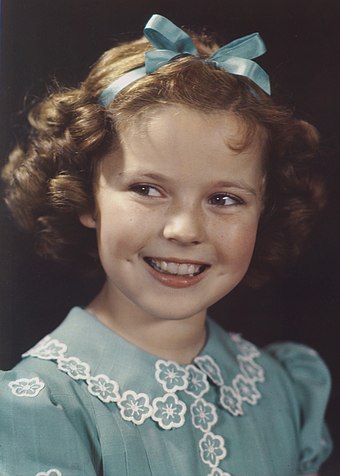
Despite the fact that I saw plenty of religious movies, the central figure of my wholesome childhood viewing was Shirley Temple. She loomed large at home and at school. We saw her movies at school at our first Friday film afternoons where the entire student body from first through ninth grade would gather. These were also shown on television on Saturday afternoons and my mother, a real devotee of Shirley’s, would watch those movies with us. We laughed and cried and “Awwwed” together. My mother could recite lines from these films that she remembered from seeing them in the movie theaters as a child and as a young adult.  She loved Shirley Temple; I could see the adoration in her eyes, and I think I wanted some of that unqualified enchantment.

Shirely Temple

She had everything on her side. She was undeniably and overwhelmingly cute. She danced and sang in an adorable little girl way. She pouted endearingly. She had a strong moral compass and consistently directed adults to do the good and better thing. She showed the path to joy through good wholesome living. Even if you were a misanthrope, you had to like this kid.  I remember feeling badly for boys because their role models seemed to be troublemakers from the Little Rascals, like Spanky, Alfalfa, and Buckwheat. 

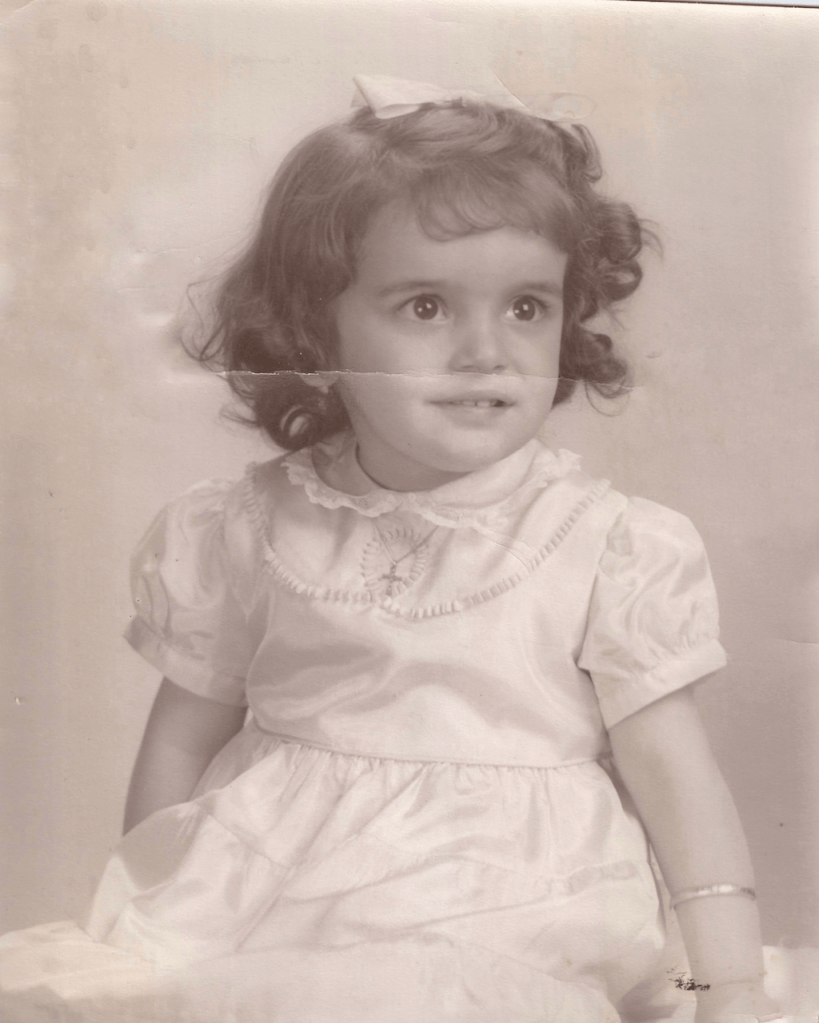
I don’t ever remember thinking that Shirley and I could be friends. I don’t remember thinking that she’d be a nice sister to have. I liked all of my friends well enough and really loved my sister. But I watched her in overalls in Rebecca of Sunnybrook Farm and made a note that I had overalls, but I didn’t quite look as cute. What was it about this kid?  I saw her in so many movies with those killer banana curls. I had thick, black, nearly uncombable hair but earlier in my life, I had workable hair. Somehow that changed. Maybe, we lose our lovely baby hair like we do our baby teeth. My mother’s only attempt at hair styling was to cut my bangs short and let things fly.  To address my hair issue, my favorite aunt took me to the hairdressers in the first grade where Leona gave me a makeover in the form of a pixie cut. With a gap in my front teeth and a very short haircut, I was quickly running away from any chance of looking like Shirley Temple. I needed another strategy.

Me at three years old. The Shirley Temple influence is obvious.

I tried to sing like Shirley Temple and followed her steps closely when she tap-danced up and down a staircase. I tried to pout, swing my arm into a let’s-go-get-‘em pose, and say cute things like, “I’m very self-reliant”, which Shirley pronounced to the great delight of her elders in Rebecca of Sunnybrook Farm.  My obsession with Shirley reflected my mother’s. She clearly adored this little girl. I compared her object of adoration and her own regard of me, which was so full of ambiguity and restraint. I recently learned that films like The Little Colonel, The Littlest Rebel, Captain January, Bright Eyes, Curly Top, Poor Little Rich Girl, andSusannah of the Mounties were made between 1935 and 1938. They were full of messages about optimism, grit, resilience, and spunkiness. Adults in Shirley’s orbit are charmed by her to do the right thing, to change their lives toward the better, to raise money for good causes, and golly, to do whatever it took to keep this child happy.  

She is often without a family of her own. She is orphaned more frequently than any kid should be, but this gives her lots of chances to wheedle her way into the hearts of rich and poor, young and old, white, Black and Native American, the kindly and the grouchy. It is truly amazing. My Mom grew up during this time – in those years between the Depression and the Second World War. She may have embraced Shirley as a role model of sorts. She had six brothers and sister in an alcoholic home and was placed in an orphanage during the Depression at two or three years old when her parents couldn’t afford to keep her at home. Shirley Temple offered a glittering example of a charmed life. If the Gods could grant it, I would have loved to have been that child for my mother, but she very effectively resisted my charms for good reason. 

But to live in the shadow of this lovely golden child – to see her weekly on TV and often at school, gave me a model of what a child I could be. What about this little girl could I emulate? Or maybe that was a losing battle. Maybe, I could simply understand that Shirley Temple was my mother’s fairy tale, and I was too busy with my own stories to be diverted by this one for too many years. I grew out of love with Shirley Temple and set my sights on Annie Oakley, another hero of fifties television.