The archeology of a long life

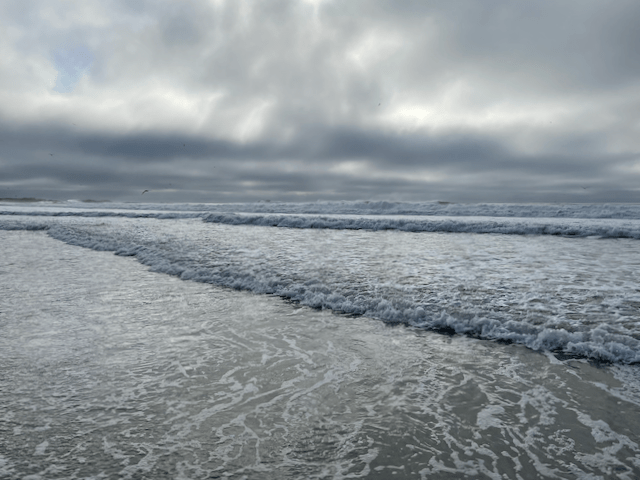
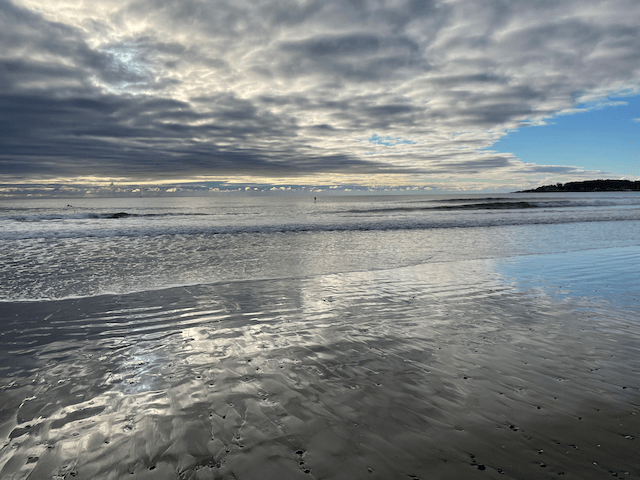
I have hit that time in my life when I less production-focused and more aligned with delivering the summary report. I have fewer things to do that are connected to larger purpose and complex organizations more to do with observing that the spit at the beach extends a little farther to the north today because of yesterday’s storm and rip currents. I do the later as part of my daily walk at the edge of the Atlantic Ocean on Narragansett Bay, which reminds me of a story. That is another artifact of this life as an elder. Much of what happens reminds you of another thing that happened a while ago.  I don’t think I have ever heard a twelve-year old say, “Oh, yes. That reminds me of a story? Have I told you about walking home from school in a blizzard and nearly dying of frostbite?”

Back to that story. A few ago, I served on the board of an organization whose mission was to provide job training and employment for refugees. I was speaking to a middle-aged woman called Maria whose husband was killed in during the Iraqi war. She was left to care for her four children and because of her dead husband’s work, she needed to leave Iraq as soon as possible. She spent years in a refugee camp in Jordan with her extended family. Many of them were eventually sent to Germany but for some unknowable reason, she and her children were to be sent to Rhode Island. She asked a fellow passenger on the flight to New York City about this place called Rhode Island. He asked her if she ever saw the movie Titanic. She replied that she had. He then said, “Well, if you remember, the Titanic sank when an iceberg hit it. That was the Atlantic Ocean. Rhode Island is at the edge of the Atlantic Ocean where the Titanic sank. Right at the edge.”  Marie would refer to that orientation point for years when as she told people of the Iraqi diaspora where she lived – here on the edge of the Atlantic Ocean where the Titanic sank. As I look out from the water, I imagine the Titanic and Marie and much more.  I can hardly see the horizon without a memory, allusion or poem flooding to the surface. That amazing neural networked, hyperlinked three-pound brain, sitting at the top of seventy-two years of lived experience. 
On a recent holiday, I brought my iPad along so that I could do some writing. I have been writing all my life without much synthesis. It is a good thing there is no editor in our Word programs that would remark in a little bubble “You are repeating yourself. Please don’t write this again!” And then it would refer you to a document or many documents from decades ago where you surfaced the same complaint or delivered the same brilliant insight. I suppose we cannot help but echo the same themes that pass through our lives; they are defining. Mary Catherine Bateson writes that our lives are not so much linear progressions as the re-circling and development of themes we live out and through. However, in this encounter with my iPad, I decided to do some digging and exploring. Instead of writing something new (Ha!), I thought to explore files I hadn’t looked at in a while — essays, poetry, observations, drawings from years ago. I found ideas I had abandoned, essays I really loved to read, stories I swear I have no recollection of and more. It was better writing than I remembered creating. I found a beautiful memoir from a painful time in Chicago. I found humorous essays that made me laugh out loud. I was gathering bits and pieces of who I was decades ago and what remained just now.  I was trying to reassemble myself the way an archeologist might put together artifacts of a vanished species.  I wanted to get a clearer view of who I was with less of a reconstructed pre-formed narrative story. As researchers have established, none of our memories are pure. All are constructed in the way we would write a movie script. We edit out the parts that don’t fit the story we wish to tell. I wanted to confront these former lives in another way.

And there is so much of this writing. Some are like the ones I find on my computer files. Others rest in repose in my large rattan chest of journals. Others in scraps of paper here and there. I have to remind myself that is somewhat unusual. I don’t know anyone else except maybe a friend who was a high school English teacher who has kept a journal for so long. And what would one do with all of this, this enormous collection of a lifetime?  It is an amazing record, I imagine of something, of a single surprising and completely average life. If I were a researcher writing my biography, (let’s put aside the question of why anyone would), what would I find? Would my writings be an accurate and telling account of what was on my mind? Would I be disturbed by this telling by another’s hand? Just writing that sentence taps into my defensive nature. I am already primed to argue. Or maybe, that blessed biographer would be gentle and put things in warm perspective. 

At the same time that I am collecting these writings wherever they lay and hide, I am reading The Practice by Seth Godin about sharing your work with an audience that will or may care, comforting myself in the knowledge that my writing is not for everyone but that doesn’t matter much. I just need to find a following that is large enough to feel worthwhile for me and them. So, reacquainting myself with all of this work has put some wind under my sails. I just need to get into a completion habit. I can’t really just put things in a TO DO file and imagine they will get done by themselves. That is probably my first and deepest resolution, the result of a life-long bad habit. I see it all over my office and in cabinets. And it weighs on me more than I think.  

So returning to the archeology idea, one finds at the end stage of a life, having evolved good and bad habits. If we had archeologists of our personalities, they could assay your long life and conclude, “Well, that lifelong optimism worked for the first five decades but after that, this was a failure.” Or “On balance, the making of new friends all your life made sense, but you lost more than you made. You were careless there.” And then maybe a medical archeologist as well, to say, “Well your chronological age is 72 but you have a 62-year-old heart, 86-year-old hair, 90-year-old hearing and a liver that is over 100. This will all get complicated very soon.”
Ode to Kale at 71

Imagining that day in January when the sun doesn’t rise 

Until after I have been up with coffee for nearly an hour

And when night falls well before I am ready to end the day

The deep dark of winter where those precious hours allow for an escape to the beach.

I walk every day 

Weather hardly matters

I am a seasonal agnostic.

In fact, facing a stiff gale

Being covered in a driving wet snow is

Hardly adequate rent for all those summer days 

That arrive soon enough.

Time moves so quickly at this age

When you see your loved ones with disappearing futures.

But today, I am holding in my mind, this particular morning

In the kale field where we gleaned this week’s growth

There won’t be another harvest until October.


And to feel that energy from the soil and the sun rendering this food for us.

And the pleasant sensation of the sun at the back. 

How to summon this on those dark days ahead 

Except to accept them as resting and

 Readying for the next season. 

We grow older but the seasons cycle. We find and shows ourselves differently at each

Rotation of our planet. 

At 71, I am thankful that I can stoop and lift and bend and enjoy this adventure and all

Other adventures that my freedom allows. 

Just because it will not always be so does nothing to diminish the moment. 

Extraordinary Heroes

We are surrounded by extraordinary heroes. Here are mine. Do you recognize their names? 

Ramsey Orta

Feiden Santana

Jamil Dewar

Karina Vargas

George Holliday

Darnella Frazier

No, these are not names of unarmed black men killed by officers of the law. Every one of these individuals was behind a camera photographing a black man, woman or a teenager being beaten or killed by police officers.  

  • Randy Orta captured the choking death of Eric Garner in 2014. 
  • Walter Scott’s murder was photographed by Fieden Santana in 2015. 
  • Jamil Dewar and Karina Vargas shot videos of 22-year old Oscar Grant in 2009 when he was killed at Fruitvale Station.  
  • George Holliday’s video captured Rodney King’s beating in 1991
  • Seventeen-year-old Darnella Frazier took the footage of Derek Chauvin pressing the life out of George Floyd in May 2020. 

I believe that these individuals are heroes.  With courage and composure, not certain of their own safety, they recorded events as they transpired — for others to see and maybe for justice to be done. If it were only so simple. 

Watching these videos should sicken us. The video of the the casual evil that we see in the George Floyd’s killing shines a glaring light on the use of police powers on unarmed black bodies. This imagery has enraged millions of people who have viewed it.  Are these videos so powerful because white people are seeing the violence for themselves, as if Black witnesses to these daily onslaughts are not to be trusted to articulate their own experiences?  

And, as compelling as these videos are, they don’t tell the whole story.  I would like to challenge filmmakers and truth tellers — ordinary heroes — to create and chronicle compelling accounts of other tools of oppression, just as powerful, just as corrupt and perhaps, even more effective as tools of subjugation and marginalization. 

Where’s the Money? I am arguing that we need compelling videos of board meetings where bank presidents plan to hide drug money, fueling not only the delivery of drugs into poor neighborhoods but also enabling the War on Drugs targeted at these communities. I also want to see how banks and financial institutions loot black neighborhoods.  I want footage of the ways in which generations of policies—corporate and governmental — have robbed Black families of opportunities to create wealth.  I want to watch the way payday lenders congregate in these neighborhoods and how banks serve communities of color so poorly. I want to watch the mechanisms that work to pay black men sixty-seven cents for every dollar a white man earns.  I want to see the STOP those stark differences in wealth where the typical white family holds $171,000 in wealth and the typical Black family owns $17,000 come from.  We know that without wealth, families and communities are bereft of safety nets of their own, relying on inadequate, ineffective, and punitive streams of public and private assistance.


Democracy under attack. I am also looking for a video that shows clearly the instruments in place for denying and suppressing the right to vote for people of color.  We need to cast a bright light on town halls and city meeting rooms and sessions of law makers for that video. As dull as gerrymandering may be to examine in process, I want to see the “room where it happens” where voters are sidelined into voting districts that work to undermine the principle of one person, one vote. I want to see it in full color how publicly elected officials undermine the democracy they are supposed to uphold. I want to see how a made-up threat of voter fraud masks the work of taking away a central right of citizenship. 

Ideology. I have been thinking about the genealogy of ideas in America.   What does our family tree of ideas about race look like in America? What is the root of all the ideas we have about race? About people of color?  And what do those ideas begat? And what actions? And what narratives? How do understand our own minds, our biases, our baked-in-the-cake regimes of superiority and inferiority. The hardest footage to capture is those stories and narratives put in place by those in power, our nation’s creation myths, that suggest that the status quo is the nature of things. That hard work makes you successful. That we are playing on an equal playing field. That white folks earn everything they get. Those powerful ideas that explain to us why some of us are at the top of the hierarchy and others at the bottom. White folks can’t understand what it is like to be Black in our nation; we hardly appreciate what it is to be white. 

We need ordinary heroes to tell these stories and others about housing and health care and criminal justice and education. To be sure, we need new tools to fight this fight. We need Oppression Impact Statementswhere we carefully critique and understand the impact of our laws and policies on vulnerable communities of color. We need to understand that even if our ancestors didn’t hold slaves, our ancestors benefitted from programs that advantaged whites and sidelined Black opportunity. And to be sure, white guilt is not the key here. Taking responsibility is—for creating a complete accounting and imagining how we address the wrongs that have created our present. 

Post-script. Darnella Frazier was issued a special award and citation by the Pulitzer Prize board for “courageously reporting the murder of George Floyd, a video that spurred protests against police brutality around the world, highlight the crucial role of citizens in journalists’ quest for for truth and justice.

Be Your Own Crash Test Dummy

About a year ago, I nearly walked into the path of a car that was entering traffic from a parking lot. The driver was edging into the road and had carefully scoped out his exit. I am certain that he had looked up the street and down. I was the surprise—a blind spot—in his field of vision. He was moving south; I was headed east. One half-second earlier and I would have gone sailing into his car and over the hood. I am a small woman, somewhat fit and maybe athletic. I saw myself arcing in a gymnastic tumble. Except, unlike those tiny bouncy teenagers who land on their tiptoes, I imagine that my head would have hit the pavement first, a non-sanctioned Olympic move called The Double Concussion Flip and Fall. Maybe, I was too distracted with my earbuds playing Moby’s Wait for Me; it is a mesmerizing tune. I was over-dressed on this seventy-degree autumn day. 

I stretched out my hands to cushion the crash. When this failed, my chest hit the hood of the car. I bounced back up and tried to resettle myself. What was I doing before I marched onto the hood of this car, I wondered? The driver waved his hands in apology; I waved back. It was like a silent movie. All gestures, no talk. I wanted to dance a bit, maybe skip in front of the car as I left the scene, just like Charlie Champlin might. It was a magic moment. A minute before we had been invisible to each other; now we separated each with a little memory, a shared story to tell our spouses, and maybe a wee lesson, depending on our temperaments.  

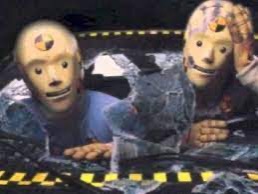
As we live our lives, we collect stories like this all the time. The older you are, the more you have of these. There are accidents, near-misses, losses and what-could-have-beens. Some we bounce back from, others less so. For me, all these brushes with illness and death bring to mind me those public service announcements from the ‘80s with those crash test dummies, Vince and Larry. 

I see much of my life a series of crash test dummy trials. This encounter with the car put my mind on the path of other near misses—a series of events that could have led to some serious trouble. I have sped through a stop sign late at night, distracted and tired. I have twice driven the wrong way down a busy street at twilight. If it had been earlier in that day when I walked into the car, I would have without doubt faced a lot more traffic and a much greater probability of getting hurt. I would have been like a little cat facing the running of the bulls. We could all have been seriously hurt. Well, not all of us equally. 

I have been in cars that have spun out, flipping on their heads in slick Alabama clay. I have been held up at gunpoint in Texas on a little walk in the good part of town. The man who did this looked upset enough to hurt me. I have dodged so many medical scares, that I am pretty certain that my health insurance company thinks that I am messing with their premium calculation algorithm. I have had so many tests and been diagnosed with so many wrongly accused major illnesses, there must be an office pool somewhere betting on my demise. This includes brain aneurysms, stomach cancer, pancreatitis, and more. I could go on and on here, but it seems with every incident I recount here, I am feeling both dizzier and bolder. To me, each of these is a like a crash test. With so much good fortune, a karmic calculation would have me dead pretty soon. As they say, I may be running out of good luck. Or maybe in that cosmic computation, or my good fortune comes at the costs of another’s unearned bad turn of chance.  

Which gets me into the meat of what is really on my mind.  Earned and unearned good fortune. the movie Funny Girlwhen Fanny Brice finds early renown, she says to her lover, the fabulously dreamy Nicky Ornstein,  and supporter that she can’t be famous yet because she hasn’t suffered enough. I understand this feeling. It is that sentiment that much of what we have is unearned. We moan, “Why me?” when bad luck strikes but when good fortune strikes, we smile, “I so deserve this.” Personally, I have unearned good health, undeserved energy, unnatural optimism. I don’t know if others feel this way about the gifts they have. I think we mainly focus on what’s missing.

It seems to me that most of us have experienced good fortune we have neither earned nor merited and of course, the reverse is trueI used to joke with a friend that I had the Luck of the PortugueseWhen that friend remarked that he never heard of the Luck of the Portuguese, I would simply reply, “Exactly.” John Rawls suggests that in considering systems of justice, we imagine that we don’t know where in a social system we may stand.  He calls this a veil of ignorance. How would we want the world to distribute its bounty if we didn’t know whether we were rich or poor or white or Black or male or female or a U.S. citizen or a citizen of another county or abled or disabled? If a thought experiment like this were possible and if it could influence social policy, we would have to be convinced that we actually could stand in someone else’s shoes. Hale doubts this can be done because of what he calls the veil of opulence—the blindness that we all have to the privileges of birth and position. We fall victim to the comfort of believing that if we fell on hard times, we would work our way out of it. The veil of opulence works like the Just World Hypothesis. It creates that delusional narrative that we are self-made, deserving human beings whose unearned good fortune insulates from caring more deeply from others who we see as not as worthy or deserving of what we have. Lots of us dodge bullets thinking we are lucky and blessed; not imaging that the cards are stacked in our favor. Like all those crash tests that I have survived, many have to do with an advantage of class or nationality or gender. Others have to do with random events completely out of our control. And like the crash test dummies, we often do not take good advice or live in a manner that reduces the risk we visit upon ourselves or others. But, as humans endowed with some degree of reasoning, we can do more than our best sometimes to avoid doing the worst. 

My favorite dress

This morning, the fifth day of the seventh month of the pandemic

I ironed my favorite dress.

The one I wear with my lucky shoes

And I pick out that necklace that my doctoral advisor gave me for my defense 

Although she smiled—You don’t need any amulets.

The necklace with its brown beads is not a perfect match for this dress 

but I will wear it anyway because I am searching for a way for everything,

Every tiny gesture to carry meaning and weight  

To touch me and save me.

And when I wear that dress that special morning, 

I will wash my hair with the lavender shampoo my friend brought back from Paris

My hair will be lovely and full in that untamed way I find comfortable and free     

That brings me joy.

And when I finally meet my dearest of all friends after all of this is over

I know that we will be crying for all the missed conversations, for the ease of time

For those past days when our hearts were not bleeding and aching.

I see us in the warm late July sun over wine, looking over the bay.

We will be somewhat triumphant but more cowed and vulnerable

Wondering if now the time has come to release that wail of

suffering and despair—whether we have stood tall for too long.

Or if we should wait until the next time we meet in the early autumn

When we are a bit more collected, steady and confident in our embrace.

And those tears I will shed alone for the simple glorious random

Stroke of luck that I wasn’t buried in this my favorite dress although I had

written directions to do so in my will, written on the third week of these times.

When I could have walked blindly right into the virus snare as innocent as I was

Just ten days prior.

One moment in all the time

This morning just forty-five minutes past sunrise

Just forty-four days short of autumn.

A fast fading two weeks past the midpoint of the summer

When each golden sunrise and sunset mean fewer minutes of daylight

Today two minutes in the morning and one in the evening.

A mere two hours ahead of low tide.

With the remnants of Gert the seventh tropical storm of the year

Six hundred miles off our New England coast

Aiming its energy with eight-foot wave swells pounding the beach.

It is four days shy of the Great Darkening–The Totality

There is no sign here of this grand event.

No portending that the cosmos has such a surprise in store.

Just ahead, a scattering of polished stones

Arranged like a Jackson Pollack painting

I run around them to leave this 

Random array so beautifully ordered

Just at is was when I found it.

I take a moment to mark my spot on the spinning planet

A hand over my beating heart to enjoy a soft breath

I anchor myself in the moment.

Even as the planet turns on its axis 

Like a gyroscope

A thousand miles an hour.

Even as we journey around the sun

Sixty-six thousand miles per hour

On target for our annual ride,

Circling the sun with the moon in tow.

As we spin around the sun

Our galaxy races around the solar system

At light-year speeds.

Even as others race apart

So, we are here on three thrill rides 

Hurtling through space and time

Confident that we are anchored in both. 

(Although we are in neither.)

Sun and shadow, I move in the rhythm of the universe

Even my tiny world, this shred of time.

Synchronized with the sun and sea

And this particular moment in time

Which commands my attention and doesn’t let go.

Running with the Hours

This brisk September morning brings a stiff headwind

New to running, I leave our island home

Pacing down the dirt road to the marsh that divides 

This island into three parts.

I am listening to The Hours

Philip Glass’s soundtrack to the film

That so rattled me 

I never watched it again.

As the score plays, scenes from the movie

Roll out before me.

The bottle of sleeping pills

The birthday cake

The former lover in the wheelchair dazzled by the light of the world.

I run with the music as I am hurtling headlong into a depression

I listen at my own risk.

Now in another time

The score marks my way.

I am thinking of Virginia Woolf 

Her madness, her brilliance and her suicide.

And Mrs. Dalloway

I see Meryl Streep in her pain

And her loss of Richard.

I see the connections between these women

Their loves and losses.

I should be listening

(According to the experts, anyway) 

To music that pulses away at 120 beats per minutes

But I prefer the company of music

That takes me somewhere

I am frightened alive to go. 

A run of my own. 

At the beach without my poet

This morning walk 

You were on my mind.

If you were here, we would toss out lovely words.

Like skipping stones

They would take flight and aim for the truth and the moment.

I would say, 

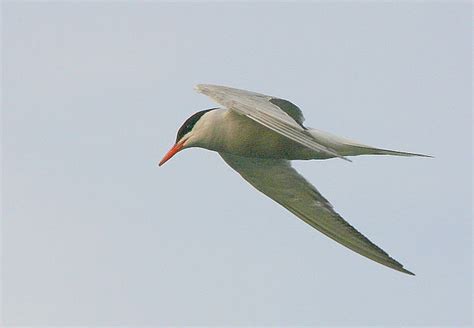
“Look, how the tern folds and unfolds his wings, 

He sails and pivots

An origami bird.”

And you, the poet, would say

“Exactly. So perfect.”

And, you watching the sea shift and balance itself would whisper

“See?  Hear how its heart beats?”

And I, your friend, would nod smiling.

The exhale and inhale of waves 

The wash of water at our feet.

And, we would kneel in veneration

Lean our ears to the beach

And, listen for the profound timing of this place.

And the poet would add another keyhole to this universe. 

One day one frog

Last week, the late COVID summer

A Wednesday when I had lost hope

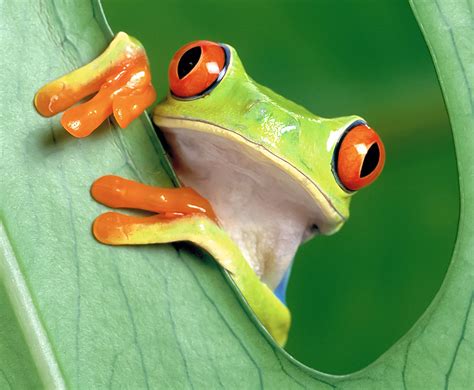
A frog jumped into my outdoor shower.

And it is said in the Bible

There we dwelleth together. 

He sat near the drain

Deep in contemplation

The soapy water swirling about

I thought he might drown.

But he remained there

Sitting for a special bath.

I thought to bend over

To kiss him.

Maybe, he was that prince I’d waited for.

But then in half bow, 

I thought,

Do I need a prince?

If I do, is this the best meeting place?

For either of us?

Is this the enchanted place

I had imagined it to be?

It was.

The sun sparkled through the water

Bouncing with light

The warm water bringing me 

This treasure of a moment 

This summer. 

This frog. 

And yet we decided to go our own ways

Each refreshed and enlightened by our encounter.

I grabbed my towel to leave the shower

As the frog made his exit near the gutter spout.

All the time

If I had all the time in the world

Such an interesting phrase

As if we did

As if we ever had.

As if we were God on the Eighth Day of Creation

When He spun out time.

The rest of his made world must have had a vexing week

Waiting for things to begin

When he crafted a vast universe 

Then cast upon the world

An uncountable galaxy of time.

But to dream and imagine

If I had all the time in the world at my dispensation

(Had God taken the day off and I stepped in his stead)

I would have a busy day

Spending my time in an inspired frenzy.


Taking time from here and placing it there

Until the world was set on a schedule that seemed to me 

Better.

Some harsh judgments

Some kind gestures

And like God’s version of the universe

Neither fair not just

Perhaps, not for the best.

But in my mind, better enough.

I would take eons from the years in takes to decay nuclear material and

Add them to the years of dogs’ lives so we would have them as life long companions.

I would tack on years to the lives of poor children who needlessly die from diseases a rich child knows how to cure and

Deduct the years spent on our planet by over-privileged individuals who have taken more than their share of the planet’s riches.

I would delay on the arrival of homo sapiens on our planet another 100,000 years hoping that the other animals can develop better defenses to our domination.

I would extend the lives of butterflies and dragonflies and

Bring to an early end the mountains of disposables 

Whose use is momentary and whose legacy is centuries long. 

I would add time to the lives of species going extinct and

Send to its death that most dangerous of all ideas

That because we pass by this way once

We can be ignorant of what comes next.  

That our obligations don’t exceed our vision.

In my own tiny life, I would underline with arias and symphonic movements 

All those moments when others had been deeply generous and kind to me and

I much less so.

The rapture of the cello and the high soprano slowing moments down 

So I can take full measure of those gifts.

Fully alive in mind that our lives that are short. 

We need to do what’s right when the occasion presents itself.

I would bless myself with the magic feeling of the summer’s start

Ten years old

The season stretched out

Time without end

Of untimed swims and bike rides

And discovery and play

And stories in books 

With late nights, capturing lightning bugs in jars

Releasing them just before a deep child’s sleep

When time disappears into another world.

I would add moments to the lives of people who have passed away so I could tell them the story of how much of themselves they have left behind

Ripples of being echoing forward.

I would interrupt time so that I could ask questions of those who have passed resolving for me great mysteries in my own life.

And I would step back almost finished with my work and 

Imagine a trial run where I see an evolving planet

The world made manifest in orchestral form.

Our beautiful tumultuous planet

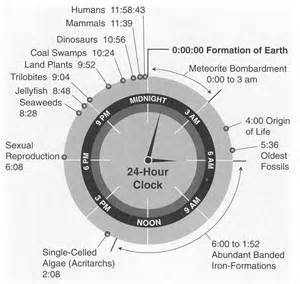
Four billion years

Laid forth in a grand four movement symphonic gesture. 

All wonderfully paced

First a single microbe 

Alone here for three billion years

In our symphony

This accounts for three quiet one note one beat movements.

Now in our final movement, the algae emerge

Followed by multicellular organisms

This, the Cambrian period, explodes into millions of species

Swimming in our seas

(Sound the cymbals: rouse the entire orchestra)

Then a mass extinction

(Quiet the horns and woodwinds:  a solo for the cello.)

Plants emerge on land

Amphibians follow.

Great diversity in plants emerge

Another extinction.

We are half-way through our last movement

245 million to 65 millions years ago

The parade of reptiles

Mammals

Dinosaurs

Birds

Primates

Speed up to seven million years ago

The apes are walking upright

Our complex family tree includes all life

The last stanza occurs in our last 15-minute movement in a matter of seconds

We will have the orchestra play this as fast as their talents allow them.

And the music in its final movement

Gliding to the end, when the universe work is about to finish

With just seconds left

 A recent 13,000 years ago, the humans arrive

Civilizations arise.

Political organization

Religions.

The printing press.

Science.

The Industrial Revolution.

The great Wars.

Globalization of the world economy. 

I enter–a millisecond of a note

One of five billion at the time of my birth

106 billion of us once occupying the planet.

All this perfectly played in time. 

All the time in the world to reconsider another plan. 

Our tiny moment of life

Manifested in the long span of our universe

Forever before us and after.