Doctoral dissertation

As wonderful as the digital world is with its gifts and surprise wonders, it is somewhat troubling to find that your stuff is online without you having any idea that this is the case.  Just today, I found my dissertation on line. http://digitalcommons.uconn.edu/dissertations/AAI9831873/

I imagine this is a good thing. No one buys a dissertation, I don’t imagine. So, at least putting it online in the digital commons means that it is available to a wider audience. It was published in 1998 so it is a bit dated but that doesn’t diminish my fondness for it–a 200-page ticket to the most fulfilling career I have ever had.


The tests fail us

When you receive a medical diagnosis that is serious, your mind moves out like a posse chasing a dangerous suspect. At first, the deputies fan out in all directions at once without much coordination. One team is off in the hills investigating where all this began, the very moment when your blood vessel bulged. A special team investigates the question: was it climbing up the stairs on the second to the last day of class in the winter session when the pressure behind your eyes pounded so hard that your brain seemed to have been invaded by a timpani orchestra? A squad of detectives inquires: was it that night when in your half-wake consciousness that you felt a sharp pain and colors swarmed in paisley patterns behind your eyes shut and you swear, your eyes opened as well? Members of the posse quickly tire of this chase, especially after learning from the Merck bible that the doctors have no idea of why aneurysms occur. You and the doctors have called back the search parties back from their assignments. So, after the news settles, the investigation begins to narrow and to focus. We find words clinging to diagnoses: we learn new vocabulary. A new word—idiopathic—flows into your conversation with friends. Idiopathic, in medical terms, means “of unknown or spontaneous origin.” Something has gone wrong; they don’t have an idea why. You think what a wonderful word. I can use this to explain relationships gone sour, missing cookies from the cupboard, and maybe, as well, unearned blessings. More about that later.

And, finally after lots of preliminary wondering about the sources of the problem, you understand that it is well beyond the point of wondering who did the dirty deed, it’s time to move to a conviction and begin the treatment. But, this neglects the long periods, or so it seems, of waiting. Every patient with a potentially troublesome diagnosis must feel that his is a cold case. The doctors and the laboratory technicians seem matter-of-fact, too measured, and taciturn. They process your case in turn as if you were ordering at the deli. In a few short weeks, I had two imaging tests and one consult with the neurologist and each encounter would have been enhanced by some training on my part in what Goffman, a favorite people-reading sociologist, calls the signals that we “give off” in impression management. Two weeks earlier, I submitted myself to a cerebral angiogram, a test where contrast is injected into your veins in order to trace your blood flow through the major arteries. The artery under suspicion was the carotid artery, specifically the choroidal artery, as the blood bearer that enters the head making its way from the heart and through the neck.   The technician was matter of fact, as disinterested in my case, as a character you would find in a tale by Kafka . Her voice modulated; her conversation as scripted as any cabin attendant warning you to fasten your seat belt and to turn off electronic devices for the first part of the flight.

The first part of the test is without the contrast, sort of to mark the ground, I suspect. Then the needle goes into your elbow crease at the opposite side of the elbow. I asked, “Will this be cold?” “No, it is warm” she replied. “For some women, it feels like they need to urinate, but that feeling will pass quickly.” I nodded and she returned to her station. The test lasted maybe ten minutes, maybe shorter. In a CAT scan machine, you enter a different time zone. One cannot be trusted to tell the time. It is suspended, in your own particular time zone, as you are when you are in the place where the long trail of medical diagnoses process.. And, that is the funny thing, I suppose. At the time of your life, when you should be most engaged, your brain recedes back and you stall. You begin not to make plans. Things are tentative.

“OK, that’s it. You can relax, Sandra.” She called my name and she was smiling sweetly and patiently. Her manner had changed and I thought, “Hmmm. I have moved or more accurately, my case has moved from “Worries-too-much-middle-aged-woman” to “Cerebral aneurysm. Too bad, she seemed like a nice person.” She helped me from the table and said that the results would be on my doctor’s desk on Monday morning. Surprisingly, the doctor called me later that day asking me to come in as soon as I could. It reminded when of crime dramas when the detective asks the unsuspecting person to come to the station and answer a few questions. Unlike a younger person with fewer medical miles under their belt, I have had plenty of health scares and I can’t tell yet which side of the equation this little medical issue will fall on. As statistics show us about tests, there are only four options:

The test could find something that really is there.

The test could correctly determine that there is nothing there.

The test could find something where there is nothing.

The test could miss something that is a problem.

With a minimal understanding of probability theory, you understand that the latter two outcomes are Type I and Type II errors, respectively. The challenge for those of us facing medical tests is that we have no idea of how accurate the tests are, how often they miss the problem or how frequently they identify problems that are not there. We assume that the tests are accurate with a certainty that simply doesn’t exist.

If I had the powers of reliable prediction, this would save me some wasted concern or it would propel me to get my affairs in order.

When this story happened, I had just one year short of sixty years old. That decade of my fifties had been a good period in my life. In fact, it is miserly and ungrateful to write “good.” These years have been wonderful and blessed. I see my left-sided brain losing its grip and see my right-sided brain coming to the rescue, allowing me to relish the beauty of the visual world. I think this is why middle-aged people find the young so lovely. The visual world begins to kick in and perhaps, in some cases, quiets that noisy interfering left side. It is the lesson of dwelling in the moment that comes with some aging. It is also the age where your contemporaries have survived medical crises. Heart attacks, breast cancer, skin cancer and others. Some close friends have died; our parents have passed away or may be in a steady decline. These incidents all line up and one hardly pays close attention until one takes her own turn. This is not to say that we are not sympathetic to the medical challenges of others but we don’t listen as carefully as we might. I think with deep shame of how not there I was when my mother was admitted to the hospital for emergency surgery. She seemed so intact, so independent, and so not needy of me. I did my duty but I probably was not that loving daughter that I am certain women dream of when they are carrying their children, hoping for a girl with whom to share the pains and promises of womanhood. One can be completely blind to one’s sins if convinced that duty is being done, especially if it is done out of obligation, and not out of love and the opportunity to love more generously.

During that episode, I wrote a question in my journal for consideration, “If you wrote a book this year and it would be the last thing or the most important thing you would write, what would it be about? Who would you want to read it? I have a lifelong friend who has been urging me to write this book for years and I have delayed doing this, believing that I have all the time in the world. I wrote in my journal that if this medical scare passed, I didn’t believe that I would change my life very much. Here is a quotation from that journal entry,

There are people who swear they will live every day to the fullest, that they will greet every day as a gift from God. I am not that sort of person. I am too programmed, too average, too much in my head. I would go on my way, thinking about squeezing in time and space here and there.

A few days later after that first troubling test, I visited the neurovascular surgeon. The doctor was very likeable and easy to speak with. He ordered an angiogram to further study the aneurysm. They are trying to locate the exact place of the aneurysm to determine if it is as dangerous as it looked in the image they had taken earlier. Another procedure. This reminded me of the stories in children’s books where the hero faces a series of challenges, running the gauntlet to slay this dragon or the monster until he is redeemed and can go home again a braver and more courageous person. And, in the same way, the hero is very much alone in this quest, even as the doctor says, “We will try this new procedure to see how we do.” The specialist reveals that discovering the aneurysm was an auspicious event because the original tests to chase down the cause of pounding head pain is completely unrelated to the suspicious blood clot in head. In other words, we are pursuing a villain for an unrelated crime. While potentially life-ending, the blood clot is completely innocent of the crime of throbbing head pain.

A few weeks later, I checked into the hospital for the cerebral angiogram. I took a careful look at the other patients in the waiting room to see if I could draw any conclusions about how sick I might be. I could draw no conclusions. A little girl. A ninety-five year old man. A middle-aged man who had to be lifted from his wheelchair to the hospital bed. I listened to the conversations between the patients, their caregivers and the nurses—all assuredly similar. We had to recite our names, our dates of birth, and the names of the procedures scheduled for us and had to point to the surgical site. I signed some paperwork, including the one document that warned me that the procedure could result in serious damage to my brain or death. I wondered if, perhaps, this was a good time to ask for a second opinion when mercifully, one of nurses brought me a heated blanket. This simple act of care and concern anchored me in a place of dispassionate observation where Buddhists hope to dwell. I was partially sedated and felt calm throughout the procedure as the doctors inserted a tube in my thigh where the dye would travel up to my brain to light up my blood vessels where more images would be taken.

After all the examinations and MRI, the angiogram revealed nothing suspicious. The MRI mistook a congenital bulge in my blood vessels for an aneurysm, sort of the like making a serious error in identifying the wrong suspect in a lineup. I learned that these malformations are common and most of them undiscovered. So, the average patient begins to wonder about these tests and their veracity. The first test that led up to the angiogram was wrong in that it concluded I did have one. The most recent test argued the opposite case. Who knows and should not the doctors tell us, like the pollsters do, about the margin of error? Shouldn’t there be a disclosure on these procedures, some clear labeling? This might read something like, “This MRI misses 15% of the tumors it is looking for and mistakes innocent cysts and congenital abnormalities for cancers/aneurysms 20% of the time. See your physician or a statistician for more information.”

A recent article in the NYTimes makes these points convincingly. Patients are typically not informed about the risks in treatment and tests and they typically over-estimate the benefits of procedures. We believe that each new procedure provides us with an invisible shield of protection when in fact the added benefits may be small. Without this information, we go blindly into the world of medical care. Some may argue that patients cannot understand this sort of information or that they are better off believing in good outcomes, even if these are not the most likely ones. There is a fruitful debate to engage here. But, that shouldn’t deter us from expecting more.

Someday I will write an article one day about my history with false positives tests and their effect on the psyche and the body and the spirit. Every time I receive one of these diagnoses (torn rotor cuff, pancreatic cancer, blocked carotid artery, heart attack, intestinal blockage, and leukemia) I could readily think the worst but these episodes have worn down my anxiety response. I used to think about my will. I fantasized about some lovely and noble ways for the managers of my family foundation to spend my fortune once I am gone, but no longer. With every test that releases me from my near-death sentence, I am reborn as the fool I am. Maybe, my brush with death is not close enough. Maybe, I am too suspicious of the field of medicine. I am growing cynical and suspect that when I die it will be of no cause at all. They will take an autopsy and find no grounds that led to my death–an idiopathic end. And, then I am certain the doctors will suggest to each other that they should have tried one more test or two more medications. I am going to take noncompliant patient to new levels of perfection.

Coffee, class and culture: Airport consumption patterns as a measure of globalization and status hierarchy

I am sitting on a tiny plane in seat 2A, a prime piece of real estate. I have just transferred from a red eye five hour fully sold out flight from Oakland where I also enjoyed an aisle seat. “Enjoyed” as it is used here is employed in the way one would say that she had a good pelvic exam. I don’t think I slept at all. I ached to sleep but a desire is never as satisfying as the real event, no matter what St. Augustine wrote about this issue, although lust is a nice run up to the real thing.

Dulles Airport, where we landed, has its own culture. I almost ran off the long flight, banging my feet on the jetport to wake up my legs to the task of carrying me into the concourse. It is just before 6 a.m.

In concourse D, few concessions are open. These include the Great American Bagel, Burger King, and for some unaccountable reason, Borders Books. Every individual staffing the fast food counters was a person of color. All the check out people were people of color.  All the baggage haulers were persons of color. I was being overly race conscious here, I guess, but it was startling. A bunch of weary travelers had lined up at Burger King begging the lady servers for breakfast. At the bagel place, they were struggling with a power outage and because of that couldn’t sell anything because their cash registers were off-line. A few of us offered cash way in excess of the cost of a plain, unsliced, untoasted, un-crème-cheesed bagel but the staff refused saying they’d get fired if they processed a transaction like that. So, we all moved on.

A clique of weary travelers made our way to the Burger King, the only show in town. The Burger King staff, maybe they are known as nourishment interfacing agents or convenience food expediters, spoke several languages, which I think is a beautiful thing in our diverse welcoming society. We monolingual Americans were being served by a variety of individuals with command of a multiplicity of tongues and dialects. This is the way we liberals think about migration. We believe it is all to the good or will be some day, if not this morning or later today. However, one problem here was that the food preparers were all Hispanic, I think. I was not certain of the country of origin. The check out lady was from Southern Asia, maybe Pakistan or Bangladesh. The lady taking the order was from Eastern Europe, I think, maybe Poland. I thought how lovely this was that those striving for freedom and life in a democratic state could find themselves joined together in common cause behind a counter at Burger King. I don’t remember many details from my history about the war between Hispaniola and the Indian sub-continent, but if the interaction between the food staff and the check out lady was any measure, there is a reservoir of very bad feelings from this conflict. The Hispanic women making the breakfast sandwiches could not get the Pakistani lady to understand what they were saying to her, no matter how loud they shouted, no matter how many of them spoke together, and no matter how many swear words they borrowed from English to try to make their point. The point in question can be boiled down to a simple one, “Does a breakfast sandwich contain meat just because the wrapper says it does?” And this moves us directly to the subsidiary issue, a simple episode that reveals class conflict, globalization, the hegemony of the West, the failure of our educational system and the need for universal training in sociology.

I joined the ordering queue at Burger King at approximately 6:15 a.m. I was fourth in line. In a matter of minutes, the line had grown to twenty and it appeared that without a miracle, the staff at Burger King would fail to serve any customer at all this morning and certainly, not the requisite share of billions. Almost every one of us in line was white. There was a black woman in line just ahead of me and she fared no better in getting her food from the staff. The customers in line were displaying typical consumer behavior in twenty-first century America. Although we know that behind the counter stands a gigantic corporate entity whose only interest is to make money in this transaction, to convince you to pay everal dollars for food that costs a lot less to prepare, we present ourselves to these corporate monoliths like children before a doting mother. Actually, this is only true of some of these transactions in the commercial feeding industry.

The upper and middle upper classes constitute a special category. Starbucks has created the model here transforming what had been a simple cup of coffee to a drinking experience that conveys and celebrate class distinctions. The upper class aesthete delivers his order with instructions detailed enough to execute D-Day. What I saw this early morning was what happens when the Starbucks crowd finds itself at Burger King, or in other words, what occurs when the upper class takes its consumer behavior and preferences to a typically lower income setting. The first man in line had evidently never been to Burger King or any equivalent fast food joint. He looked at the menu and considered it not like the Ten Commandments, which it is—written in stone, the word made food–but instead like an opening for further discussion. He wanted scrambled eggs and whole-wheat toast. He wanted a latte. He wanted to know if everything was fresh. He wanted soy milk. The ladies behind the counter gave him that sort of big arching eyebrow look that black women deliver most effectively. “What, are you kiddin’ me?” Translated: “You must be insane to ask me that because if I had the time, I would give you a piece of my mind or the end of my fist.” The first man exhausting his welcome asked if they had anything wrapped, like a Devil Dog or something. The second man tried something simpler. He was asking the staff to put together a croissant breakfast sandwich without meat. The woman who took his order nodded and titled her head indicating that like the rest of the cattle, he should move along to pick up his sandwich. I ordered the same thing. We traveled down the line and found instead two English Muffins with sausage. I took mine and moved to the checkout. The second guy decided to rectify the situation. He cut in front of someone and reordered. The same lady nodded and he picked up the new sandwich, which now had ham and was on an English muffin. Partially victorious, he moved to the checkout where another backup was in the making. I had also ordered coffee but that wasn’t ready yet so a bunch of us were waiting around like drug addicts looking for a new dealer. One man actually had the shakes and we had to calm him down. The line continued to grow. The man behind me ordered five sandwiches, all different and specialized.   The lady nodded and pointed him down the line. These customers eventually reached the check out lady who was either praying or swearing to herself. The sandwiches were piling up in the chute. The check out lady would ring the purchases up coming up with widely different prices. I thought this was all supposed to be automated but there were big breakdowns this morning.

It was clear that things were not going to work out this morning at Burger King. The servers should have adopted the stance of my working class mother which is,

Listen, you little brats. This is what I have made you for breakfast. Either eat it now or go to your room. I don’t have all day to cook this and that for you and fussy brother, missy. This is not some fancy restaurant and I am not your slave!

That would have set us straight.

If I had had more time, I would have suggested to the line of customers that we take whatever the cooks made us and paid whatever the Pakistani lady charged us and then gathered our food at the nearest gate. We would disassemble all the food and then remake the sandwiches to our liking. This would have led to a happier outcome and also would have tapped into another bit of my mother’s sage advice, which is, “God’s sake, make your own damn sandwich!”

As I watched the customers, they were slow to learn the drill. They insisted on tailoring their orders. “What kind of tea do you have?” one nice lady asked.

The eyebrow look again, glancing up at the menu,

“Lady, we have hot tea. Hot tea in a cup.”

The lady smiled apologetically, understanding that she had asked the wrong question.

“Oh, no, I’m sorry,” smiling her liberal educated smile, “I meant do you have any green tea? Or maybe something herbal?”

The counter lady didn’t have time for this.

Listen, lady, I don’t know what color the tea is. It looks rusty to me. I don’t nothin’ about herbal.

Well, OK, then. Could I have a cup of hot tea with a two ice cubes in it?

Thinking that today is the day that she has heard everything from these crazy customers, she makes a show of putting ice in hot water, making certain the other ladies see this!

 Now, you want ice in here in this hot tea, right?

She glances at all the customers to demonstrate clearly to them that they are in the company of a bunch of fools and idiots.

So, in a brief few minutes, at this Burger King, we have a glimpse into the class dynamics in fast food. Unsophisticated people may see the scene as bad service but that is a wrong interpretation. What this is is class conflict. A sociologist can see the big things simmering here–the significant differences in the privileges and customs of class, even in something as prevalent as fast food. My mother won’t go to Starbucks. “They ask you too many damned questions there,” she complains. “They makes you feel stupid.” The ladies behind the BUGER KING counter must feel the same way, confronted on these occasions by the upper classes who are demanding accommodations they are unknown in the world of the fast food shoveler. It takes certain denseness on the part of the privileged to expect this. Sort of an ugly American thing going on.

A minute before class warfare broke out, the feeling of the crowd changed.   Word was spreading that Starbucks was open for business in the adjacent concourse. A businessman stopped his order in mid-sentence to abandon his place at the top of the Burger King queue. Others followed in hungry pursuit. The scene was reminiscent of footage of the American exit from Cambodia. That loyal Starbucks clientele was rescued. They could go home to a place where they spoke the language, where their every desire for foam, and cream and shots, for sprinkles, and would be respected and fulfilled.

It is good to go home, even if that is Starbucks. My sociological understanding also suggests that Burger King and Starbucks are stand-ins for different parenting styles in our culture. Starbucks, the indulgent parent who seeks to give his child as much variety as possible and allows him to make his own choices. The psychologists say that this style of parenting leads to great success since the children learn decision making skills early on in their careers. The other style of parenting, the Burger King approach  more the subject of criticism by the scientists is where the parents make the choices and preach obedience, a bending of the child’s will to a larger authority.

I am not certain the Freud would agree with this analysis but I am quite certain the marketing geniuses know that this is the way fast food culture plays out and that they are betting market share on it.


At the beach without my poet

The second morning walk
You were on my mind.

If you were here, we would toss out lovely names.
Our words taking aim for the truth and the moment.

I would say,
“Look, how the tern folds and unfolds his wings,
He sails and pivots
An origami bird.”

th

And you, the poet, would say
“Exactly. So perfect.”

And, you watching the sea shift and balance itself would whisper
“See, hear, how its heart beats.”
And I, your friend, would nod smiling satisfied.

The exhale and inhale of waves
The wash of water at our feet

And, we would kneel in veneration
Place our ears to the beach
And, listen for the profound timing of this place.

And the poet would add another keyhole to this universe.
Our place.

The courage of children

My pretty enough mother was always worried that we, her children, would have large noses. She would point to her own and my father’s as examples of noses that were simply too big. It seemed, however, that with sufficient and sturdy conviction, she and we could will these away. And, as fate and faith would have it, my sister, brother, and I are blessed with average, nearly admirable noses.

She also despised the color of her eyes, calling them yellow––“Cat’s eyes, they are.” I would stare at her as long as I comfortably could to get a good look but she would catch me and I’d have to quickly swing away my gaze. When I did sneak a look, I didn’t see the yellow at all. I saw brown which was the only color those nice people at Motor Vehicles would let her put on her driver’s license. To this day, I don’t know where she got this idea.

My mother was a devoted fan of blue eyes. She could list a whole series of notable and smart people she knew with blue eyes and for a while I thought that we would be blessed with these someday, as well. I thought this despite the fact that all my cousins, my aunts and uncles––all of them with very few exceptions––had dark brown eyes. I just suspected that if we prayed hard enough, the treasure of blue eyes would be ours.

Our parents sent us to an Irish Catholic grammar school even though we were descended from French-Canadian and Portuguese-Azorean stock. My sister and I have talked about this, about how strange we felt in this school. We were dark-skinned compared to our little Irish friends in this school which took its Irishness seriously. A child did not have to be Irish to attend this school. A devout Catholic family or a family that was headed in that direction was all that was required. My mother made it clear to the principal that she wouldn’t mind being Irish herself. This was decades before a child could be proud of her ethnicity and could demand accommodations for culture, language and customs. This was an era where we child considered the foods we ate at home and the festivals their parents dragged us to an embarrassment. At St. James, we sang Irish songs, spent a week celebrating St. Patrick’s Day, learned the jig, and brought home Irish culture–whatever that was. In the mid-1950s, it was as good as any other heritage and as disposable, for the most part. Our parents laid their Americaness like a thick blanket over their nationalities––intending to suffocate it for good. My father fought in World War II and taught us the lessons he learned from that conflict. American people were heroic. As Americans, it was in our nature to know and do the good and noble thing. We were blessed to be American and doubly blessed to be Catholic and American.

These were the chief lessons of our eight years at St. James. The blessed good fortune of all this was weighed heavily with the awesome responsibility of being a good Catholic uniformschild. Even now, four decades later, the language of this formation–grace, blessings, contrition, penance–remains like scaffolding in my brain and in vocabularly, even though I have attempted to destroy and expunge it many times. A good Catholic child lived in two places­­––in the real world full of temptation and in the temple of the Holy Spirit. We children easily comprehended the architecture of faith, enormously difficult for men of God to explain. We learned all this complexity easily, the way French children breeze their way through verb tenses that elude college graduates.

We learned this arcanum readily because it provided a clear way to understand the world. Children seek clarity and order. They struggle against it, of course, by asking questions to see if this adult-given explanation makes sense and is compatible with their own developing stories about the world. But, as they bang their wills against the rules, they learn the boundaries of their adventures and just how far adults will let them go. The 1950s in the Catholic Church were a stark testament to this fact. Without benefit of referred journals, supported research, conferences, government grants or other artifacts, our teachers––all nuns. Sisters of Mercy––created an intact, tightly woven, bullet proof method of teaching us things that we would remember forever.

Of course, the habits they wore made them both strange and fearsome, as well as comforting and familiar. Long black robes, rosary beads worn like large necklaces, black shoes and stockings. Their faces were completely framed by a starched wimple at their foreheads, which wrapped around their heads, set off with a stiff bib that stretched over their bodices, nearly reaching their waists. We learned to read a subtle body language. It wasn’t much beyond second grade when we knew what they were all about. But, their real power spun around their knowledge of what we children we all about. Our mothers th-1 warned us against wrongdoing, as all mothers will and used as ammunition the fact that no matter where we were, what we were doing, they would know. We could get away with nothing. This served as a magnificent check on our behavior, especially for the girls. But, even more powerful that our mothers’ omnipresence was the specter of the nuns as representatives of God who was truly all being, all seeing, all there and everywhere. And the Sisters, as his lookouts and lieutenants, could not only see around corners and under desktops, but could detect a whisper when you didn’t even know you were talking. They could not only see, hear, and smell what you could be sensed––they could also peer into our beings, see our wretched little souls and examine the sins we might be entertaining in our lack of grace and prayer.

Although we were very young, only six or seven years old, we were sorely tested by the devil and his workers. We faced daily temptations like calling each other bad names, dishonoring our parents, failing to bow our heads and recite the requisite prayers, and having impure thoughts. But being good was only half of the challenge. Important as the commandments and Catechism was a duty to suffer for our faith.

On selected Friday afternoons, we watched films in the school basement. The older students set up rows of folding chairs and we sat with our classmates in our assigned seats. We were led quietly downstairs and were not to speak with each other or with members of other classes. We paid a small fee to see movies like Cheaper by the Dozen, Rebecca of Sunnybrook Farm, Heidi, and the like. We also watched religious movies about the miracle at Fatima and the stories of saints. We were supposed to pick up lessons from these movies. It was a new media-savvy way to reach the young barbarians.

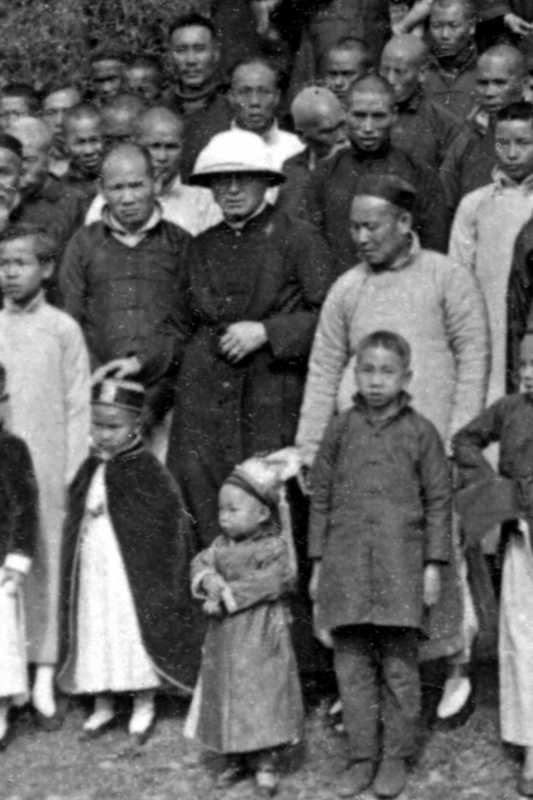
During missionary season when the parish was visited by a priest, brother or nun who had been converting the heathens in poor countries, we would watch black and white films of the missionaries at work. I clearly remember a movie about a Maryknoll brother and the work he was doing he was doing to bring Christ to the pagans in China. In this movie, an army of Chinese peasants surrounded a tall, strong, dark-haired Maryknoll in a black cassock. They carried sticks, waving them angrily above their heads. and marching CO-FOUNDER OF MARYKNOLL FATHERS AND BROTHERS PICTURED IN CHINA IN 1918in a circle around the priest on a dusty barren hilltop. His head was bowed and his hands were tied behind him. The film was very grainy and the camera seemed to jump around. The narrator spoke deliberately about the priest and his devotion to God, how he had not betrayed his faith despite being tortured to renounce Jesus. The crowd led him up the hill where a wooden cross stood. I cannot remember if the film showed the priest on the cross but to the mind of a second grade, it seemed like this would be next step in the story.  I remember that we were terrified and that some of us were crying.
We walked back to our second grade classroom saddened and silent, filing quietly into our seats. When Sister Frances stood at her desk, she placed the small tin missionary box on a student’s desk. On these Fridays, we were told to bring in a donation for the missions. The children who had spent their money on candy and treats at lunch sunk in their seats, their souls stained with the sin of greed and filled with regret. They quickly passed the can over a shoulder without looking at it. Children, who had saved their money, shook the can, loudly clanged in their nickels and passed it back with a smug look of victory on their faces. We were warned against this sin, a demonstration of pride, but some of us could not help ourselves. The nun pretended not to notice all this and busied herself with an attendance chart or something on her desk. After the bank made its way around the room, we placed our hands on our desk in anticipation of the last lesson of the day and homework for the weekend. Instead, she spoke about the film and about the beautiful sacrifice that was only available to God’s chosen people. She told us about courage and the importance of living our lives as children in Christ. “Denying the Lord is the very worst sin you can commit, children. You have been blessed to be born in the Faith.” We had heard this many times and took it seriously.

Then she asked, “How many of you are willing to die for your faith?” Our hands shot up as fast as they could. The boys yelled out, “Me, Sister! Me, Sister”, competing with each other to be the first to be sacrificed. The girls were quieter, polite, stretching our arms, waving them to catch her attention. She had us. We were all going to be martyrs and saints!

No child hesitated and said, “Excuse me, Sister, I will have to ask my parents.” No child asked, “Can you tell me when I will die and if it will hurt a lot?”

We were ready to go, happy to, in fact. Today, I try to put myself in that teacher’s place and I think, “Oh, my God, they are ready to go wherever we will take them! Do they know what they are saying? Do I know what I am asking?” And, I think, “What kind of game is this nun playing? What a crazy insane thing to ask a child!”

I also consider other parts of this scene. I think about being in the first row, third seat down, a member of the top reading group, looking at the other students so eager to die for Christ, feeling very grown up. I was proud of making this courageous and correct decision on my own. This was my way to certain sainthood. There were other paths, of course, but this was offered in a manner that we could understand. It was compelling and seductive. Being slaughtered by a pagan because we refused to renounce the Holy, Catholic, and Apostolic Church seemed noble and good. I don’t remember a second of doubt. I filed away this promise to die for my faith expecting that the good Sister would inform the proper authorities when the time came for me to go, to be crucified, burned at the stake, buried alive or otherwise disposed of in the most gruesome manner.

Perhaps, children at that time were more susceptible to adult direction. Perhaps, adults were less careful about the terrors they willingly placed in the paths of children. Perhaps, both contributed to our growing up terrified, not of the man next door, or the predator down the street, or the gun toting madman at the fast food restaurant––but of large, mysterious things, like the heathen anti-Christs, communism, and polio.

And, of course, we were frightened by the atomic bomb. We did exercises in school, practicing in the event of an attack by the Russians. Sirens would go off and we would file into the fallout shelter at school. We asked the nuns where our parents would go when the bomb went off and they comforted us by reminding us that our parents could take care of themselves. I worried that my father who drove a service truck around the state would not be able to remember the location of each and every fallout shelter when the bomb fell. It seemed to me that he was always in danger.

At the distance of almost fifty years, I can see clearly how children are trapped by the fears of they adults they grow up with. Our own terrors create demons for them to avoid. Children can put off some of these fears to parental weirdness, but others resonate for a long time. When the whole culture creates and animates these bogeymen, children must take heed. They must take cover and run.

In addition to warning us away from big noses and wishing us blue eyes and lighter skin, my mother also guarded us against profligacy, against pride and gloating, against being too pretty, too smart, too anything, lest this draw the attention of God and engage his punishments. Sometimes, I wonder what terrors and frights I would have instilled in my own children had I given birth.

It seems that children survive childhood by creating play and joy to counter the admonitions and fears visited upon them by their parents and teachers. Sometimes they do this deliberately. They cannot figure out why adults are not happier than they are. So, they act silly. They giggle. They try to entertain and distract us. At least for a time, children face their parents without fear, with abiding trust, with the assumption that they are loved and lovable. Although we adults think we are amusing and comforting our children, it is, in fact, the exact reverse. The truth is that children assure us as their caretakers. Children enter a world that we have created and they begin to build it again, weighing all that we have taught them and tossing off what seems wrong headed and mean spirited. And so, a seven-year old can pledge her faith in afternoon, take her teaspoon of cod liver oil at night, bite her tongue when someone calls her a bad name, and still sneak a book to bed at night when she is supposed to be asleep. She can read this book of stories about St. Dom Bosco, who juggled for Jesus, and about Saint Theresa, the Little Flower, who would rather die than entertain impure thoughts. She can try to make sense of those tales of childhood heroics. And, she can struggle to be a model of virtue while scheming to avoid detection and punishment from vigilant adults.

And in these conflicts, children work things out. They soon understand that there is the world that adults would like them to fashion, where you as a child are kinder, more forgiving, more tender, and wiser than the adults guiding you. And, very quickly, children take their own counsel and assemble their own views of the world, their own stories that set them apart from the place their parents know the world to be.

Remarks for 2014 HerStory dinner: Four steps to living a life of purpose summarized in eight minutes

First, I am delighted to have the honor to speak to you this evening. Friends, faculty, staff, family members, our leaders, President and Mrs. Machtley. This dinner is one of my favorite events here on campus. I leave here feeling recharged and reminded of how blessed I am to be in the company of such exemplary young women and the brilliant, talented and dedicated staff and faculty that bring us all together. Thanks from all of us for the tireless efforts of Toby Simon, Carolina Bogeart and many many more people who make this event happen.

So, I am going to take advantage of this opportunity to share with you, for the first time ever on this stage or any other, my four-step formula for living a good life in just under ten minutes. Based on a lifetime of research and reflection, I will lead you quickly through these steps and hope that you find something valuable and true in what I have to say.

To me, living a meaningful life is more important than anything else we may achieve or possess. My four points are to imagine, to contemplate, to visualize and to reflect. So, let’s get right to it.

STEP ONE Imagine all your possibilities. Living a life where you follow someone else’s dream cheapens the whole enterprise. You may have heard it a million times but it bears repeating again. Life is more amazing than you can plan for. As Alice Walker wrote, “Expect nothing, live frugally, on surprise.”

Don’t put off doing good or following a passion until you are rich and your children enter college. In my life, I have owned a computer consulting business and been a humorist and comedian. It is true that when I was 45 years old I debated whether to chase a career as a stand up comic or to pursue a PhD. To the great relief of my best friend, Tina Fey, I went the professor route and well, she went her own way. I still dream of being a back up singer in a girls group–think of the Supremes, the Shirelles, Destiny’s Child. Check this out—and sing along if you’d like—– ShooBop, ShooBop. I dream of being TechGirl, a superwoman in a cape who would arrive at the scene when your cell phone is dying and your computer seems to need an exorcism.

I have been a construction worker, an aide to the Governor, a child welfare worker. I worked at the state prison. I didn’t know that I was called to teach until I was in my mid-forties and didn’t understand my own sexuality until I was in late thirties. As I said before, one never knows.

But I have a strong creative spirit and I haven’t for a minute thought that I should drown these other interests so that I could be fully a professor. It doesn’t work that way. You are so much more than you know yourself to be at this age.

Of the life we may live, Marcel Proust wrote,

The only true voyage would be not to visit strange lands but to see the universe through the eyes of another, of a hundred others, to see the hundred universes that each of them sees, that each of them is.

Unlike many of your advisors, I will urge you not to focus too soon or too narrowly. Be everything. Pursue much. Think right now of something you have been passionate about that you have let go studying in school or moving down a narrow road. Go down that other path and embrace it. It’s what makes you special. In his lovely poem, Langston Hughes wrote,

Hold fast to dreams

For if dreams die

Life is a broken-winged bird

That cannot fly.

 STEP TWO Contemplate your galaxy and your orbits. As a sociologist and by temperament, I see the multiple ways that we are connected to people across the planet and back through generations. I think of everything that makes us what and who we are. I think of the people in my personal orbit and how they have influenced me. The steady hand of my now deceased mother who, as proud as she was that I graduated from college, would pull me back into her orbit when she thought I was wandering too far from my working class roots. Or the influence of my oldest friend in the world, a Trappist monk, who reminds me of how distracted my life can be, how far I can range from being fully alive. I think of my friends who have rescued me from deep dark depressions and those whom I saved from other tragedies, an attempted suicide, an abusive husband. I think about the mothers in prison that I’ve met and the children in foster care I have encountered who have fashioned my view of justice and right and wrong more powerfully than have my education and religious training have. These people are all treasures in my life. Think carefully about whom you allow to serve as your guide, as your northern star. Put people in that galaxy who can make you a better, more authentic, more compassionate person who can be challenged to do better.

And think about the gravitational force you exert on others and how you make them better and more loving, more caring, more cared about—or just the reverse. Be always on the search for inspiration; for people and books and ideas that feed your curiosity and push you away from complacency and self-satisfaction.

STEP THREE Visualize the person you would like to be. Even at my mature age, I think about all the potentials we are, all the projects we could begin, all the interests we can pursue. I must say that in many ways, the days that you are living now can be the most challenging times in your lives. We say that these are the best times of your lives but people your age face so much uncertainty. Whom will I marry? What will be I do for a living? How will this all turn out? This uncertainly was true when we were young and it is certainly true now. It is simply a stage of life.

Live your life so that when you are a bit older you can say that I gave it my all, that I was never bored, that I lived my life as if it were a profound gift, that I made beautiful use of the talents, all of the heart, all of the love that had been bestowed upon me. At the end of the day, I can solve that big equation and see that I gave away much more than I took.

STEP FOUR Reflect upon our bounded fates. I am certain that you have heard of Lean In by Sheryl Sanberg of FaceBook. What she means by leaning in is to take up challenges, to put yourself forward, to show them what you’ve got, girl! I’ve been thinking that leaning in is not sufficient if we really want to make a difference, so I tell a short story here. In my mid-twenties, I accepted a position at the state prison where I was the only professional woman in a decidedly male and macho environment. Six months into the job, it was time for my performance review, which determined whether I would keep my job or be asked to leave. My boss said, “Sandra, you’re well liked here; people find you easy to work with; you are very pleasant person; you are an excellent writer.” My gosh, I thought, this is going well. But then he said, “The BEST thing about you is that you think JUST like a man.” Amazed I was to hear this. Actually, I was so young and so undeveloped in my feminist thinking that I took it as a compliment, as a testimony to my, I don’t know, clear thinking, my lack of drama, my ability to understand sports metaphors? I don’t know really. But I know he meant it as a good thing, something that distinguished me from the rest of the women he thought he knew. And while I accepted the complement and was promoted soon after our conversation, I did nothing at all to convince him that I was NOT the exception, that plenty of women thought as clearly as any man, were as smart, and as capable, and in some instances, doing their work in more exceptional ways, just to be considered average. I regret my actions that day—leaving that “compliment” on the table and not making the situation right.

So, I want to propose is that you lean together, not alone; that you don’t just make the mark for yourself, but strive, as you move along in your careers and lives, to advance the case for other women and for others that you believe don’t benefit from easy privilege, and are not part of the insider group. You are old enough and savvy enough to know what I am talking about here. You know in your heart that some of us just don’t get the breaks we deserve–some of us don’t have access to the golden rings. And if you don’t know that, if you don’t feel that, if you think everything that you have you have earned entirely on your own merit, if you feel no obligation to others who have less but deserve more, then we have failed you in your education and I am sorry about that. In this world, it is impossible for us not to make a difference, good or bad. Martin Luther King, Jr. said this beautifully, when he suggested that we are tied together in the single garment of destiny.

As members of this generation, you have been given opportunities that are unprecedented in our history. With so many possibilities and so much promise, we expect a great deal from you. We want you to be happy, to put your talents to good use, and to see the world for what it is, a place of great magic and mystery and fun and hard work. You will be blessed with many gifts and more importantly; you will face challenges that without doubt will reveal your deepest character. You cannot escape this life without ecstatic joy and unbearable pain.

For the seniors in our audience, you know that we love you, that we will miss you for everything you have contributed to Bryant, for lighting up our lives, but more importantly, for the spirits that you are.

May all of your paths shine brightly and may you light the way for others. Thank you very much for your kind attention.

Speech delivered at Bryant University, March 31, 2014.

Fifty shades of grey (hair)

I am just learning that some time in the last decade that I’d gone over to the other side. I don’t mean that I’ve had a near-death experience and glimpsed heaven. I mean that I now find myself on the other side of the cultural divide—those who can appreciate all that our media machines have to offer and those of us who are so out of it that we are turning off our TVs, opting out of Twitter feeds and locking our Google glasses in a dark room. Several indications line up and as the media commentators sometime say, “All the date is in and we are prepared to call the election.” I am officially out of the cultural mainstream.

Despite my best intentions and heartfelt efforts, I just don’t get it any longer. As evidence, I could cite my cluelessness at the Grammies (I don’t know how these people are or how they made their way to fame), my failure to be enchanted by most of the ads during the Super Bowl (That’s supposed to be funny?). I could go on and on here. But, perhaps, the conclusive event was my reaction to Vermont Teddy Bear’s Valentine’s Day promotion. First of all, I must admit my fondness for Teddy Bears and although I have never ordered anything from this company, I liked their support of NPR. I had imagined that the leaders of this organization were enlightened public-spirited men and women. And, perhaps, they are. I mean really what else would you imagine about a company that makes teddy bears AND is located in Vermont (although I don’t if the location is just a ruse; maybe they are located in communist Russia.)

What has thrown me for a loop is their promotion for their 50 Shades of Grey Teddy Bear. The ad reads,

Dominate Valentine’s Day. Give the one you want something that will obsess and possess them. With all of the trappings of a memorable gift–daring, passion, exciting next-to-skin touch–she’ll be desperate to get one. Bear seduces with silky smooth Grey fur, smoldering grey eyes, a handsome grey suit and silver tie. He even comes with a mask and handcuffs.

Now, it seems from reading the copy here that the writers are having fun, which is fine for them. Maybe, this is their way of adding some sexiness and spark to their own tame workplace. thHowever, the pleasure of having this bear join your household or book club or whatever will cost you $90. And, there may be other costs, as well. I am imagining the look on a mature woman’s face when she gets this bear from her new male friend after she has already complained to him about his dominating their conversations in mixed sex groups. This gift could make most situations worse, I am fairly certain. I would suggest to most couples that they stick to roses and chocolate and leave these aggressive bears to another demographic.

Because I am so out of the mainstream and because no one who is reading this is likely to take my opinion as the end of this important debate, I want to be clear and frank about my position. I like my bears cute and submissive and I like them with traditional teddy bear garb. If we are nominating bears for Valentine’s dates, my vote is cast in a tie ballot between Paddington and Pooh. I like the former for his erudition and the latter for his social networks and can’t choose between them. Taking on two bear lovers on may be frowned upon but I just can’t help myself.

We should put this issue in context. Toy companies have made lots of goofy moves and found themselves in the middle of media firestorms. The creative geniuses at Mattel may take the first prize for their lineup of Barbie kerfuffles. A website has conveniently put 24 of these missteps together for us in a slide show. There was Tokidoki, a tattooed, pink-haired Barbie with a skull and cross bone T-shirt and leopard leggings. There was Oreo Fun Barbie with an African American doll. There was Midge, a pregnant friend of Barbie whose flip-open stomach revealed a well-developed baby. There was Growing Up Skipper who developed breasts as your child turned her grow dial. There was Teen Talk Barbie who talked and said, “Math is tough”. There was Share a Smile Barbie who sat in pink wheelchair, which was too wide to get through the elevator doors in Barbie’s Dream House.

There are others. Doesn’t it seem that Saturday Night Live must have planted a confederate in the New Ideas for Barbies office, offering crazy schemes so that SNL could make fun of these later? I have worked in organizations where we have done some very dumb things that could only have been initiated by a sworn enemy of ours masquerading as a vice president of strategic strategy (or something like that.) There have also been products blowups associated with Legos and Mr. Potato Head. One has to wonder how tone deaf we all can be to make major mistakes like this. Or maybe, this is part of the plan. “Let’s do something that’s offensive and see how that turns out.” We can give people a break for silly mistakes but sexualizing an innocent bear, no way.

http://blog.sfgate.com/sfmoms/2012/01/25/barbie-dolls-that-have-stirred-up-controversy/#photo-45870

http://www.slate.com/articles/news_and_politics/chatterbox/2000/10/is_mr_potato_head_racist_part_2.html

http://listverse.com/2013/11/13/10-controversial-events-involving-lego/

Doggie diligence

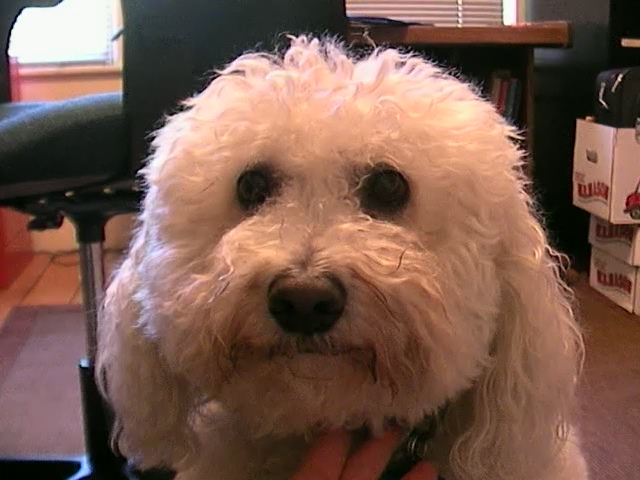
My dog Rags died last week. He was old and feeble, blind, deaf, incontinent; his organs were failing. He had to put him down, and it was so sad. We had spent sixteen years together on long walks, running on the beach, going to the groomers, enjoying each SANYO DIGITAL CAMERAother’s cookies. He was a great dog—lots of people who knew Rags were genuinely fond of him. He was the sort of dog you want to like you. He was furry, easy to pet, desperate for human attention, and eager to please. He was that dog that truly looked well-turned out in doggie clothes; not all of them do, I feel. In the truest sense, I was really missing him.

Then, last night, I got a letter in the mail from his attorney. It seems that my impression that we had a wonderful life together is being challenged by a civil suit filed on his behalf. Amazing, right? He is being represented by one of those sleazy attorneys who solicit cases on late night TV. This one specializes in domesticated animals malpractice claims. His attorney is claiming that I am obligated to pay for years’ worth of doggie mistreatment, including emotional abuse.

As I review our many years together, it seems to me that, if anything, he was an indulged dog, which is not to say that he didn’t deserve the best of everything but there were some demands that could have been considered excessive. I mean how many dogs insist on a Tempurdic dog bed? He actually refused to sleep in ours.

We subscribed to a dog magazine on his behalf, although it was much more focused on dog consumerism than on the human experience of dog ownership. (It should be noted here that he absolutely despised the term “ownership” to reflect the relationship between domestic pets (he didn’t like that term either) and their human companions. Often enough at night, when I would bring him his slippers, (we shared household duties) I would find this magazine opened up to a page full of advertisements for gourmet dog food that was guaranteed to stave off doggie dementia. His right paw was placed right on the order blank for this stuff. When I tried to pull the magazine away, he lifted his right doggie eyebrow, I gesture I read as a not so veiled threat. If I didn’t buy this food, there would be repercussions. Enough said. I took his advice I ordered the food right away at $100 for 40 lbs. The stuff smelled like a dead cat (which I assume he found charming) and had the consistent of hot fudge sauce with gravely bits. And sure enough, he was right. He was in complete command of his senses till his last day on earth, thanks to that food.

With respect to all the doggie arrangements—food, water, cookies, walks, toys, access to furniture and leftovers—I felt that we had negotiated fairly with him. I thought I could read this affect very well and thought he was happy. In retrospect, I should have known better. We referred to him as a mutt; he, on other hand, made much of his hybridized pedigree, the result of planned pregnancy between a poodle and a Bichon Frise, which he argued made him French. I must note here that I did speak French to him on occasion. He seemed not to understand the “Sit” command any better in French than he did in English. Either he was faking his knowledge of French or simply disdained my accent, which it should be noted is more Canadian than Parisian, so I can understand the confusion.

There were other episodes and indications as well now that I look back on our time together. I ended up in the hospital a few times on his account. One a third degree rope burn. On another occasion, my partner tripped on his leash which Rags had tangled, and knocked out her front teeth. Yet another time, he ran away and caused another dog to burst out of his house, flying through the screen door to chase him. The owner (sorry) thfollowed, calling “Killer, come back.” He didn’t, meaning that I crossed several lanes of heavy traffic (courageously with no concern for my own safety) to rescue him. And there was another time, when he stared down a female pit bull, growled at her actually, causing the other dog to grab him by the neck, pushing me to the ground, where I nearly got mauled by this vicious animal and could have died right then and there, except that the other dog lost interest when his owner called him back. And, then another time, when he stuck his nose into a nest, which liberated a troop of hornets in attack him and me. I then hauled him out of the forest in a two-mile walk with a thirty-pound dog whining in my arms. I fixed up a special doggie sling out of twigs and my torn shorts to carry him. I was swollen for a week.

It occurs to me now that I am hearing from his lawyer that these were not casual accidents but instead something more ominous. Foucault and post-modern theorists may characterize his behavior as resistance to hegemony, which I accept and understand. And, I must say that I forgave him at each turn, attributing these events to immaturity and a failure to plan. But, what I am left with here? Could all these incidents be signs of aggression on his part, against me, the most devoted dog owner one could imagine? Or maybe he was passive-aggressive? My therapist doesn’t think dogs are smart enough to be passive aggressive, especially Bichons, but I think she has a personal issue with my dog. She felt all along that I was a little too indulgent with him. I do think she blames me for this turn of events, but no matter, this is my issue to fight.

Here is the real problem. I cannot find an attorney to take my case. They all expect that Rags must have a case otherwise he wouldn’t have contacted a lawyer. “No dog would do such a thing—they are much too loyal and adoring—unless they have been provoked.” I hear this over and over again. So, it seems that either I defend myself or settle out of court. And, if I defend myself am I really going to get a fair trial in any state in our dog crazy culture? I would stand a much better chance defending myself against a Vietnamese pot bellied pig. And, there’s another problem. The complaint insists that I located his siblings and his children (he claims he fathered six puppies before he was placed at the shelter for adoption) so that I can pass on the settlement to them. It seems of all the “sins” I committed this was the worse. I know the pains of adoption and should have been sensitive. Maybe, we could have arranged a monthly visitation program. I wish I could have told him the bitter truth—that he wasn’t a very good father after all. When we adopted him, he had his eyes on another lady dog—not the mother of his children. But, you know, we all live with regrets. And, even with this lawsuit hanging over my head, I am glad he went to his grave with this delusion that he could have been a good dad with a swarm of happy puppies. Let him rest in peace.

A final cautionary note. I can’t say that I would have treated my canine companion any differently had I know this would have been the outcome. We may have had more heart-to-hearts about whether he was happy. Maybe, I would have asked him if he wanted to go back to the shelter or maybe list himself on dogmatch.com to find a more perfect owner. Maybe, I could have indulged him less and made him watch videos of working dogs on sheep farms so he would have known how bad things could get. Or maybe, that was the sort of life he was dreaming of. I know that his favorite movies of all time were Wallace and Gromit series. He never was happier than when he watched Gromit, the super-intelligent dog with rectitude and grace, get the idiot human Wallace out of yet another scrape. In fact, that is only time I really ever heard him really laugh long and hard. I remember that now with such mixed emotions.


Imagine.Engage. Reflect. Repeat: Forty years of civic work

An anniversary is always a good time to take measure of where we have been, where we are and where we might go. So, when I look ahead, Compact’s thirtieth anniversary next year provokes me to consider the arc of the work we do and to consider my own path within this larger story. Next year, I also mark a personal anniversary. In 1971, I joined VISTA, finding my way to southeastern Alabama for a year of service–a short 45 years ago. This year turned out to be the most determinative event of my life. From that year, I can trace an unsteady path from my sojourn in the south to my early career in child welfare and corrections to my later time at the Compact’s national office twenty years later to my current position as a faculty member. Throughout all of this work, one question has haunted me–whether working in the state prison or behalf of foster children or building houses in Alabama or teaching sociology at a private university: how do I understand what I am doing when I aim to be of service? And after decades of being in the company of some people who I think are the finest I will ever meet, I think this question haunts many of them, as well.

We could consider this question as a standard reflective practice—a way to understand our experiences—but I think it is much more important than a learning exercise to tick off as end a particular project. I think of questions like these as our life’s work, creating and calibrating the compasses we use to steer our hearts, minds and souls. I think about how the purest of intentions have formed some of our local, national and international efforts to do good and I have to consider why and how these so often go awry. I think about how those of us who do this work appear to those whom we aim to help. In my own experience, I think about how a ragtag group of twelve long-haired young people from the north looked to the poor black folks in rural Alabama when we showed up to “help.” I reflect upon what their white neighbors may have made of us and our intentions. So many decades later, I can still hear the echoes of those conversations when my host family asked, “Didn’t your family need you at home?” or when the waitress at the restaurant said to us, “Things must be very bad down here for you to trouble yourself to come all this way.” All those misunderstood motives for our being there put me on a path to question my own reasons and purposes for service.

That year of service taught me many things, most of which were most likely not the part of any administrator’s strategic plan. Our planned projects—building houses, organizing the community improve the distribution of commodity foo, extending family planning—became so complicated and difficult that I finally understood that the art and science of helping and bettering the world was much more complex than simply planting that disposition in one’s heart. The challenge was to not allow those difficulties and complications to stop us from doing what we believe ought to be rightly done. This is as true on our campuses today as it was in rural Alabama forty years ago.

There are many benefits to being a member of service-learning and community engagement communities. I have never worked in a field where there are so many individuals to emulate. I find myself taking on mentors who have no idea I have chosen them to guide and enrich my work. One of my heroes, Ira Harkavy quoted Chilean sociologist Eugenio Tironi in a recent speech.

The answer to the question “What kind of education do we need?” is to be found in the answer to the question, “What kind of society do we want…If human beings hope to maintain and develop a particular type of society, they must develop and maintain the particular type of education system conducive to it.

This point is a critical one if we in higher education believe we have something to offer to the public, as a public good, well beyond career training and a narrow agenda. And, I would argue, well beyond mandatory community service projects and days of service. What I have learned after two decades in this field is that we need to be both ambitious in our aims and humble in our approaches. I will try to make these points as clearly as I can. First, I have been thinking deeply about what we need as citizens and members of our communities to be full-fledged members of our community. In teaching sociology at Bryant, I try to help students understand all the ways that their lives are implicated in the lives of others. So, we think about ways to be more conscientious in what and how we consume, to be more thoughtful about philanthropy, to be better informed about public events, to be careful researchers, to design new approaches to social problems, and to be accountable for our actions, especially those meant to do good. This is what I meant about ambition or maybe, more correctly, vision. It is just too easy to keep doing what we have been doing without considering how we might take on more. As Tompkins reminds us,

 The classroom is a microcosm of the world; it is the chance to practice whatever ideals we may cherish. They kind of classroom one creates is the acid test of what it is one really stands for.

Onto my second point. The lesson here may seem remote. A recent article in the New York Times traced the impact of the campaign to distribute millions of mosquito nets to eradicate malaria—an effort that has had multiple unanticipated negative consequences. Play Pump met with a similar fate. Great excitement over a cool idea. Millions of dollars to ramp up and spread this innovation. Six months later, most pumps were out of service and residents were left with less access to water than they had before the pumps were installed. We don’t have to go to far off regions to find other instances where our own intentions went away. As I wrote earlier, these issues are complicated. This is not to say that we are not obligated to do much better and bigger than we do at doing good; the second lesson suggests we be as careful with the lives and life-spaces of others that we seek to help as we would be of our own lives and communities.

New York Times columnist David Brooks offers two paths for living a worthwhile life. The first, the well-planned life, is the one we typically suggest to students–that they find their passions and follow these. We argue that it is only when we are deeply inspired by own dreams that we accomplish anything of significance. Brooks suggests an additional path, which he calls the summoned life. In contrast to the first model, individuals drawn to the summoned life believe that, as Brooks writes, that “life isn’t a project to be completed; it is an unknowable landscape to be explored.” And because of this, we have to be open and engaged to pose the questions that Brooks suggests, “What are these circumstances summoning me to do? What is needed in this place? What is the most useful social role before me?” To these questions, I would add, “And what can we do as educators to help students develop those visions, skills, and values that get us closer to the society we want?”